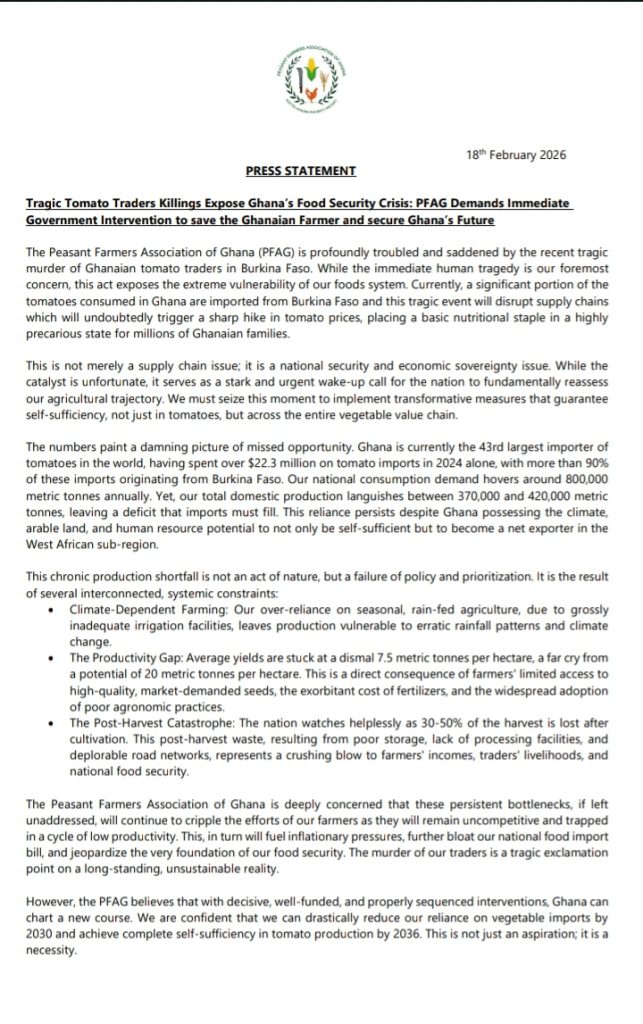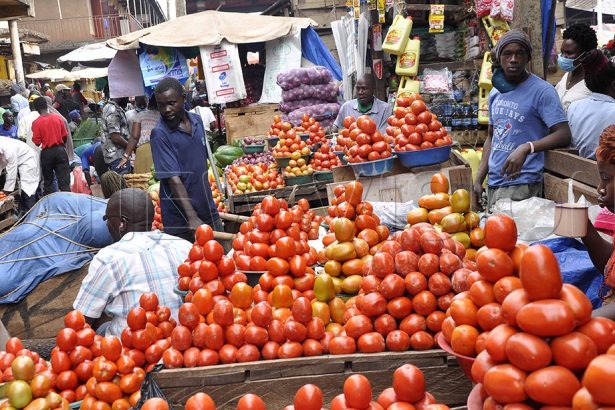
The Peasant Farmers Association of Ghana (PFAG) has expressed deep concern over the recent killings of Ghanaian tomato traders in Burkina Faso, warning that the tragedy exposes serious vulnerabilities in the country’s food system.
In a statement dated Wednesday, 18 February, the association said the deaths could disrupt tomato supply chains in Ghana, triggering sharp price hikes and placing a basic nutritional staple at risk for millions of families. PFAG described the situation not just as a supply issue, but as a national security and economic sovereignty concern.
The group highlighted Ghana’s heavy reliance on imports from Burkina Faso, noting that the country is the 43rd largest importer of tomatoes globally, spending over $22.3 million in 2024, with more than 90 percent coming from Burkina Faso.
While national consumption demand stands at around 800,000 metric tonnes annually, domestic production is estimated at only 370,000 to 420,000 metric tonnes, leaving a significant deficit. PFAG said Ghana has the climate, arable land, and human resources to achieve self-sufficiency and even become a net exporter.
The association blamed chronic production shortfalls on policy gaps, highlighting over-reliance on rain-fed agriculture, low productivity with average yields of 7.5 metric tonnes per hectare, and post-harvest losses of 30-50 percent due to poor storage, limited processing facilities, and inadequate road networks.

PFAG warned that without urgent interventions, farmers would remain uncompetitive, inflationary pressures would rise, and the nation’s food security would be at risk.
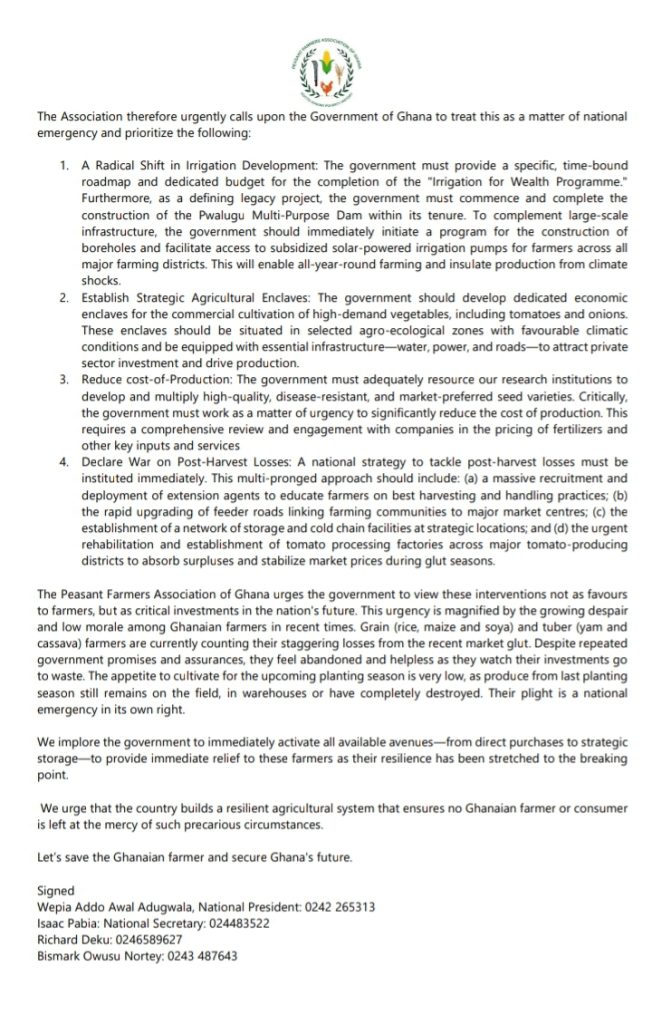
PFAG outlined a series of urgent recommendations for government action.
These include accelerating irrigation development through completion of the “Irrigation for Wealth Programme” and the Pwalugu Multi-Purpose Dam, and providing boreholes and subsidised solar-powered pumps to enable year-round farming.
The association also called for the establishment of strategic agricultural enclaves with essential infrastructure to support commercial cultivation of high-demand vegetables.
Reducing the cost of production through support for research institutions, the development of disease-resistant seeds, and engagement with input suppliers was also highlighted.
PFAG urged a national strategy to reduce post-harvest losses, including deploying extension officers, upgrading feeder roads, expanding storage and cold chain facilities, and establishing tomato processing factories in major production areas.
The association stressed that these interventions should be seen as critical investments in the nation’s future rather than favors for farmers, noting the growing despair and low morale among Ghanaian farmers, including rice, maize, soya, yam, and cassava producers, who are struggling with losses from recent market gluts.
PFAG called on government to provide immediate relief measures, including direct purchases and strategic storage, to support farmers whose resilience is under severe strain.
The statement concluded with a call for a resilient agricultural system to ensure that no Ghanaian farmer or consumer is left vulnerable, urging the government to take urgent steps to save the Ghanaian farmer and secure the nation’s future.