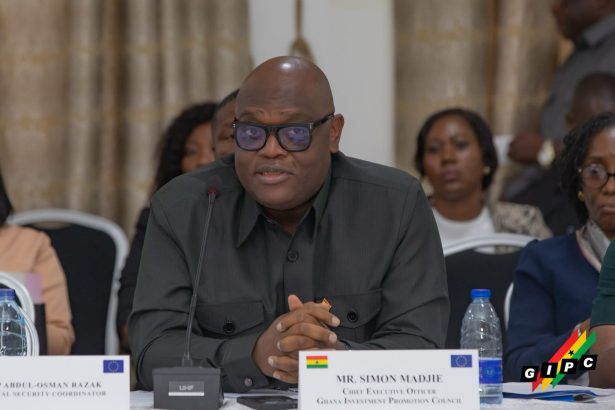
Government is finalising a new Investment Law that will establish a one-stop shop for investors and introduce an Investor Grievance Mechanism, as part of a broader package of reforms aimed at improving Ghana’s business environment and attracting foreign investment.
The reforms, which also include VAT simplification, the removal of the E-Levy and betting tax, digitalisation of tax administration and efficiency measures at the ports, were highlighted by the Chief Executive Officer of the Ghana Investment Promotion Centre (GIPC), Mr Simon Madjie, during the 2026 Ghana-European Union Partnership Dialogue in Accra.
Mr Madjie said the proposed Investment Law, currently undergoing final legal review, is expected to reduce bureaucratic bottlenecks by providing investors with a centralised platform through which they can access key government services and approvals.
He explained that the legislation will also establish an Investor Grievance Mechanism designed to address investor concerns before they develop into formal disputes, thereby strengthening investor confidence and improving the ease of doing business in Ghana.
Beyond the proposed law, Mr Madjie outlined a number of economic reforms being pursued by government to stimulate investment and support private sector growth.
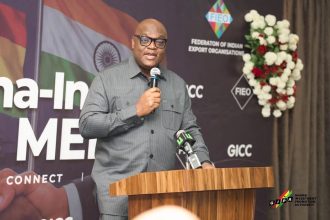
These include efforts to simplify the Value Added Tax (VAT) regime, the abolition of the Electronic Transfer Levy (E-Levy) and betting tax, as well as ongoing digitalisation initiatives being undertaken by the Ghana Revenue Authority to improve tax administration and compliance.
The GIPC Chief Executive also highlighted reforms within the country’s ports sector, including expedited clearance procedures for authorised economic operators and the deployment of an Artificial Intelligence-supported customs valuation system under the Integrated Customs Management System (ICUMS).
According to him, the measures are expected to improve transparency, reduce processing times and enhance operational efficiency at Ghana’s ports.
Mr Madjie further indicated that reforms in the energy and financial sectors remain ongoing, stressing that existing investors continue to serve as important ambassadors in attracting new investment into the country.
The Minister for Foreign Affairs, Mr Samuel Okudzeto Ablakwa, proposed the establishment of a local assessment mechanism to verify that Ghanaian exports meet European Union requirements before shipment.
The proposal, he noted, would help reduce delays, minimise compliance costs and lower the risk of Ghanaian products being rejected upon arrival in European markets.
The European Union Ambassador to Ghana, Mr Rune Skinnebach, acknowledged concerns regarding evolving EU regulations, including the European Union Deforestation Regulation (EUDR) and sanitary and phytosanitary requirements.
He reaffirmed the European Union’s commitment to sustained engagement with Ghanaian authorities and stakeholders to ensure better communication and support for exporters navigating the changing regulatory landscape.
The dialogue reaffirmed the commitment of both Ghana and the European Union to strengthening trade facilitation, regulatory compliance and economic cooperation as part of efforts to deepen bilateral relations and expand investment opportunities.