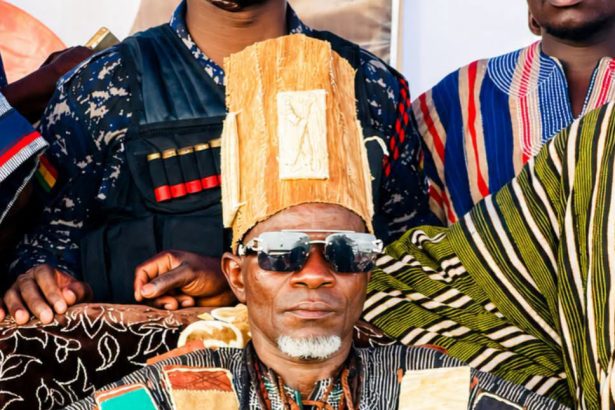
The newly installed Regent of Dagbon, Kampakuya Naa Yakubu II, has pledged to preserve the hard-won peace in the kingdom and faithfully uphold the rotational chieftaincy succession arrangement between the Andani and Abudu royal gates, declaring that he would not depart from the legacy of his late father, Yaa Naa Abukari II.
Delivering his maiden address at the Gbewaa Palace in Yendi on Friday, July 31, through the Paramount Chief of the Zanbalung Traditional Area, Zangbalun Naa Dr Jacob Yakubu Mahama, the Regent described peace as the greatest inheritance left by the late Overlord and vowed to protect it throughout the transition period leading to the enskinment of a new Yaa Naa.
“My father was a builder. Not of monuments, though he built those too. He was a builder of peace. A builder of bridges of reconciliation,” the Regent said.
Quoting the late Yaa Naa, he added: “I love those who build bridges of peace, but I do not like those who destroy the peace.”
Kampakuya Naa Yakubu II reaffirmed his commitment to the peace agreement that ended years of chieftaincy conflict in Dagbon, stressing that the established rotational succession arrangement between the Abudu and Andani gates would be strictly observed.
“The rotational arrangement for chieftaincy succession in Dagbon, I affirm it. I embrace it. I will uphold it,” he declared.
He described the arrangement as a product of wisdom and reconciliation rather than partisan triumph.
“It is the wisdom of men and women who understood that peace is more valuable than victory, and that a united Dagbon is stronger than the triumph of any single gate.”
Reflecting on the reign of the late Yaa Naa Abukari II, the Regent said his father consistently placed the interests of the kingdom above those of either royal gate.
“My father demonstrated this wisdom when he enskinned more Abudu chiefs than Andani chiefs during his reign, choosing the kingdom’s peace over gate advantage,” he said, describing the decision as “his greatest act of statesmanship.”
He assured the people of Dagbon that the process of selecting and enskinning a new Yaa Naa would be conducted transparently and in strict accordance with Dagbon custom and the existing peace agreement.
The Regent also cautioned against any attempt to exploit the transition period to pursue sectional interests.
“Let no one use this transition period to plant seeds of discord. Let no one exploit this solemn moment to advance gate interests over Dagbon’s interests. I will not permit it,” he warned.
Kampakuya Naa Yakubu II pledged to continue the development agenda initiated by the late Overlord, including the completion of the new Gbewaa Palace, the implementation of the Dagbon Ten-Year Development Plan, the establishment of the University for Development Studies (UDS) Yendi Campus, and ongoing partnerships in agriculture and energy.
“My father is gone. But Dagbon stands,” he said. “This is the Dagbon he built. This is the Dagbon he left us. And this is the Dagbon we must protect.”
President John Dramani Mahama, who attended the ceremony alongside former Vice-President Dr Mahamudu Bawumia, ministers of state, Members of Parliament (MPs), traditional rulers, members of the diplomatic corps and other dignitaries, urged the Regent to build upon the legacy of the late Yaa Naa by promoting peace, unity and development.
The President praised the people of Dagbon for the calm and restraint they had demonstrated following the death of the late Overlord, describing their conduct as evidence of the kingdom’s resilience and maturity.
According to him, Yaa Naa Abukari II inherited a divided kingdom but devoted his reign to reconciliation, stability and development.
“He was very passionate about agriculture, health, road infrastructure, education, youth development and many others,” President Mahama said.
Reaffirming his government’s commitment to supporting Dagbon during the transition, the President pledged to work closely with the Regent and the Dagbon Traditional Council to complete projects initiated during the late monarch’s reign.
“My brothers and sisters, the installation of a new Regent of Dagbon, Kampakuya Naa Yakubu, carries more than just symbolism. And I pledge to Kampakuya Naa to work closely with you to fulfil the dream of your father, to continue working on all the development projects that we started during your father’s reign.
“I commend the Regent for his very uplifting speech this afternoon and his solemn pledge to uphold the time-tested traditions of Dagbon over and above his personal interest,” he said.
Former Vice-President Dr Bawumia also paid tribute to the late Yaa Naa, describing him as a father figure whose leadership consolidated lasting peace in Dagbon.
He appealed to all stakeholders to ensure that the selection of the next Yaa Naa strictly adhered to the kingdom’s established customary arrangements and to further strengthen the peace agreement that has sustained stability in Dagbon.
The installation of Kampakuya Naa Yakubu II marks the beginning of the next phase of Dagbon’s customary succession process following the death of Yaa Naa Abukari II.
Installed by the kingmakers at the Gbewaa Palace in Yendi, the Regent assumes responsibility for administering the kingdom’s affairs pending the selection and enskinment of a new Yaa Naa.
Under Dagbon customary law, the title of Kampakuya Naa is reserved for the eldest son of a deceased Yaa Naa, who serves as caretaker of the kingdom until the succession process is completed.
The Regent is expected to work with the kingmakers and the Dagbon Traditional Council to supervise the remaining funeral rites of the late monarch, preserve peace and stability, and oversee the kingdom’s administration throughout the transition.
The colourful but solemn ceremony drew thousands of mourners, chiefs, opinion leaders and visitors to Yendi.
Among those present were Education Minister Haruna Iddrisu, Northern Regional Minister Ali Adolf John, the National Chief Imam, Sheikh Osman Nuhu Sharubutu, members of the diplomatic corps, traditional rulers and representatives of various political parties.
Traditional drumming, cultural performances and Islamic prayers formed part of the ceremony, which combined Dagbon customs with Islamic rites, including the shaving of the Regent’s head and special Quranic prayers for the repose of the late Yaa Naa’s soul.
Yaa Naa Abukari II died in South Africa on July 12, 2026, while receiving medical treatment. He was buried at Katini, the royal mausoleum of Dagbon, last Monday, in accordance with the kingdom’s customs and traditions, after his remains were flown from South Africa to Yendi.
The observance of the third-day and seventh-day Islamic prayers has now paved the way for the customary installation of the Kampakuya Naa and the commencement of the succession process that will ultimately culminate in the enskinment of a new Yaa Naa.