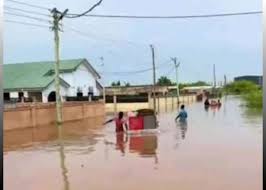
Monday’s torrential rainfall left a trail of devastation across parts of Ghana, particularly in Accra, claiming at least ten lives, displacing families, submerging homes and businesses, destroying properties worth millions of Ghana cedis, and bringing economic activity to a standstill.
Roads became rivers, vehicles were swept away, communities were cut off, and countless residents watched helplessly as floodwaters consumed everything they had worked for.
Sadly, this is not a natural tragedy alone. It is a national failure.
For far too long, Ghana has treated annual flooding as an unavoidable seasonal event, rather than the predictable consequence of poor urban planning, weak enforcement of building regulations, inadequate drainage infrastructure, indiscriminate development, and years of institutional neglect. Every rainy season exposes the same weaknesses, claims more lives, and destroys more livelihoods.
Yet the official response rarely changes.
More Read
Political leaders and public officials visit affected communities, accompanied by television cameras and journalists. They express sympathy, announce relief packages, promise investigations, identify familiar causes, and assure the public that lessons will be learned. A few committees are established, recommendations are made, and headlines fade. Before long, those reports gather dust, reforms stall, and Ghana is once again left counting the dead after the next heavy downpour.
Monday’s disaster is another painful reminder that the country has failed to break this cycle.
The loss of ten lives should never be dismissed as the unfortunate cost of heavy rainfall. Behind every statistic is a family grieving a loved one whose death may well have been preventable. Behind every collapsed wall, flooded home, or destroyed business is a citizen whose future has been thrown into uncertainty because systems meant to protect lives and property have failed.
The disaster demands more than condolences. It demands accountability.
As climate change contributes to more intense and unpredictable rainfall, Ghana’s vulnerability will only increase unless decisive action is taken. Flood resilience can no longer be treated as an afterthought. The country urgently needs sustained investment in modern drainage infrastructure, strict enforcement of planning and building regulations, protection of wetlands and waterways, improved waste management, effective public education, and stronger disaster preparedness at both national and local levels.
The cost of inaction is measured not only in billions of cedis lost each year but, more importantly, in human lives.
Monday’s catastrophe should mark a turning point. It must become the moment when Ghana finally chooses prevention over reaction, enforcement over excuses, and long-term planning over short-term political rhetoric.
Ghana cannot continue to normalize preventable tragedies.
The rain may have fallen on Monday, but the disaster was years in the making. Unless bold reforms begin today, the next heavy rainfall will produce the same heartbreaking headlines, the same official visits, the same promises, and yet another list of names added to the growing toll of lives that could have been saved.
The time for expressions of sympathy has passed. The time for decisive reform is now.