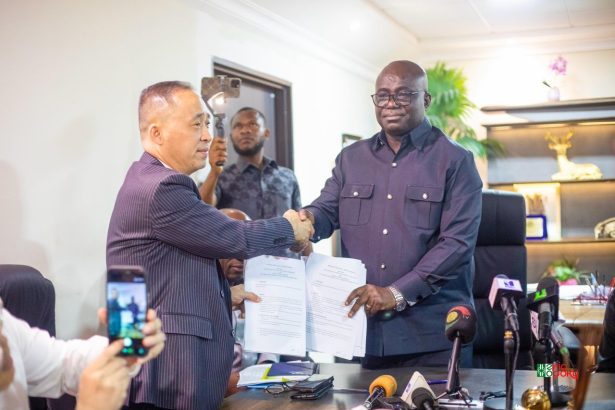
The Ministry of Food and Agriculture (MoFA) has entered into a partnership with Sentuo Group Limited to establish a national fertiliser manufacturing plant and expand agro-processing capacity in Ghana.
The agreement, announced in Accra on Monday, 13 April 2026, forms part of efforts to reduce the country’s reliance on imported fertilisers and promote value addition in agriculture.
Minister for Food and Agriculture, Eric Opoku, said the deal represents a strategic move to address long-standing challenges in the sector, particularly the high cost and limited availability of fertiliser.
“With this agreement, we are taking a decisive step toward fertiliser independence,” he said.
The project will support the production of different types of fertilisers, including NPK, urea-based, blended, organic and specialty products, while also strengthening the agricultural input supply chain.
More Read

It will further cover key crops such as cashew, maize, rice, soybean and oil palm, with the aim of shifting Ghana from exporting raw commodities to a more industrialised, value-driven agricultural system.
Mr Opoku described the agreement as a “bold and deliberate step” towards repositioning the sector under President John Dramani Mahama.
He noted that although government continues to provide support to farmers through the 2026 budget—such as the distribution of 272,000 metric tonnes of fertiliser nationwide and over 164,000 metric tonnes for intensified crop production—long-term sustainability will depend on local production.
The budget also includes GH¢2.7 billion for cocoa fertiliser support, expected to benefit more than 661,000 farmers.
Under the arrangement, Sentuo Group will finance, design, construct and operate the proposed facilities through a Public-Private Partnership in line with Ghana’s Public Private Partnership Act, 2020.
The Minister indicated that the Memorandum of Understanding (MoU) is non-binding, with subsequent stages subject to feasibility studies, environmental and social assessments, regulatory approvals and government oversight.
The project is expected to deliver multiple benefits, including reduced post-harvest losses, increased export earnings, job creation, improved food security and stabilised input costs.
Mr Opoku added that the initiative will be aligned with national programmes such as the Feed Ghana Programme and the 24-Hour Economy policy.
“Today’s signing is not just an agreement—it is a signal that Ghana is ready for serious, long-term industrial investment,” he said.