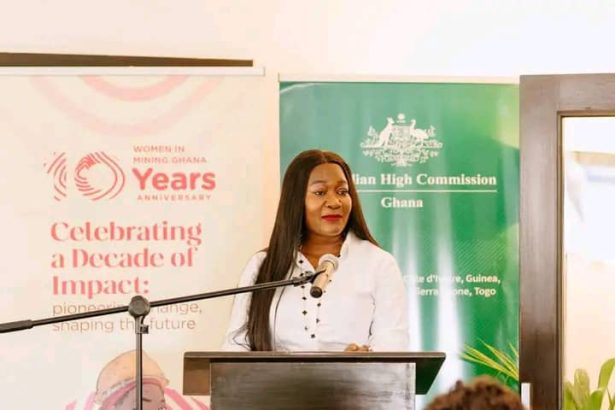
The Chief Executive Officer of the Minerals Income Investment Fund (MIIF), Justina Nelson, has called for deeper gender inclusion, equity and empowerment across Ghana’s mining value chain.
She said a more inclusive mining sector will not only advance gender equity but also improve productivity, innovation and governance within the country’s mining ecosystem.
Mrs. Nelson made the call while speaking as the keynote guest at the 10th anniversary celebration of Women in Mining Ghana (WIM Ghana) held in Accra.
According to her, the push for inclusion must go beyond representation to ensure that women are fully empowered to lead, influence decision-making and thrive in the mining industry.
She commended WIM Ghana for a decade of what she described as “courage, resilience and vision,” noting that the organisation has played a critical role in advocating for women, developing leadership capacity and expanding opportunities in a historically male-dominated sector.
“Your work has helped shape national perceptions, amplified women’s voices, challenged stereotypes and opened doors that were once firmly shut,” she said, adding that “MIIF salutes you.”
Citing a 2023 data from the Ghana Chamber of Mines, Mrs Nelson highlighted the persistent gaps in women’s participation across the mining sector.
She stated that women currently account for between 9 and 10 per cent of the large-scale mining workforce, 9 per cent of contractor workforce, 10 per cent of junior-level roles, 14 per cent of senior positions and 21 per cent of professional roles.
“These are interesting figures, but they are far from where we need to be,” she stated.
Mrs Nelson identified key challenges facing women in mining, including inequitable earnings, gender bias and workplace harassment.
Drawing from her own experience since assuming office at MIIF earlier this year, she said she has faced false publications and malicious attacks for insisting on accountability and perspective.
“I stand here today not as a victim, but as a woman who refuses to be distracted. Let us hold and defend one another, for we are few at the top,” she told the gathering.
Mrs. Nelson reaffirmed MIIF’s commitment to promoting an inclusive and progressive mining sector, highlighting the Fund’s Women from Mining Communities (WoMCom) Scholarship Scheme.
She said the initiative supports brilliant but financially needy female students pursuing STEM programmes, noting that over 90 young women from the University of Mines and Technology (UMaT) in Tarkwa have already benefited.
According to her, MIIF plans to expand the scholarship scheme to universities in the middle belt and northern Ghana in 2026, subject to support from corporate Ghana.
“Our goal is to ensure that women from mining communities are not left behind in Ghana’s mineral-driven transformation,” she said.
She also commended corporate Ghana for its support and urged companies to continue partnering with MIIF to empower more women in the mining space as part of their Corporate Social Responsibility initiatives.
Mrs. Nelson further reported significant improvements in Ghana’s mineral royalty inflows for 2025, attributing the gains to stronger regulatory compliance and growing investor confidence.
She said data for the first three quarters of 2025 showed that large-scale gold mining generated US$291.87 million in royalties, representing a 40.18 per cent increase over 2024. Mid-tier gold operations recorded GH₵59.44 million, a 46.38 per cent rise, while manganese royalties surged by 170 per cent to US$12.75 million.
The quarry industry recorded GH₵13.15 million in royalties, reflecting a 13.12 per cent growth, while sand mining generated GH₵433,406.41, a 21.48 per cent increase.
“These figures underscore strong momentum in Ghana’s mineral revenue outlook,” she said.
Mrs Nelson urged stakeholders to work collectively towards building a mining sector where women are respected, safe, visible and empowered.
“As MIIF continues to secure Ghana’s mineral revenues, we stand ready to partner with Women in Mining Ghana to champion a future where gender does not limit potential,” she said, congratulating WIM Ghana on its 10-year milestone and expressing optimism about greater transformation in the decade ahead.