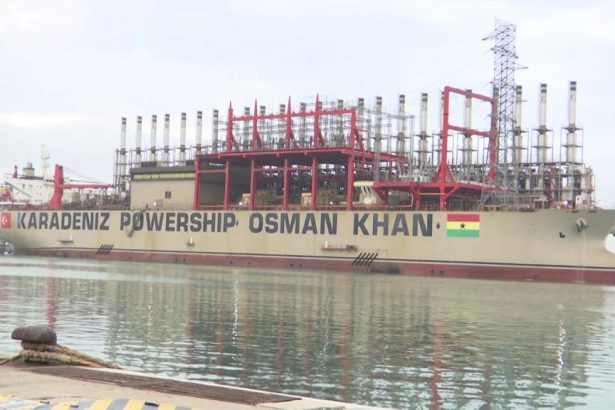
An official of Karpowership has denied claims that the company has threatened to shut down its power plant over an alleged US$400 million debt owed by the Government of Ghana.
The denial follows media reports suggesting that the company was planning to switch off its 470-megawatt facility, which is estimated to supply between 12 and 23 per cent of the country’s electricity.
Speaking to The Herald in a telephone interview yesterday, the company official, Sandra Amartikar Amaquaye, dismissed the reports outright, stating: “Not true. The story is false.”
The official acknowledged that some outstanding payments exist, but stressed that the situation is being managed and does not warrant any shutdown.
“We are owed, but the government is making payments,” she said, adding that references to a shutdown relate to a past incident. “This is last year’s shutdown.”

Sandra Amartikar Amaquaye, further emphasised that the company has not issued any threat to suspend operations.
“We haven’t threatened. As I said, Karpowership hasn’t threatened to shut down. They – government – have been making payments,” she noted.
Reaffirming the company’s position, the official stated: “We are committed to supplying reliable power to the people of Ghana.”
The clarification comes amid heightened public concern over the country’s power supply stability, following recurring reports of indebtedness within the energy sector.
The report had claimed that the Mahama government hadaverted a potential power disruption after Karpowership suspended plans to shut down its operations in May, following successful negotiations with the government over the US$400 million debt.
It went on to say the agreement secures the continued supply of about 450 megawatts of electricity to the national grid, easing immediate concerns over power stability.
Energy and Green Transition Minister John Abdulai Jinapor had confirmed that both parties have agreed on a structured repayment roadmap, leading to the withdrawal of an earlier shutdown notice.
He said the government is managing Ghana’s broader energy sector debt crisis, which continues to weigh heavily on the country’s fiscal position and power supply chain.
According to the Minister, the debt forms part of legacy obligations that have complicated ongoing reforms in the sector.
He noted that government engagement with Karpowership reflects a broader strategy of active liability management and stakeholder negotiations to maintain supply while addressing arrears.
The near-shutdown threat emerged after the company signalled its intention to halt operations due to non-payment.
Ghana’s energy sector is currently burdened with an estimated US$3.1 billion in outstanding debt, including about $1.7 billion owed to Independent Power Producers, alongside roughly GH¢2 billion in monthly revenue shortfalls linked to under-recoveries by the Electricity Company of Ghana.
In November, Finance Minister Cassiel Ato Forson revealed that the government has programmed US$345 million in payments to Independent Power Producers (IPPs) for 2026, following successful renegotiations of all Power Purchase Agreements (PPAs).
Presenting the 2026 Budget on Thursday, November 13, Dr Forson said the renegotiations, conducted entirely by Ghanaian experts at no cost to the state, have saved the nation over US$250 million and eased cash-flow pressures in the energy sector.
“The renegotiations have delivered concrete results, while reprofiling the remaining US$1.1 billion in legacy obligations over four years ending in 2028. This ensures financial sustainability in the energy sector,” he said.
Dr Forson further noted that the government is up-to-date with its payment obligations under the revised agreements. “In 2025 alone, we have paid US$300 million, and we have programmed an additional US$345 million for payment in 2026,” he added.
The Finance Minister emphasised that leveraging local expertise to renegotiate PPAs demonstrates the government’s commitment to homegrown solutions for structural economic challenges, while freeing up resources to support other priority sectors and broader economic growth.
“Furthermore, all new IPP invoices are being settled on time. We are no longer accumulating arrears or adding to the legacy debt stock. For the first time in over a decade, Ghana’s energy sector is operating on a predictable and sustainable payment schedule,” he added.