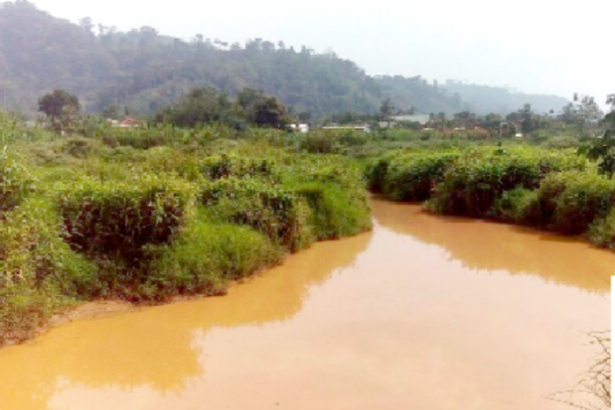
Policy think tank IMANI Africa has raised red flags over a proposal by the Environmental Protection Authority (EPA)to chemically treat heavily polluted rivers, cautioning that the initiative could evolve into an expensive intervention if illegal mining—the main source of contamination—is not first brought under control.
The concerns follow recent comments by the EPA’s Executive Director, Nana Ama Klutse, who defended the agency’s plan to restore contaminated rivers using nano-liquid particles designed to neutralise pollutants and settle suspended sediments.
But in a policy brief titled “The Miracle on the Birim: Ecological Restoration or Procurement Pitfall?”, IMANI argued that while the science behind the technology may appear promising in controlled settings, applying it to Ghana’s flowing river systems could present far more complex challenges.
“The primary concern for analysts is not merely the chemistry, but the inevitable intersection of environmental policy and public procurement,” the think tank stated.
The debate intensified after a public demonstration was conducted on the Birim River, which originates from the Atewa Range and has been heavily impacted by illegal mining activities, commonly known as galamsey.
More Read

According to IMANI, the EPA introduced nano-liquid particles into a controlled section of the river during the demonstration.
The results, the brief said, appeared dramatic.
“Within hours, sediments settled, and the water transitioned from a turbid ochre to relative clarity.”
However, the think tank insisted that the controlled conditions of the test limit the conclusions that can be drawn about its effectiveness in natural river environments.
“To the casual observer, it was a ‘miracle.’ To a prober, however, the ‘controlled’ nature of the experiment failed to account for the velocity, sectional depth, and volume of a living, flowing river,” the report stated.
IMANI also highlighted the symbolic significance of the Birim River, noting that it flows through the home region of former president Nana Akufo-Addo, who previously vowed to stake his presidency on efforts to curb illegal mining.
Beyond technical questions, the think tank pointed to potential financial implications if the restoration approach is scaled across the country’s major rivers.
Based on estimates cited in the brief, chemical restoration could cost about $200,000 per kilometre. Applied to multiple polluted rivers—including the Pra River, Tano River, Ankobra River, Densu River and Offin River—the total cost could exceed $227 million, or roughly GH¢2.4 billion.
“This raises a fundamental question of public choice: is this an investment in ecology, or the birth of a lucrative new industry for ‘restoration contractors’?” IMANI asked.
The think tank maintained that chemical treatment alone would not resolve the crisis if illegal mining operations continue upstream.
“Pouring chemicals into rivers while illegal mining remains unchecked is an exercise in futility,” the brief warned.
IMANI said available data suggests the number of forest reserves affected by illegal mining increased from 44 to 50 between 2025 and 2026.
It therefore urged authorities to adopt a phased ecological restoration strategy, beginning with strict enforcement against galamsey activities before introducing chemical treatment programmes.
The brief also recommended reconnecting diverted river channels and restoring vegetation along degraded riverbanks to reduce erosion and sedimentation.
“Until the source of the pollution is neutralised, any chemical miracle will be washed away by the next tide of illegal activity,” IMANI cautioned.
Without such measures, the think tank concluded, the proposed dechemicalisation programme risks becoming “a drain of resources rather than a solution.”