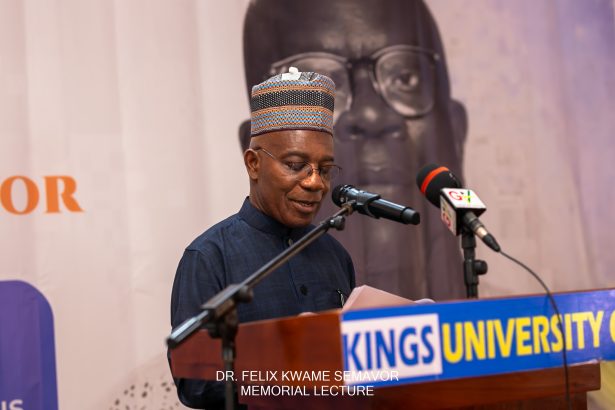
— Cries Ex-Apex Bank MD, advocates entrepreneurial leadership at Semavor Memorial Lecture
Former Managing Director of ARB Apex Bank, Kojo Mattah, has warned that Ghana stands at “a critical crossroads” as unemployment, particularly among tertiary graduates, continues to rise despite years of policy interventions and economic reforms.
Speaking at a public lecture in honour of the late Dr Felix Kwame Semavor, Mr Mattah said entrepreneurial leadership must become a central pillar of national development, stressing that the country can no longer rely on traditional job pathways to absorb its rapidly growing pool of graduates.
He cited recent data from the Ghana Statistical Service, stating that overall unemployment averaged 13.6 per cent in 2024, with youth unemployment increasing to 22.5 per cent. Among 15 to 24-year-olds, the rate rose to 32 per cent. Even more concerning, over 22 per cent of those who remained unemployed continuously between 2022 and 2023 held a tertiary qualification.

“This is no longer just a labour market challenge, it is a national development crisis,” Mr Mattah warned, adding “When we train thousands of teachers, nurses, engineers and professionals who cannot find meaningful work, the nation loses valuable human capital.”

The lecture, held on Saturday, 29th November 2025, at the Kekeli Auditorium of Kings University College (KUC) at Aplaku, gathered academics, business leaders, traditional rulers, policymakers, students, and family members to reflect on the life, vision, and legacy of the renowned accountant, industrialist, and educationist.
Dr Simon Peter Tsekpo, Vice-President of KUC, was the Chairman of the programme. Present were the C.E.O of Kingdom Group Ghana Ltd (KGGL), Vincent Senyo Semavor, a son of the late Dr Felix Kwame Semavor, and Mrs Janet Afi Semavor, wife of the late Dr Felix Kwame Semavor.

Also in attendance were the Registrar of the KUCC, Michael Augustt, Prof H.H. Mensah, Dr Clement Kardogbe, Dr Samuel Osei-Attakora, amongst others.
It was on the theme“Entrepreneurial Leadership for National Impact: A Practical Guide to Starting and Growing a Sustainable Business in Ghana, Lessons from the Vision and Legacy of Dr Felix Kwame Semavor”.
The ex-Apex Bank MD argued that Ghana must urgently shift from a society focused on seeking jobs to one that creates them, aligning with global research that urges universities and skills-development institutions to prioritize entrepreneurial intention, self-efficacy, and practical, hands-on training.
While acknowledging emerging signs of macroeconomic stability, including a gradual decline in Treasury bill rates, Mr Mattah said the business environment remains harsh, particularly for start-ups and small and medium-sized enterprises (SMEs).
Mr Mattah, who was the Special Guest of Honour, noted that commercial lending rates, often above 30 per cent, continue to suffocate private-sector growth.

“The cost of capital remains prohibitive for young businesses. As long as lending rates stay high, SMEs and first-generation enterprises will struggle to scale,” he said, calling for financial-sector reforms that encourage productive investment rather than short-term consumption.
Mr Mattah also drew attention to the economic burden of Ghana’s persistent road safety crisis. In 2024 alone, more than 2,400 deaths and over 15,000 injuries were recorded.
He said road crashes impose annual economic losses estimated at over US$230 million, resources that could otherwise support infrastructure development, entrepreneurship and innovation.
He emphasized that addressing unemployment, access to finance and road safety must be viewed as interconnected pillars of national progress.
“Building a resilient economy requires intentional investment in human capital, safer systems and an enabling environment for young entrepreneurs,” he said.
“Ghana’s future depends on the choices we make today.”
It was evident at the maiden memorial lecture that Ghana must urgently embrace entrepreneurial leadership as a national development strategy to tackle rising unemployment and drive long-term economic transformation.
Mr Mattah said the situation calls for a shift from job-seeking to job-creation, echoing research that shows universities and skills programmes must prioritise entrepreneurial intention, self-efficacy, and practical training.
The lecture celebrated Dr Felix Kwame Semavor, the first African Financial Director of Shell Ghana and the founder of Kingdom Transport Services, part of the Kingdom Group.
A distinguished chartered accountant, entrepreneur, and philanthropist, Dr Semavor played key roles in transport development and in establishing Kings University College (KUCC).
KUCC is affiliated to the University of Cape Coast (UCC) and currently has a student population of 520 studying programmes such as Business Administration, Law, Governance and International Relations and Computer Science and Engineering.
His legacy, Mr Mattah said, “Is a model of entrepreneurial leadership anchored in vision, excellence, service and faith.”
Drawing lessons from his life, the speaker outlined five enduring pillars of sustainable entrepreneurship: vision beyond profit; the pursuit of enterprises that deliver both economic value and social impact; and long-term investment and innovation, particularly in high-impact sectors such as transport and education.
Sound governance and succession planning, crucial weaknesses in many Ghanaian-owned family businesses, are challenges that Dr Semavor deliberately addressed, along with financial literacy and risk management skills essential to building resilient businesses.
Institution-building and mentorship, creating structures that outlive founders and investing in future generations.
Citing studies on family-owned enterprises in Ghana, Mr Mattah noted that most do not survive beyond the first generation due to poor governance, informal decision-making, and lack of succession plans.
“In contrast, firms with strong governance frameworks, regardless of origin, tend to endure,” he said. “Thankfully, Dr Semavor left behind systems and structures capable of sustaining his legacy.”
The lecture also provided a step-by-step framework for students, lecturers and young entrepreneurs seeking to build sustainable enterprises by cultivating the right entrepreneurial mindset built on purpose, innovation and resilience, identifying opportunities in high-need sectors such as agriculture, healthcare, transport, energy and education.
It was also to strengthen financial management, explore diverse funding avenues, develop a scalable, impactful, and adaptable business model, build capable teams, and promote a culture of continuous learning.
Lastly, it helped to measure performance not only in profit but in jobs created and communities served, and give back to society through mentorship and institution-building.
Mr Mattah urged universities to integrate entrepreneurship education more deeply into academic programmes and to mentor students beyond the classroom.
He also encouraged policymakers to support enterprise development with enabling policies, transparent financing mechanisms and improved infrastructure.
“For students, this is your moment, you are not just future employees; you are potential job creators,” he said, adding, “For lecturers, create ecosystems that nurture innovation. For the public and policymakers, support businesses that create lasting national value.”
Mr Mattah invoked Psalm 127:1, a favourite of Dr Semavor: “Unless the Lord builds the house, the builders labour in vain.”
He said the late entrepreneur embodied this principle by grounding his ventures in faith, excellence and service.
“As we honour his memory, let us commit ourselves to entrepreneurial leadership that transforms Ghana,” he said.
“Let us build, innovate and leave a legacy that future generations will cherish.”
The C.E.O of Kingdom Group Ghana Ltd (KGGL), Vincent Senyo Semavor, described his father, Dr Felix Kwame Semavor, “as a man whose life was a melody of faith, discipline, and service; whose story teaches us that from humble beginnings can spring extraordinary legacies”.
The memorial lecture, the first of its kind, is expected to become an annual event celebrating visionary leadership and inspiring young Ghanaians to pursue entrepreneurship as a pathway to national development.