By Patrick Biddah
Ghana and Morocco have pledged to deepen cooperation in energy, health, agriculture and trade following the Second Session of the Permanent Joint Commission for Cooperation (PJCC), held in Accra on July 21, 2026, where the two countries signed 11 agreements aimed at strengthening bilateral relations.
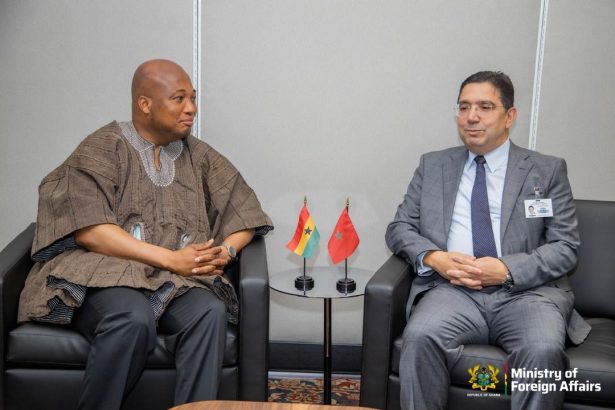
The meeting, which followed the inaugural session held in 2015, was co-chaired by Ghana’s Minister for Foreign Affairs, Samuel Okudzeto Ablakwa, and Morocco’s Minister of Foreign Affairs, Nasser Bourita.
Addressing the ministerial session, Mr. Ablakwa said President John Dramani Mahama had directed that the partnership between the two countries be expanded into three strategic areas, including energy cooperation, pharmaceutical manufacturing and implementation of bilateral agreements to deliver tangible benefits for citizens.
On energy, the Foreign Affairs Minister said Ghana was seeking to significantly increase renewable energy, particularly solar power, as part of efforts to strengthen the country’s energy mix.
More Read
He noted that renewable energy currently contributes about 2 percent to Ghana’s energy mix, with the government targeting an increase to 10 percent, adding that Morocco’s experience in developing renewable energy offered valuable lessons that Ghana could adopt as it expands its solar generation capacity.
Mr. Ablakwa also highlighted the strategic importance of the Africa Atlantic Gas Pipeline project, describing it as more than an energy infrastructure initiative.
He said the project would enhance regional integration, improve energy security and support industrialisation across West Africa by ensuring reliable access to natural gas for participating countries.
He added that beyond supplying gas for electricity generation, the project also presents opportunities to develop industries that rely on gas derivatives, including the production of fertiliser, which he said would support agricultural productivity and food security across the region.
The Ghanaian Foreign Affairs Minister devoted considerable attention to pharmaceutical manufacturing, arguing that Africa must achieve greater health sovereignty by reducing dependence on external suppliers for vaccines and medicines.
He said although countries such as Morocco had demonstrated the capacity to manufacture vaccines through substantial investments in production facilities, African countries still depended on institutions outside the continent for certification before their products could be widely distributed.
Mr. Ablakwa said the situation underscored the need for an African Union certification framework that would enable vaccines and pharmaceuticals produced on the continent to be assessed and approved through African regulatory institutions.
He said such a system would strengthen the continent’s resilience during future health emergencies and would be among the priorities as Ghana prepares to assume the chairmanship of the African Union.
He stressed that the success of the renewed partnership would not be measured by the number of agreements signed but by their effective implementation, urging officials from both countries to quickly develop clear roadmaps to translate the commitments into concrete outcomes for businesses, institutions, young people and citizens.
For his part, Morocco’s Foreign Minister, Nasser Bourita, said the two countries should build on their respective economic strengths to create a more ambitious partnership capable of driving Africa’s development through practical cooperation rather than dependence on external powers.
He said Morocco’s experience in renewable energy demonstrated what African countries could achieve through long-term planning, noting that between 40 and 42 percent of Morocco’s energy mix now comes from renewable sources, particularly solar, wind and green hydrogen, with the country targeting 54 percent by 2030.
He said Morocco was ready to share both its successes and the lessons learned from challenges encountered during its energy transition.
On the gas pipeline project, Mr. Bourita described it as a development and integration initiative that would connect countries across West Africa, expand electricity access, stimulate economic activity and strengthen regional cooperation by creating shared infrastructure and common economic interests.
He also echoed Mr. Ablakwa’s concerns on pharmaceutical manufacturing, saying Morocco had built the capacity to produce more than 100 million doses of vaccines intended to serve not only Morocco but the wider African continent.
However, he said African manufacturers remained constrained because they were still required to obtain licences and regulatory approvals from institutions outside Africa before vaccines could be marketed on the continent.
Mr. Bourita said Africa’s next challenge was therefore not only to build factories but also to secure greater control over technology, licensing and regulatory systems, expressing support for Ghana’s call to establish stronger African regulatory mechanisms under the African Union to enable the continent to become self-reliant in vaccine production and public health.