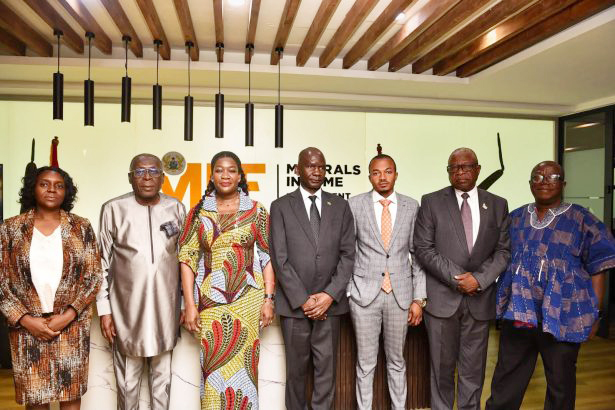
The Minerals Income Investment Fund (MIIF) has hosted a high-level delegation from the Government of Zambia to share Ghana’s experience in managing mineral wealth through a dedicated sovereign minerals investment fund.
The 12-member delegation was led by the Permanent Secretary for Budget at Zambia’s Ministry of Finance and National Planning (MoFNP), Mwaka Mukubesa, and comprised officials from the Ministry of Finance and National Planning, the Ministry of Mines and Minerals Development, the Zambia Revenue Authority, the Ministry of Justice and other key state institutions. They were received by members of the MIIF Board, management and staff.
Welcoming the delegation, Chairman of the MIIF Board, Richard Kwame Asante, described the visit as a reflection of the growing bilateral cooperation between Ghana and Zambia following recent engagements between President John Dramani Mahama and Zambian President Hakainde Hichilema.
He said both countries share a common vision of using their mineral resources to drive industrialisation, economic transformation and sustainable development under the African Continental Free Trade Area (AfCFTA).
Mr Asante also pointed to strategic regional initiatives, including the Abidjan-Lagos Corridor, as examples of how sound policies and investments can unlock greater value from Africa’s natural resources.
More Read
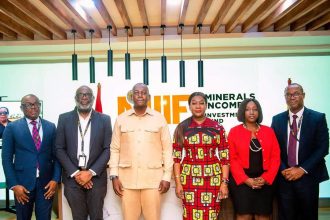
He explained that MIIF’s mandate is to maximise the long-term value of Ghana’s mineral wealth through strategic investments and responsible stewardship, adding that the visit provided an opportunity to deepen institutional collaboration and address common challenges in natural resource governance.
The Chief Executive Officer of MIIF, Justina Nelson, gave an overview of the Fund, which was established under the Minerals Income Investment Fund Act, 2018 (Act 978), as amended, and became operational in 2020.
She said the Fund receives and invests Ghana’s mineral royalties to maximise long-term value, working closely with agencies, including the Ghana Revenue Authority, the Minerals Commission, and the Ghana Gold Board, to ensure efficient royalty mobilisation.
Mrs Nelson also outlined MIIF’s investment strategy, governance framework, portfolio performance and efforts to position the Fund as a globally recognised sovereign minerals investment fund.
She noted that the visit followed preliminary engagements initiated by Zambia’s High Commissioner to Ghana, Daniel Mahongo, in 2025, and would further strengthen cooperation and the exchange of best practices in mineral resource governance.
Speaking on behalf of the delegation, Mrs Mukubesa expressed appreciation for MIIF’s willingness to share Ghana’s experience.
She said that although Zambia’s economy had recorded recent macroeconomic improvements and renewed investor confidence following debt restructuring, the government remained committed to ensuring that the country’s mineral wealth translates into tangible benefits for its citizens.
Mrs Mukubesa disclosed that Zambia is pursuing reforms aimed at increasing annual copper production to three million tonnes, undertaking a nationwide geological survey and establishing the Zambia Minerals Investment Corporation to convert finite mineral resources into long-term national wealth for present and future generations.
She added that the delegation was particularly interested in understanding how Ghana successfully transitioned from depositing mineral royalties directly into the national budget to managing them through a dedicated sovereign minerals investment fund.
The study visit concluded with technical sessions on investment management, royalty mobilisation and opportunities for long-term partnerships to promote sustainable mineral resource management in both countries.