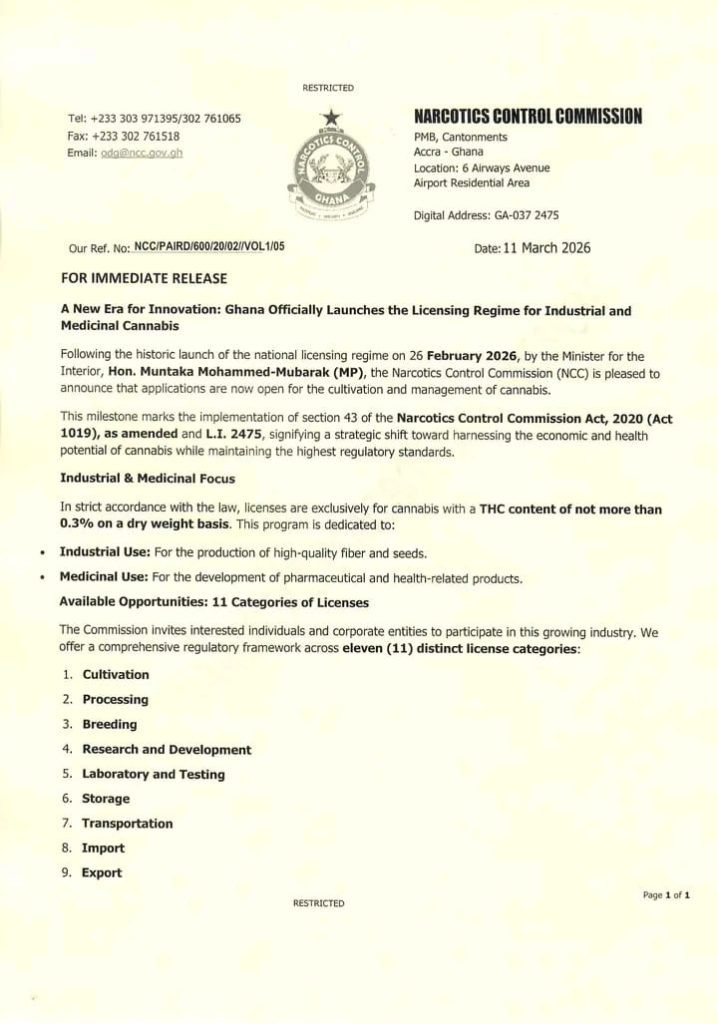
The Narcotics Control Commission (NCC) has announced the opening of applications for licences to cultivate and manage cannabis strictly for industrial and medicinal purposes, marking a new phase in the regulation of the crop in Ghana.
The development follows the official rollout of the national cannabis licensing regime on 26 February 2026 by the Minister for the Interior, Muntaka Mohammed-Mubarak, as part of government efforts to regulate and harness the economic potential of the emerging industry.
According to the Commission, the move represents the operationalisation of provisions under the Narcotics Control Commission Act, 2020 (Act 1019), as amended, together with Legislative Instrument 2475, which allows the controlled cultivation and use of cannabis for specific industrial and medical purposes.
Under the regulatory framework, licences will only be granted for cannabis varieties containing no more than 0.3 percent tetrahydrocannabinol (THC) on a dry weight basis. The low-THC threshold ensures that production remains within industrial and medicinal limits and does not encourage recreational use.
The NCC explained that the policy is designed to promote the production of industrial raw materials such as fibre and seeds while also supporting the development of pharmaceutical and health-related products derived from cannabis.

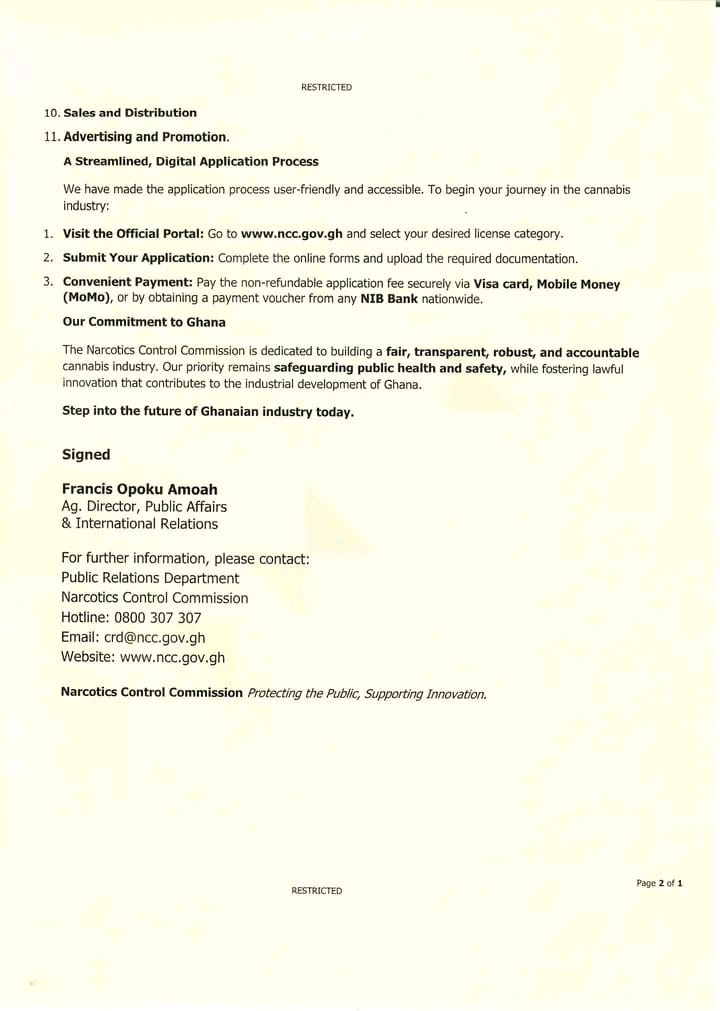
As part of the programme, the Commission has outlined eleven licence categories to regulate activities across the cannabis value chain. These include cultivation, processing, breeding, research and development, laboratory testing, storage, transportation, import and export, as well as sales, distribution, advertising and promotion.
Officials say the framework is intended to provide a structured and transparent system for investors, researchers and businesses interested in participating in the sector.
The Commission has also introduced a digital application process to make licensing more accessible. Prospective applicants are required to submit their applications through the Commission’s online portal and provide the necessary documentation for assessment.
Payments for the non-refundable application fees can be made electronically through bank cards or mobile money platforms, while applicants may also obtain payment vouchers from designated banking institutions.
The NCC says the initiative forms part of a broader commitment to build a transparent and accountable cannabis industry while safeguarding public health and safety.
Authorities believe the regulated development of the sector could contribute to Ghana’s industrial growth and create new economic opportunities if properly managed.