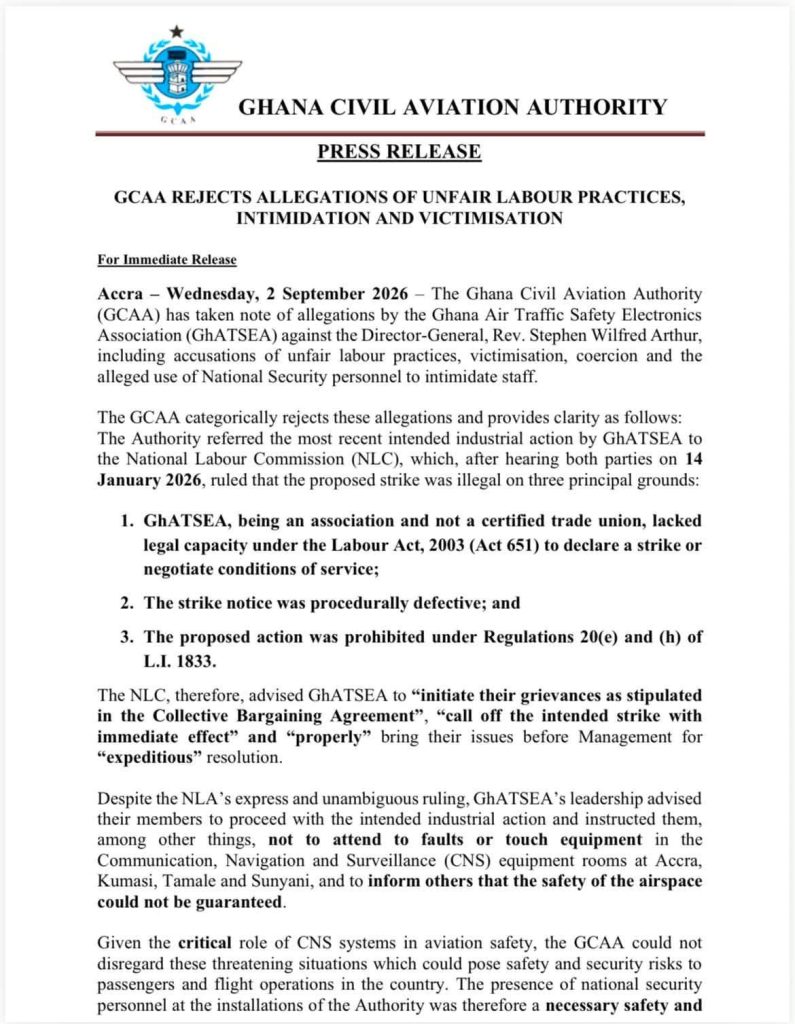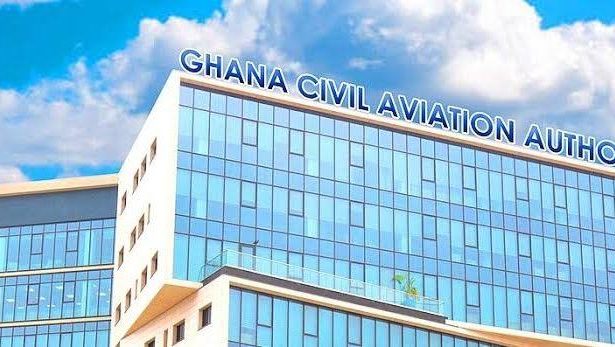
The Ghana Civil Aviation Authority (GCAA) has rejected allegations of unfair labour practices, victimisation and intimidation levelled against its management, insisting that all actions taken during its dispute with the Ghana Air Traffic Safety Electronics Technicians Association (GhATSEA) were lawful and necessary to safeguard the country’s aviation infrastructure.
In a statement issued on Wednesday (2 September), the Authority also denied claims that National Security personnel were deployed to intimidate staff, describing their presence at key aviation installations as a precautionary measure to protect critical communication and navigation systems.
According to the GCAA, the dispute stemmed from an intended industrial action by GhATSEA, which it referred to the National Labour Commission (NLC) for determination.
The Authority said the Commission ruled on 14 January 2026 that the planned strike was illegal on three grounds: GhATSEA, as an association rather than a certified trade union, lacked the legal authority under the Labour Act, 2003 (Act 651) to declare a strike or negotiate conditions of service; the strike notice failed to comply with legal procedures; and the proposed action contravened Regulations 20(e) and (h) of Legislative Instrument 1833.
The GCAA said the Commission subsequently directed the association to call off the intended strike and pursue its grievances through the procedures outlined in the applicable Collective Bargaining Agreement.

Despite the ruling, the Authority alleged that GhATSEA’s leadership instructed members to proceed with the industrial action and advised them not to respond to faults or handle equipment in Communication, Navigation and Surveillance (CNS) facilities in Accra, Kumasi, Tamale and Sunyani.
It further claimed that members were encouraged to communicate that the safety of Ghana’s airspace could not be guaranteed.
The Authority described the alleged directives as a serious threat to aviation safety, noting that CNS systems are critical to the safe management of aircraft operations.
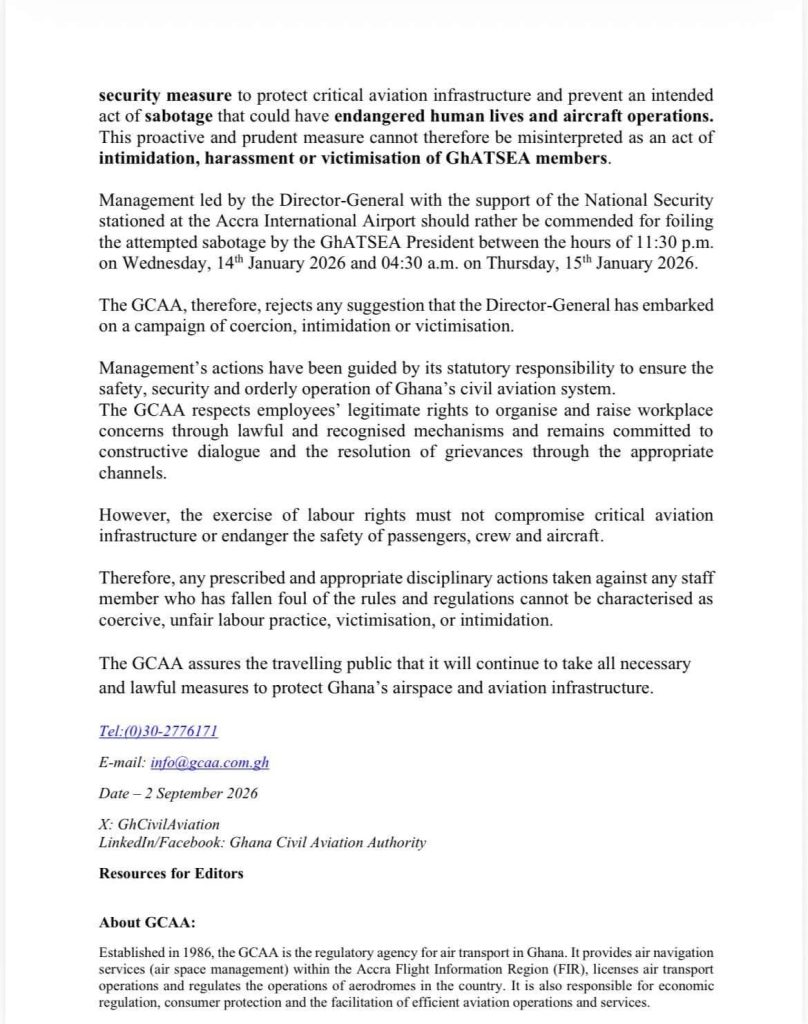
It said the deployment of National Security personnel was intended solely to protect vital installations and prevent any attempt to disrupt aviation services.
The GCAA also alleged that management, together with National Security personnel stationed at Kotoka International Airport, prevented an attempted act of sabotage involving the GhATSEA President between the night of 14 January and the early hours of 15 January 2026.
The Authority maintained that its Director-General had not engaged in any campaign of intimidation or victimisation, stressing that management had acted within its statutory mandate to ensure the safety, security and orderly operation of Ghana’s civil aviation system.
While reaffirming employees’ right to organise and raise workplace concerns through lawful channels, the GCAA said labour rights must not be exercised in ways that threaten critical national infrastructure or compromise passenger safety.
It added that disciplinary measures taken against any staff found to have breached established rules and regulations should not be interpreted as unfair labour practices or acts of coercion.
The Authority assured the travelling public that it would continue to take all lawful measures necessary to protect Ghana’s airspace and maintain the safety and integrity of the country’s aviation sector.