…. Upon return from IMF-World Bank meetings in Bangkok
Ghana’s Minister for Finance, Dr Cassiel Ato Forson, has promised to unveil a new economic development blueprint in the 2027 Budget, as the government seeks to move the country beyond economic stabilization towards sustained growth, industrial transformation and long-term prosperity.
The proposed policy framework, christened the ‘New Economy’, is expected to outline the next phase of the government’s economic development agenda under President John Dramani Mahama, following efforts to restore macroeconomic stability after the country’s 2022 economic crisis.
Dr Forson is leading Ghana’s delegation to the 2026 Annual Meetings of the International Monetary Fund (IMF) and the World Bank Group in Bangkok, Thailand, where discussions are expected to focus on global economic developments, financial stability, investment and sustainable growth.
The meetings, which started on October 12 and ran through the 18th, come at a crucial time for Ghana, with the government preparing to translate recent economic gains into a broader development strategy aimed at strengthening productive sectors, creating jobs and building a more resilient economy.
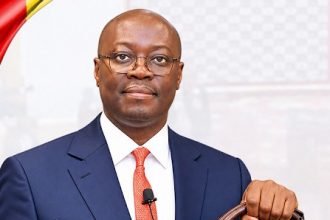
The Finance Minister is expected to engage world leaders, senior representatives of international financial institutions and fellow finance ministers in a series of bilateral meetings and multilateral discussions.
His programme includes engagements with the leadership of the IMF, senior World Bank officials and other multilateral institutions, alongside discussions with development and financial partners.
This year’s gathering is the first IMF–World Bank Annual Meeting being held outside Washington, DC, since Dr Forson assumed office as Finance Minister in 2025.
Ghana enters the discussions against the backdrop of positive assessments from the Bretton Woods institutions regarding the country’s progress in restoring economic stability following the 2022 crisis.
The Mahama government believes the recovery has created an opportunity to move beyond stabilization and establish an economic framework capable of sustaining growth, attracting investment and delivering lasting development.
The forthcoming New Economy blueprint is expected to provide that direction, with the 2027 Budget outlining the policies and programmes through which the government intends to translate its ambitions into action.
Dr Forson signalled the shift during his presentation of the 2026 Mid-Year Fiscal Policy Review.
“Stabilization was never the destination. It was the price of entry,” he declared.
The statement underscored the government’s position that restoring economic stability, although necessary, must serve as the foundation for a broader transformation of Ghana’s economy.
The Finance Minister’s participation in the Bangkok meetings coincides with an improved economic outlook for Ghana, with the IMF raising its 2026 growth forecast to 5.7 per cent and lowering its year-end inflation projection to 4.8 per cent.
The revised growth forecast represents an increase of 1.1 percentage points over the Fund’s April projection of 4.6 per cent and exceeds the government’s own estimate of 4.8 per cent contained in the 2026 Budget.
Similarly, the inflation projection has been revised downwards from 7.9 per cent to 4.8 per cent, signalling expectations of a further easing of price pressures.
The revised projections, contained in the IMF’s latest economic outlook released during the Annual Meetings in Bangkok, suggest improving prospects for Ghana despite uncertainties in the global economy.
The improved outlook has been linked to fiscal discipline, growth-oriented public expenditure and strong commodity export earnings, particularly from gold.
Higher gold earnings have strengthened Ghana’s trade balance and contributed to the accumulation of buffers against external economic shocks.
The country’s commitment to economic policy targets under the Policy Coordination Instrument (PCI) has also been cited as a factor supporting the improved outlook.
The upgrade follows a strong economic performance during the first half of 2026.
According to the Ghana Statistical Service, the economy expanded by 6.0 per cent in the second quarter, bringing growth for the first half of the year to 6.2 per cent.
However, sources close to the IMF have cautioned against excessive dependence on gold exports, stressing the need for Ghana to diversify its export earnings and strengthen domestic productive capacity.
The Fund expects economic growth to moderate to 5.2 per cent in 2027, reinforcing the importance of structural reforms and policies capable of sustaining economic expansion beyond the current recovery.
The IMF’s revised inflation forecast also points to a further improvement in Ghana’s macroeconomic conditions.
Year-end inflation is projected to decline to 4.8 percent, compared with the 5.2 percent recorded in September 2026.
If realized, the projection would place inflation below the lower boundary of the Bank of Ghana’s medium-term inflation target band of 6 to 10 percent.
The development would mark a significant change in the country’s inflation outlook following the severe price pressures experienced during the economic crisis.
However, sustaining the gains will require continued fiscal discipline, prudent monetary management and policies aimed at reducing vulnerabilities to external shocks.
Dr Forson has expressed confidence that Ghana has turned the corner from economic crisis and established the foundation for sustained progress.
According to him, the country is moving in the right direction, with the government’s economic management measures beginning to produce the desired results.
“Today we have turned the tide. We are moving in the right direction. And I can assure you that based on the foundation that we have laid, this country is ready to take off,” he declared.
The Finance Minister, however, cautioned that the recovery should not be interpreted as an opportunity to abandon the fiscal discipline and economic management measures that have contributed to the improvement.
“And we will take off cautiously. Bear in mind that all the gains we have made are dependent on us maintaining macroeconomic stability,” he warned.
He stressed that future economic expansion must be built on the foundations already established, rather than pursued at the expense of stability.
“And so the gains that we will build on, we should not forget the foundation that we have laid,” Dr Forson added.
The Finance Minister also reminded members of the government that the National Democratic Congress (NDC) administration was elected to address the economic difficulties confronting the country.
“We were elected to come and save a country in crisis. Don’t forget that. President Mahama and his members of parliament were elected to save this country because Ghana was in a crisis. Let us not forget that,” he stated.
He emphasized that the responsibility of delivering economic improvements to Ghanaians remained central to the government’s mandate.
“Together, we have a responsibility. A responsibility to work to the satisfaction of the people of Ghana,” he said.
The anticipated presentation of the New Economy blueprint in the 2027 Budget is expected to provide further details of the government’s long-term economic priorities and the measures required to sustain the recovery.
While the full details of the framework have yet to be unveiled, the government has indicated that its next phase of economic management will focus on moving beyond stabilization to building an economy capable of generating sustainable growth and development.
The Bangkok meetings therefore provide an opportunity for Ghana to strengthen relations with international financial institutions and development partners ahead of the implementation of the proposed economic transformation agenda.
They also offer Dr Forson an opportunity to present Ghana’s economic recovery to international investors and financial institutions while seeking support for the country’s next development priorities.
For the Mahama administration, the challenge will be to ensure that the improvement in macroeconomic indicators translates into tangible benefits for businesses, workers, and households.
The 2027 Budget is therefore expected to become an important test of the government’s ability to convert the gains from economic stabilization into sustained investment, employment opportunities, increased productivity and improved living standards.
With the IMF projecting stronger growth and lower inflation, attention is now shifting from Ghana’s recovery from crisis to whether the government can maintain economic stability while delivering the transformation promised under its New Economy agenda.