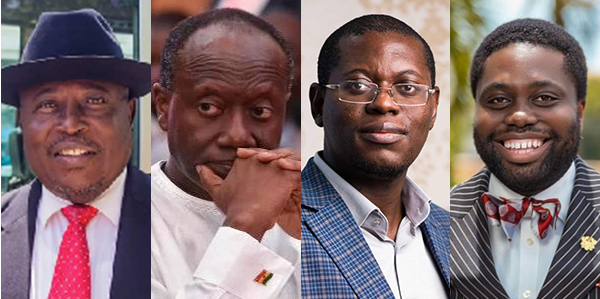
A former senior aide to ex-President Nana Addo Dankwa Akufo-Addo, has faced widespread public criticism after trying to reignite discussion about the scandalous Agyapa Royalties deal, while distorting facts and figures.
This provoked critics, including Bright Simons, to accuse Kow Abaka Essuman, ex-Deputy Secretary and legal counsel to President Akufo-Addo, of disregarding what was widely held as genuine flaws and a self-serving arrangement.
According to Mr Essuman, Ghanaians missed a significant opportunity by allowing what he called “petty politics and personal interest” to override “national interest” in the debate over the Agyapa Royalties policy.
Interestingly, at the start of Agyapa, Ghana lost US$12 million in payments to private companies connected to family members of the then-President. The payments were revealed on Tuesday, 13 February 2024, during a Public Accounts Committee of Parliament hearing by Nana Yaw Koranteng, who served as the Chief Executive Officer of the Minerals Income Investment Fund (MIIF).
However, Mr Essuman, a former deputy to Nana Bediatuo Asante at the Office of the President, on Saturday, 24 January 2026, took to the social media platform X (formerly Twitter) to argue that, compared to what GoldBod has earned, Ghana would today be earning far more revenue had the Agyapa Royalties deal been allowed to proceed.
More Read
“The gold price when Asaase Royalties (later Agyapa Royalties) was birthed and ready to be listed on the London Stock Exchange was approximately $1,300. There was a strong appetite for the listing, with over $750m to be raised by floating 49% of the shares on the stock exchange, while Ghana still retains its majority shareholding”.
“Today, the gold price is almost $5,000. Now, just imagine how much money would have been flowing into our economy if Agyapa Royalties had been listed on the LSE, GSE, and other stock exchanges, alongside the work that GoldBod is doing. Sadly, we will never know. That is what happens when petty politics and personal interest override the national interest. A vision that is good for our country should not be killed because we want personal interests, including political interests, to override the national interest”.
However, Mr Essuman’s comments triggered a fierce backlash, with many social media users arguing that it was fortunate the deal did not materialise, as the proceeds would allegedly have benefited political insiders rather than the Ghanaian state.
One respondent wrote, “One of them wrote in response to Mr Essuman’s claim, saying, ‘So in summary, had Ghana entered into the Agyapa deal in 2020, within a space of 5 years, $3bn worth of royalties would have gone to investors in exchange for the $500m one-time they gave us. lol big man come back stronger. You thought you ate, I guess”.
The Agyapa Royalties deal was an initiative of the Akufo-Addo administration, launched in 2020, to raise funds for national development without increasing public debt. Under the plan, a special purpose vehicle, Agyapa Royalties Limited, was incorporated in Jersey, a tax haven, to take over future gold royalty income from some of Ghana’s largest mines and raise funds through listings on international and local stock exchanges, including those in London, New York and Ghana.
It lacked transparency and was riddled with corruption; the government was forced to abort it.
The most comprehensive rebuttal of Mr Essuman’s stance came from Bright Simons, Vice-President of IMANI Africa, who stated that the issue warranted renewed scrutiny despite having been thoroughly analysed in the past. He took time to educate Essuman.
Mr Simons stated that even “The government’s own Special Prosecutor at the time said Agyapa was unconscionable and plainly bad”, referencing Martin Amidu’s statement in which he branded Akufo-Addo “ the mother serpent of corruption”, following disagreements over the handling of corruption cases, including the Agyapa Royalties deal.
“…Essuman’s post recalls the POLITICAL posturing around Agyapa at the time: a visionary solution to the old problem of Ghana not getting enough benefits from its mineral resources. It is a position MIIF will inherit at the time Mantse Essuman was on its board”.
“But, as katanomics (http://katanomics.org) teaches, the devil is always in the POLICY details; the HOWs and not just the WHATs.
“Here is how Agyapa was to work: A. Take most of the 4.5% in gross revenues of the big gold mines that comes to Ghana, put it in a pot, and convert the pot to a company to be put on the London Stock Exchange. B. Sell 49% upfront for $500 million in a book-running IPO. Contrary to what was peddled about, this valuation was set in stone. It was in the contract that the IPO company was signing with the state. C. Keep the 51% equity in the company so the country can continue earning dividends. D. In short, future value of royalties = $500m + future value of dividends”.
To Mr Simons, “A sharp reader would realise that Ghana could not keep 51% because the money raised at the IPO was not going to the company. It would have had to sell more stock to raise money, which would have diluted Ghana to minority status, but let’s not even dwell on that”.
He attached images and asked Essuman, “Pay attention to the tables in the attached images. Take a few minutes and study them”.
“You will notice that the government was totally conservative in how much gold they expected to be produced and what the average price might be. The country was thus seriously shortchanged (just as we are seeing with lithium) It is as if whenever the government has to negotiate on the country’s behalf, the public must be short-changed”.
“You would notice from the table that at 4.5% royalty rate, production volume of ~3 million ounces, and an average gold price of $4000 for 2025, Ghana makes more in royalties from its gold in just ONE YEAR than the entire $500m. You can also see that instead of the country was going to be shortchanged by nearly $3 billion over time, the same amount as the IMF deal.
“You would also notice that even if Agyapa became as strong as the biggest and most successful royalty streaming companies in the world (like Franco-Nevada, Wheaton & Royal Gold), its dividends would have been peanuts because of reinvestment needs, high corporate opex, etc”
“The only people who would have benefitted massively from Agyapa would have been the dealmakers behind the bookrunning IPO who were going to choose the investors. These investors would have come in through trusts based in Jersey, where the company was incorporated. Ghana would have been taken for a sucker!
“Today, large amounts of royalty cash is coming into MIIF. The same investments that Agyapa was going to be making are open to MIIF. We must scrutinise it effectively to make sure that the long-term benefits come to Ghana. And, oh, Ghana owns 100% of MIIF! So, no shakara!
“As for Mantse Essuman, I think he should concentrate on messaging for Ghana’s largest opposition party that is more uplifting, especially as the Party prepares to crown a new candidate.
One Alfred@CallmeAlfredo also hit at Essuman, saying, “Hahaha, this actually proves Agyapa was a terrible idea. Imagine valuing the royalties from our most promising mining concessions at $1 billion, then looking at gold prices today. Since we cancelled Agyapa in 2020, we have generated over $1 billion in royalties. That’s more than the total valuation in 2020. We haven’t even added 2025 values yet, and with record-high prices, we’ll definitely be getting more. Certainly, some people would be smiling to the bank now if Agyapa had gone ahead. And it most certainly wouldn’t have been the Government of Ghana nor the average Ghanaian. It was a terrible deal, and the surge in gold prices now makes that point even clearer.
Mansa Musah @Mansa Musah also fired “This ekow guy… Is he a lawyer??? Hmmmm Sometimes hmmmm”.
Kafui Dogba also fired him, stating, “They would have been insulting our grandparents for not sending us to Yale or other Ivy League school, if you should be questioning them now”.
Montee @techy_tony said Essuman’s claim, which had some graphs, was “talking rubbish”.
LiuKang @LiuKang911 said “The only sensible thing in his write-up was the term “personal interest” – cos they exhibited a masterclass in advancing personal interest in governance”.
Franklin A. @tetteh_akweh Bam – “don’t mind those who wanted to profit at the expense of the nation.”
Sweet Poppee @Mister_Manaf “I couldn’t believe his tweet” while “KOA @UCHAKWA fired back “Exactly my point too. We all know who the beneficiaries would have been”.
The Agyapa Royalties deal was a plan to convert future gold royalty income into upfront financing through an offshore company and a stock market listing. It became controversial because critics saw it as risky, undervaluing Ghana’s resources, lacking transparency and potentially violating governance laws.
The Akufo-Addo government had described Agyapa as an “innovative financing solution”, a method to raise long-term capital (estimates ranged from US$500m to US$750m) for infrastructure, education, health, and development projects without increasing Ghana’s public debt.
Many Ghanaians opposed the deal for several reasons, including the argument that the plan would have effectively mortgaged future gold royalty revenue, a resource that should benefit Ghana in the long term, in return for a one-off cash sum now.
Agyapa Royalties was registered in Jersey, a tax haven with strict secrecy laws. Many civil society organisations were concerned that this would diminish transparency and potentially facilitate money laundering or illicit financial flows.
Bodies such as the Office of the Special Prosecutor (OSP) reported that some of the deal’s structuring and procurement processes breached financial and procurement laws, and that Parliament’s approval process was rushed without thorough scrutiny.
Critics claimed there was inadequate public consultation and disclosure of key information before final decisions were made.
Civil society groups, including Transparency International Ghana and IMANI Africa, argued that the deal risked significant future revenue and failed to deliver “value for money” to the state.
Opposition politicians accused government officials of nepotism and mismanagement, citing payments to connected private companies involving Gabby Asare-Otchere Darko and Finance Minister Ken Ofori-Atta, both cousins of the then-President Akufo-Addo, during the setup.
This arrangement included the son, then Senior Minister Yaw Osafo Marfo, and Dr Kofi Osafo-Maafo, a Deputy Director-General of SSNIT, appointed as the CEO of Agyapaa Royalties Limited.
Some claimed the government undervalued the royalties and hurried the parliamentary process. Due to public outcry, legal challenges and oversight interventions, the listing was haltedbefore it could happen. A report by the OSP highlighted corruption risks, and Parliament returned the deal for review.
The deal remains a major political issue in Ghana, with some parties, including the then-major opposition party, the NDC, promising to investigate the matter for accountability and review.