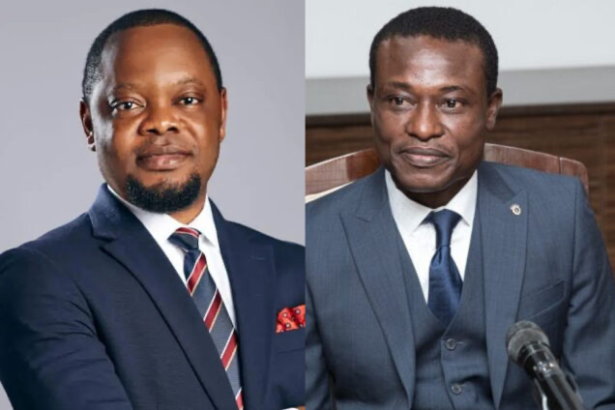
Deputy Attorney-General Justice Srem-Sai has dismissed claims that the Attorney-General’s Office has repeatedly rejected requests from the Office of the Special Prosecutor (OSP) to collaborate on corruption investigations.
Justice Srem-Sai described the allegation as false and said the Attorney-General’s Office has no interest in creating institutional tensions with the OSP or any other state agency responsible for fighting crime.
His comments follow claims by OSP Director of Strategy, Research and Communications, Sammy Darko, that the Special Prosecutor’s Office had on previous occasions sought to work with the Attorney-General’s Office on some cases but had been turned down.
Justice Srem-Sai, however, insisted that the Attorney-General’s Office treats the OSP in the same manner as other institutions involved in law enforcement and the fight against corruption.
“There has never been any tension between OSP as far as Attorney-General is concerned,” he said.

He explained that Attorney-General Dr Dominic Ayine’s priority was to ensure that criminal offences were properly investigated and prosecuted while safeguarding the rights of accused persons.
“My boss has no desire whatsoever to struggle with anyone over a job or what to do. What my boss knows and what he’s always asking us to do is to ensure that we fight crime and fight crime properly, respecting the rights of accused persons,” he said.
Justice Srem-Sai said there was therefore no reason for the OSP to have a different relationship with the Attorney-General’s Office from other law enforcement institutions.
He cited the National Commission for Civic Education, Ghana Immigration Service, Ghana Police Service and other state agencies as institutions with which the Attorney-General’s Office works in carrying out its mandate.
“Why should there be some particular tension between us and them?” he asked.
He further argued that the Attorney-General’s constitutional responsibility as the country’s Chief Law Enforcement Officer means the office must ensure that agencies mandated to fight crime operate effectively.
Justice Srem-Sai rejected suggestions that the Attorney-General’s Office was deliberately frustrating the OSP, stressing that the two institutions were both operating under laws that define their respective responsibilities.
“OSP is another agency created by legislation to fight crime. And like the way we work with all the other institutions, we work with the OSP the same way,” he said.
He added that where necessary, the Attorney-General’s Office would provide direction or assistance to the OSP, but maintained that the claim that requests for collaboration had been rejected was unfounded.
“But to say you have come to collaborate with us and we said no, there wouldn’t be any need for that approach in the first place,” he said.
Asked whether the Attorney-General’s Office would be prepared to cooperate with the OSP on cases requiring joint efforts, Justice Srem-Sai said such cooperation was part of its legal obligation.
“We don’t have a choice. It’s not about being ready to welcome [the OSP]. We are bound as the Office of Attorney-General to make sure that all the agencies that are fighting crime do their work and do their work properly,” he said.
The disagreement comes amid heightened public attention to the relationship between the OSP and the Attorney-General’s Office following a series of legal and political developments surrounding the Special Prosecutor’s mandate.
The OSP’s independence came under scrutiny in December 2025 after Majority Leader Mahama Ayariga and Majority Chief Whip Rockson-Nelson Dafeamekpor initiated moves in Parliament to repeal the Office of the Special Prosecutor Act, 2017 (Act 959).
President John Dramani Mahama subsequently asked that the proposed repeal be withdrawn, describing the move as premature and defending the importance of an independent OSP in Ghana’s fight against corruption.
The OSP’s prosecutorial powers were also challenged in court.
In April 2026, an Accra High Court ruled that the OSP could not independently prosecute criminal cases without authorisation from the Attorney-General and ordered that cases being prosecuted by the Office be transferred to the Attorney-General’s Department.
The ruling followed a constitutional challenge by private legal practitioner Noah Ephraem Tetteh Adamtey, who argued that Parliament could not grant independent prosecutorial powers to the OSP because Article 88 of the Constitution places prosecutorial authority in the hands of the Attorney-General.
The Attorney-General supported the challenge, arguing that while prosecutorial powers could be delegated, such delegation remained subject to the Attorney-General’s constitutional authority.
The Supreme Court, however, on July 29, 2026, unanimously upheld the constitutionality of the OSP Act and affirmed the legal basis for the Office to investigate and prosecute corruption and corruption-related offences.
The Court also clarified that the Attorney-General retains the constitutional power to discontinue prosecutions initiated by the OSP.
The ruling effectively overturned the April High Court decision that had questioned the OSP’s prosecutorial authority.
While the Supreme Court judgment clarified the legal relationship between the two institutions, their overlapping mandates continue to attract public scrutiny.
The OSP has statutory authority to investigate and prosecute corruption-related offences, while the Constitution gives the Attorney-General overarching prosecutorial authority.
Against that background, Justice Srem-Sai’s rejection of the alleged refusal to collaborate adds to an ongoing debate about how the two institutions will navigate their respective powers while working towards the same objective of fighting corruption and crime.
For now, the Deputy Attorney-General maintains that there is no institutional conflict and that both offices remain bound by law to cooperate where necessary.