


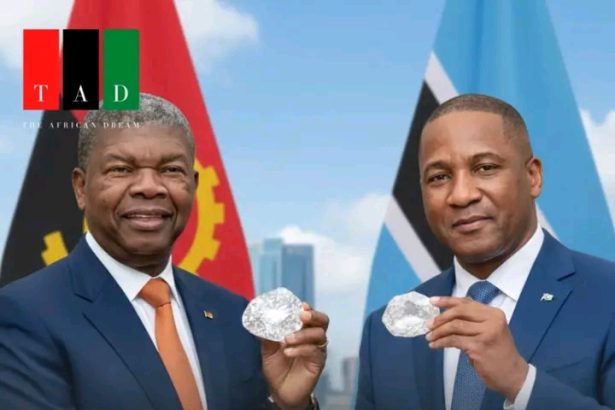
Angola and Botswana, two of Africa’s leading diamond producers, are stepping up efforts to secure strategic ownership in De Beers, the world’s most iconic diamond company, even as Angola sets ambitious production targets that underscore its rising influence in the global diamond market.
Angola’s state‑owned diamond company, Endiama, has unveiled plans to increase rough diamond output to 17 million carats by 2027, building on a record production performance in 2024 that consolidated the country’s position as the world’s third‑largest rough diamond producer by volume, trailing only Russia and Botswana.
The production surge forms part of the government’s broader strategy to deepen participation in the upstream diamond value chain and capture greater value for the Angolan economy.
Angola is weighing a strategic equity investment of between 20 % and 30 % in De Beers.
While formal agreements have not yet been signed, government officials from Luanda have confirmed that negotiations are at an advanced stage.
More Read

At the same time, the government of Botswana is moving to acquire an additional 15 % stake in De Beers, further strengthening its ownership position in the century‑old diamond giant. Currently, Botswana, through its sovereign wealth arm the Botswana Diamonds Fund, already holds a substantial share of De Beers alongside global partner Anglo American.
Together, strategic investments by Angola and Botswana could see African states controlling more than 30 % of De Beers — a landmark shift for an industry long shaped by colonial‑era dynamics.
De Beers was established over 135 years ago by British entrepreneur Cecil Rhodes, initially operating in South Africa’s diamond fields. Over decades it became synonymous with the diamond trade, mining hundreds of millions of carats across Africa — particularly in South Africa, Botswana, and Namibia — and generating tens of billions of dollars in revenue for its shareholders.
For much of the 20th century, De Beers dominated the global diamond supply chain, shaping pricing and distribution through its Central Selling Organisation.
However, gradual changes in ownership, regulation, and competition over the past two decades have reduced its dominance.
The moves by Luanda and Gaborone reflect a wider strategic effort by African producers to assert greater control over their mineral resources and participate more fully in value creation beyond extraction.
Angola’s production ambitions come amid investment in mining infrastructure, exploration, and moves to attract downstream diamond beneficiation and polishing operations.
Endiama’s target of 17 million carats by 2027 will see Angola compete more directly with established producers and diversify its mineral export base.
Botswana, long a leading diamond producer, has already leveraged its substantial diamond revenues to build resilient national finances and infrastructure. The country’s expanded stake in De Beers is expected to complement its policy of capturing greater upstream and midstream value from the diamond sector.