…Says Ghana cannot wait for perfect roads before enforcing speed limits
President John Dramani Mahama has thrown his weight behind the controversial TraffiTech-GH automated traffic enforcement system, dismissing growing calls for the government to fix Ghana’s deteriorating road infrastructure before imposing technology-driven fines on motorists.
The President insists that Ghana cannot wait for perfect roads before enforcing traffic regulations, arguing that motorists who obey speed limits have nothing to fear from the newly introduced system.
However, his endorsement comes amid mounting public outrage over the state of the country’s roads, malfunctioning traffic lights, inadequate street lighting, missing road markings and speed-limit signs, as well as concerns about the financial arrangement under which a private Swedish-Ghanaian company is reportedly entitled to 40 percent of fines collected from offending motorists.
The controversy has also been compounded by allegations that some police officers are exploiting the introduction of TraffiTech-GH to extort money from motorists, particularly in parts of Accra, where drivers are already struggling with poor road conditions and heavy traffic.

The Herald has picked up complaints from motorists around Shiashie, Lapaz and other busy parts of the capital, where some drivers claim police officers have been demanding money under the guise of enforcing the new automated traffic regulations.
There are also concerns that the system has created fear and uncertainty among motorists, with some drivers now travelling at unusually low speeds to avoid attracting fines.
Commercial drivers, particularly operators of Trotro minibusses, have reportedly turned their vehicles into platforms for expressing their frustration with the Mahama government.
Some drivers have been openly criticizing the Mahama administration in conversations with passengers, accusing it of introducing additional financial burdens at a time when the cost of maintaining vehicles, fuel, spare parts and operating commercial transport services remains high.
For these drivers, the controversy goes beyond the enforcement of speed limits to what they perceive as the Mahama government’s misplaced priorities in addressing the country’s transportation challenges.
They argue that while the authorities are eager to deploy sophisticated European technology to detect traffic violations and collect fines, little urgency has been demonstrated in repairing damaged roads, restoring broken traffic lights, providing adequate street lighting, and ensuring that road markings are visible.
Others have raised security concerns, explaining that motorists sometimes drive faster than usual on poorly lit roads along the GIMPA bypass into Haatso, Kwabenya, Madina, North Legon, among others, particularly at night, due to fears of highway robberies and other criminal attacks.
Although such concerns do not legally justify speeding, critics insist that they reflect the difficult and sometimes dangerous conditions under which motorists operate.
The introduction of the Swedish technology has also reignited questions about the country’s investment in surveillance cameras and whether similar technological resources are being adequately deployed to combat armed robbery and other crimes.
Some motorists have questioned why the authorities appear capable of deploying sophisticated cameras to identify traffic offenders and generate fines, while surveillance infrastructure has not produced similarly visible results in apprehending criminals, including armed robbers.
They argue that public confidence in the system would improve if the government demonstrated equal commitment to using technology to protect citizens from crime.
At the centre of the controversy is the financial arrangement underpinning TraffiTech-GH, which was concluded during the administration of former President Nana Addo Dankwa Akufo-Addo.
Information about the project indicates that private operators are entitled to 40 percent of the fines collected under an 11-year agreement.
The arrangement has raised questions about whether traffic enforcement is driven primarily by road safety considerations or has also become a lucrative revenue-generating venture for private interests.
Critics contend that the government must explain why such a substantial proportion of fines imposed under the authority of the state should accrue to a private company.
They have also questioned whether the arrangement creates a financial incentive for increased enforcement and whether adequate safeguards exist to prevent abuse.
The Herald understands that the company behind the arrangement involves Ghanaian and Swedish interests, with the technology associated with Sweden-based Sensys Gatso.
However, the ownership structure, contractual obligations and precise distribution of revenue under the agreement remain matters of considerable public interest.
Despite the growing criticism, President Mahama has defended the implementation of the system, insisting that enforcing speed limits is essential to reducing road accidents and protecting lives.
Speaking in Antigua ahead of the 2026 Commonwealth Heads of Government Meeting (CHOGM), the President rejected suggestions that the government should first rehabilitate the country’s roads before implementing the automated traffic enforcement programme.
“I hear they say we should fix the roads before we introduce TraffiTech. It does not work like that. I mean, the roads are not perfect in the UK, yet they have speed cameras,” he said.
According to him, the primary objective of the system is to reduce speeding, which remains a major contributor to road traffic crashes and fatalities.
He maintained that motorists who comply with the prescribed speed limits would not incur any financial penalties.
“If it is too expensive, then do not speed, and so there is a solution to that. The maximum speed in town is 50km/h. However good the road is, you do the 50km/h. If you do that, you are fine, and you will not have to pay anything,” President Mahama stated.
The President also drew attention to the dangers posed by speeding vehicles to vulnerable road users, particularly schoolchildren, who are sometimes knocked down while crossing roads.
He argued that the government had a responsibility to introduce measures to reduce such incidents rather than postpone enforcement until every road had been rehabilitated.
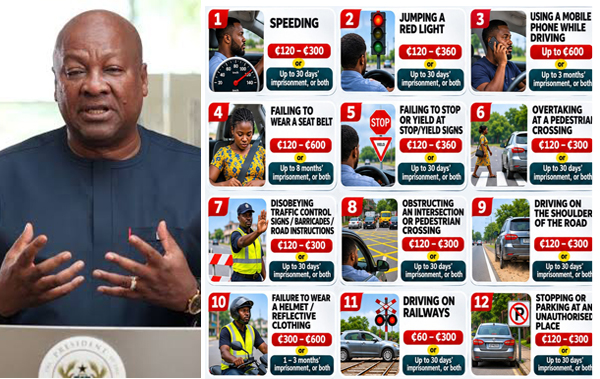
President Mahama explained that the implementation of TraffiTech-GH would be undertaken in phases, beginning with speeding offences before extending to other traffic violations.
“TraffiTech has begun with checking speeding. They have not yet added the other components such as jumping red lights, wrong-way parking and others,” he said.
The Motor Traffic and Transport Department (MTTD) of the Ghana Police Service commenced the rollout of TraffiTech-GH on November 1, 2026, using high-tech cameras to detect speeding and issue electronic notices to offending vehicle owners.
The system is intended to reduce direct human involvement in detecting certain traffic offences, improve compliance with road traffic regulations and enhance road safety.
However, its introduction has generated widespread debate, with some transport operators threatening industrial action over the policy.
For critics, the President’s comparison with the United Kingdom fails to adequately address the differences between the road infrastructure, traffic management systems and enforcement conditions in the two countries.
They argue that although roads in the United Kingdom may not be perfect, motorists generally benefit from more consistent road markings, functional traffic signals, visible speed-limit signs, street lighting and established systems for challenging traffic penalties.
In Ghana, however, motorists frequently encounter roads riddled with potholes, broken traffic lights, faded pedestrian crossings and poorly illuminated highways.
Some drivers have questioned how automated enforcement will account for situations in which motorists are compelled to make sudden manoeuvres to avoid potholes, stationary vehicles or other hazards created by inadequate road maintenance.
Others are demanding clear public education on the locations of speed cameras, applicable speed limits, procedures for challenging fines and the safeguards established to prevent wrongful penalties.
There are also questions about whether the police have put in place adequate measures to prevent officers from exploiting the system to demand unofficial payments from motorists.
Indeed, allegations of police extortion appear particularly troubling because one of the anticipated benefits of automated enforcement is the reduction of opportunities for corruption associated with direct encounters between motorists and law enforcement officers.
The Herald has learnt that some motorists are increasingly apprehensive about being stopped by police officers, fearing that the introduction of TraffiTech-GH could provide another justification for demanding money.
The growing dissatisfaction is also finding expression in commercial vehicles, where conversations between drivers and passengers have increasingly centred on the perceived unfairness of the new arrangement.
Some drivers have accused the government of being more interested in collecting money from motorists than addressing the infrastructure and security challenges confronting road users.
The controversy is unfolding against the backdrop of Ghana’s worrying road accident statistics.
According to government figures, 2,949 people died in road traffic crashes in 2025, compared with 2,494 in 2024, representing an increase of approximately 18.2 percent.
The figures highlight the urgent need for effective interventions to reduce road traffic fatalities, particularly those associated with excessive speeding, reckless driving and other dangerous practices.
Road safety advocates have long maintained that automated speed enforcement can contribute to reducing accidents when implemented transparently and supported by appropriate road engineering, public education and credible enforcement mechanisms.
However, critics of the TraffiTech-GH arrangement insist that the effectiveness of such technology should not prevent scrutiny of the contract, its financial implications, and the conditions under which motorists are being penalized.
They are demanding greater transparency regarding the 11-year agreement, including the justification for the reported 40 per cent share of fines accruing to the private operator.
Questions have also been raised about whether the contract contains performance targets, provisions for independent auditing and mechanisms for protecting motorists against inaccurate or disputed violations.
The government has yet to publicly address all these concerns, including data protection and privacy issues.
While President Mahama has made it clear that his government will not postpone automated traffic enforcement until the country’s roads are perfect, motorists insist that the state must equally fulfill its responsibility to provide safe and properly maintained road infrastructure.
For many Ghanaians, the central issue is not whether speeding should be punished, but whether a government that has failed to provide adequate road markings, functional traffic lights, street lighting and safe roads can justify prioritizing a system that imposes financial penalties while allowing a private company to retain a substantial share of the proceeds.
The emerging controversy poses a significant test for the Mahama administration, particularly as public frustration over the cost of living, road infrastructure, and alleged police misconduct continues to shape perceptions of government policy.
With commercial drivers threatening resistance and motorists increasingly questioning the fairness of the arrangement, the government faces growing pressure to demonstrate that TraffiTech-GH is genuinely a road safety intervention rather than a revenue-generating scheme benefiting private interests.
For now, President Mahama’s position remains unequivocal: motorists must obey the speed limits, regardless of road conditions.
But whether his message will calm public anger over the controversial contract, police extortion and Ghana’s deteriorating road infrastructure remains to be seen.