…..As he identifies rightful beneficiaries under Ada customary law
The name of retired Supreme Court Justice Nene Amegatcher has surfaced in the protracted inheritance dispute between legal practitioners Peter Okudzeto and his half-brother, Sam Okudzeto, following the emergence of a 2014 legal opinion on the distribution of the estate of the late Angelina Siaw Sappore.
The legal opinion, dated December 10, 2014, examined the application of Ada customary law to inheritance and identified the persons entitled to share in the disputed estate.
Peter has accused Sam, his daughter Esine Okudzeto, their law firm Okudzeto and Associates, and other parties of alleged inheritance fraud, forgery, and intermeddling in the estates.
Peter has submitted the document to the Supreme Court as part of fresh evidence in support of his objection to an application filed by Sam and other applicants, arguing conflict of interest because their lawyer, Isaac Ofosu-Boateng, also from the same Sam Okudzeto & Associates, had had previous professional involvement with the estates at the centre of the litigation.
More Read
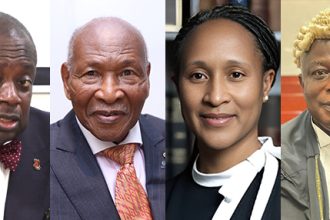
The document, referenced NAOA/IOB/12/14 and attached to Peter’s supplementary affidavit as Exhibit PK8, was authored by Justice Amegatcher before his elevation to the Supreme Court bench.
It was addressed to the administrators of the Estate of Baby Angelina Mamle Siaw Sappore and concerned the case of Eric Tei Akwetey Siaw & 2 Others v Tetteh Siaw Sappore & Another.
Peter contends that the opinion is significant because Justice Amegatcher is now practizing at Sam Okudzeto & Associates, the law firm representing Sam, a former Council of State Member and one-time President of the Ghana Bar Association (GBA), and other applicants in the ongoing proceedings.
He further alleges that Justice Amegatcher previously supervised lawyer Isaac Ofosu-Boateng before the latter’s appointment to the Supreme Court and handed the inheritance matter over to him after his own elevation to the bench.
The allegations form part of Peter’s broader argument that the firm and its lawyers should not continue representing parties whose interests he considers adverse to those of estates they previously represented.
The claims have yet to be determined by the court.
In the 2014 opinion, Justice Amegatcher examined the customary inheritance rules applicable to the Ada people, whom he described as a patrilineal community.
Drawing on the late Supreme Court Justice A.K.P. Kluzde’s 1988 book, Modern Law of Succession in Ghana, the opinion identified Ga-Adangbe communities, including Ada, among Ghana’s patrilineal societies.
It also relied on the decision in Makata v Ahorli (1956) 1 W.A.L.R. 169, in which the West African Court of Appeal considered customary inheritance among the Agave (Addah) people.
The opinion stated that, under the applicable customary law, the eldest surviving brother ordinarily serves as administrator and distributes family property among eligible beneficiaries.
Justice Amegatcher also considered section 11(1) of the Intestate Succession Law, 1985 (PNDCL 111), which provides for an intestate’s estate to devolve according to the applicable customary law where the deceased leaves no surviving spouse, child or parent.
Applying those principles, he concluded that the estate should devolve according to Ada customary law, identifying three groups of beneficiaries.
They were Eric Tei Akwetey Siaw, Dr Daniel Narh Siaw and the late Madam Aku Sappore, whom the opinion identified as the surviving paternal siblings entitled to share in the estate of the late Mokoledzen Siaw Sappore, also referred to in the documents as Angelina Siaw Sappore.
The opinion stated that the father of Tetteh Siaw-Sappore, Narteh Siaw-Sappore and Siaw Sappore Otubuah had died before the deceased.
Consequently, he had not acquired an interest in the estate, and his children could not inherit a share through him, according to the opinion.
However, Justice Amegatcher drew a distinction between those children and the children of Madam Aku Sappore, who survived the deceased and inherited a share of her sister’s estate before subsequently dying intestate.
The opinion held that Aku Sappore’s interest should pass to her children under PNDCL 111.
It identified those children as Peter, Thomas Sekou and Felicia Sekou, concluding that they were entitled to their mother’s share.
The opinion therefore recommended an equal division of the estate among Eric Tei Akwetey Siaw, Dr Daniel Narh Siaw and the children of Aku Sappore.
Peter relies on that conclusion to support his position that the inheritance dispute should be determined in accordance with the applicable customary law and the documented interests of the original beneficiaries and their successors.
The 2014 opinion is one of three documents Peter has submitted to support his allegations concerning the law firm’s previous involvement in the estates.
In a supplementary affidavit filed on October 7, 2026, he argues that the documents demonstrate a professional relationship between Sam Okudzeto & Associates, Mr Ofosu-Boateng and the Estate of Angelina Siaw Sappore.
The first document, attached as Exhibit PK6, is a letter dated April 22, 2024, addressed to beneficiaries of the estate and signed by Mr Ofosu-Boateng.
The letter identified the firm as lawyers for the estate and invited beneficiaries to a meeting to discuss the sharing and distribution of properties, the winding-up of the estate and outstanding legal fees.
It stated that the estate’s properties had been vested in Dr Daniel Narh Siaw for himself and in trust for the other beneficiaries. Following his death, the surviving beneficiaries were expected to meet to discuss the distribution of the properties.
The second document, Exhibit PK7, is a letter dated March 5, 2025, from Sam Okudzeto & Associates to Peter.
According to Peter, the firm stated that it had been appointed by Charles Noble Acolatse and Eric Akwetey Siaw-Sappore to represent beneficiaries of Dr Narh’s estate and the children of Eric Teye Akwetey Siaw, respectively.
The letter also disputed aspects of Peter’s position concerning the administration of the estate.
It stated that Dr Narh had executed a will on September 2, 2018, which was admitted to probate by the High Court in Accra on July 24, 2024.
The letter further stated that the court had granted Letters of Administration with Will Annexed to Charles Noble Acolatse and Eric Akwetey-Siaw Sappore.
The firm maintained that its appointment had been made by the relevant administrators and that it was acting in the interests of the parties who had retained it.
It also stated that Peter, as a representative of the children of the late Christiana Aku Siaw-Sappor, was entitled to appoint his own lawyers to represent their interests in the winding-up of the estate.
Peter argues that the three documents establish that the firm and Mr Ofosu-Boateng previously acted for the estate and have continued to represent parties connected to the administration of the properties.
He alleges that the applicants’ current interests are adverse to those of the estates the firm previously represented, particularly in relation to properties he claims have been subjected to intermeddling, undervaluation and diversion.
Those allegations remain contested and have not been established by the court.
Peter has invoked Rules 20, 21, 22, 31 and 89 of the Legal Profession (Professional Conduct and Etiquette) Rules, 2020 (L.I. 2423), arguing that legal practitioners must avoid conflicts of interest, including situations in which they represent parties whose interests are materially adverse to those of former clients in the same or substantially related matters.
He has also cited the Supreme Court decision in Madam Akosua Adade v Okesseku Mintah [TLP-SC-2026-17], which he says was delivered on April 22, 2026.
According to Peter, the decision supports his contention that a breach of professional obligations arising from a conflict of interest may justify invalidating court processes filed by the lawyer concerned and removing the lawyer’s name from the proceedings as counsel.
He is asking the Supreme Court to strike out and dismiss the applicants’ motion seeking rectification of the record of appeal and an extension of time.
Peter filed his initial affidavit in opposition on October 6, 2026, following the applicants’ motion of September 25, 2026.
He says the supplementary affidavit became necessary after additional information and documents came to his attention, which he considers material to determining whether the application is competent.
He is seeking leave for the supplementary affidavit and its accompanying exhibits to be admitted and considered alongside his earlier affidavit.
The legal challenge forms part of a wider inheritance dispute involving allegations of fraud, forgery and unlawful interference with estate properties.
Peter, who says he is pursuing the matter on his own behalf and on behalf of his siblings, Thomas Sekou and Felicia Sekou, maintains that their interests derive through their late mother, Christiana Aku Siaw Sappor, whom he identifies as a sister of Angelina Siaw Sappore and Dr Daniel Narh Siaw.
He also disputes their entitlement to the properties, arguing that they have no blood relationship to his maternal family that would entitle them to inherit.
Peter maintains that the firm’s previous professional involvement with the estates raises questions about the propriety of its continued representation of the applicants in related proceedings.
He argues that admitting the additional evidence would enable the Supreme Court to assess his objection and safeguard the integrity of the judicial process.