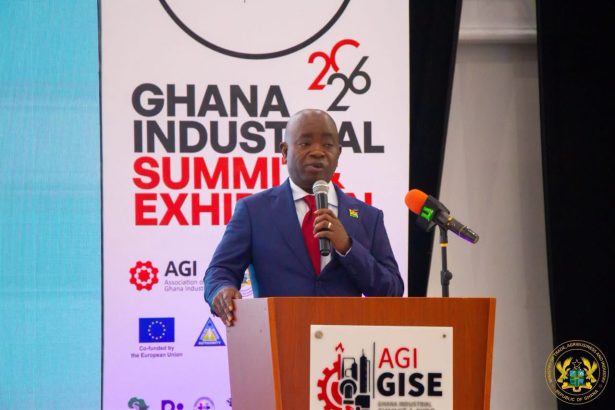
Government says it is moving beyond industrial policy formulation to implementation, with targeted interventions in textiles, pharmaceuticals, automotive components and agribusiness aimed at strengthening Ghana’s manufacturing base and export capacity.
Deputy Minister for Trade, Agribusiness and Industry, Sampson Ahi, said the government was prioritising reliable energy, digital innovation and local value addition as key pillars of its strategy to make Ghanaian industries more competitive.
Mr Ahi made the remarks at the 2026 Ghana Industrial Summit and Exhibition (GISE) in Accra, where he delivered a speech on behalf of the Minister for Trade, Agribusiness and Industry, Elizabeth Ofosu-Adjare.
The summit was held under the theme, “Driving Sustainable Export-Led Industrial Growth through Energy Reliability and Digital Innovation.”
According to Mr Ahi, government’s approach is now focused on translating industrial policies into practical interventions that can increase production, create jobs and expand Ghana’s presence in international markets.

He said initiatives targeting the textiles and garments sector, pharmaceutical manufacturing, automotive components and agribusiness formed part of efforts to build stronger domestic production capacity.
Mr Ahi also cited Ghana’s recent economic performance as providing a foundation for increased industrial activity.
He said foreign direct investment rose from $652 million in 2024 to $2.62 billion in 2025, while the economy recorded real GDP growth of six per cent in 2025.
He said government initiatives including the 24-Hour Economy, the Rapid Industrialization for Jobs Initiative and the Feed the Industry Programme were designed to support increased production and employment while improving Ghana’s export competitiveness.
The government’s focus on local value addition is expected to deepen the connection between industrial production and domestic suppliers, particularly in sectors where Ghana continues to rely heavily on imported inputs.
For industry, however, the success of the strategy will depend on the policy environment, financing and the reliability of critical infrastructure.
President of the Association of Ghana Industries (AGI), Dr Pharma Kofi Nsiah-Poku, called for consistency in government policies, regulatory clarity and improved access to financing for businesses.
He urged stakeholders to move beyond discussions at the summit and implement practical measures to address the energy constraints facing industry, accelerate digital transformation and strengthen Ghana’s export strategy.
The European Union Ambassador to Ghana, Rune Skinnebach, also said the EU wanted to see more products made in Ghana entering European markets.
He reaffirmed the EU’s commitment to supporting Ghana’s industrial ambitions and helping local businesses access international markets.
The 2026 Ghana Industrial Summit and Exhibition, organised by the AGI, brought together government representatives, businesses and development partners to discuss investment, innovation and measures to support export-led industrial growth.
The summit is the ninth edition of the GISE, which serves as a platform for industry stakeholders to examine challenges confronting Ghana’s manufacturing sector and identify opportunities for expanding production and exports.