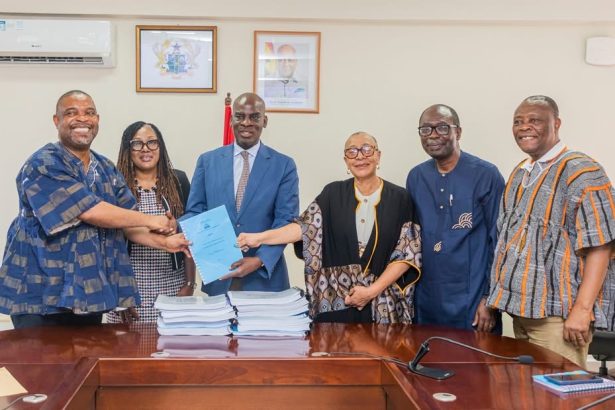
The National Council for Curriculum and Assessment (NaCCA) has presented a revised Kindergarten to Primary Six (KG–P6) curriculum to the Minister for Education, introducing reforms aimed at strengthening foundational literacy, digital competencies and values-based education.
The curriculum, officially presented at the Ministry of Education in Accra on 22 July, forms part of Ghana’s ongoing education reform agenda and is expected to reshape teaching and learning at the basic education level.
According to NaCCA, the revised curriculum was developed through extensive consultations involving about 160 curriculum experts and seeks to reduce curriculum overload while equipping learners with the knowledge, skills and competencies required for the 21st century.
Among the key reforms are enhanced Foundational Literacy, Digital Literacy, Coding and Computational Thinking, Citizenship Education, and Ethics and Values Education.
The new curriculum also introduces Citizenship Education as a single learning area that combines History, Civic Education and National Values.
In addition, agricultural concepts have been integrated into Integrated Science, while Chinese has been proposed as an optional foreign language from Primary One alongside a standardised Arabic curriculum.
NaCCA said the revised curriculum adopts a competency-based assessment system with three performance standards—Basic, Attained and Deeper—to better measure learners’ progress.
Receiving the curriculum, the Minister for Education commended NaCCA for its work in advancing education reforms and endorsed the continued use of Ghanaian languages as the medium of instruction from Kindergarten to Basic Three to strengthen foundational literacy.
The minister also reaffirmed that English remains Ghana’s official language.
NaCCA said the revised curriculum is expected to promote learner-centred education, improve literacy outcomes, strengthen digital skills and nurture responsible citizenship, positioning learners for lifelong learning and national development.