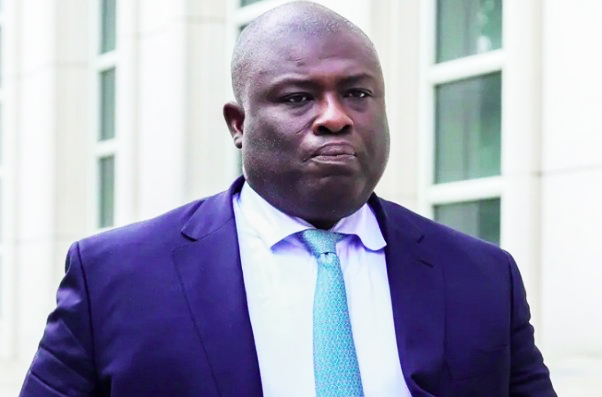
Asante Berko, a former Goldman Sachs Group Inc banker who also served as Managing Director of the Tema Oil Refinery (TOR) during the Akufo-Addo administration, went on trial on Tuesday for allegedly bribing Ghanaian government officials to secure a lucrative power plant deal for a Turkish client, Aksa Energy.
The bribes, reportedly more than US$1 million, were allegedly dished out in 2015, at the height of the country’s power crisis during Mahama’s first administration.
US prosecutors have promised jurors that during the two-week trial they would see a trove of evidence including bank records and emails outlining the bribe scheme.
Mr Berko went on trial for allegedly paying the Ghanaian government what has been described as a “holy rain” of bribes to secure a lucrative power plant deal for a client.
No names have been mentioned as recipients of the bribe. Berko’s lawyers have indicated their readiness to mount a spirited defence against a possible 20-year imprisonment.

Asante Berko, 52, and his associates outside the bank paid high-ranking government officials in the West African nation more than $1 million in bribes a decade ago to approve the development and financing of the multimillion-dollar power plant, Prosecutor Katherine Raut told a federal jury in Brooklyn, New York, in her opening statement.
Berko hid the alleged scheme from Goldman’s compliance department, according to the US. The bank wasn’t accused of wrongdoing and cooperated with the government investigations.
Berko was a member of the team at Goldman responsible for securing and managing financing for the power plant project.
Prosecutors allege the bribes were paid to obtain the necessary approvals for a Turkish company, in which Goldman held a 16% stake, and that Berko laundered the bribe money through US financial institutions.
Raut told the jury so many “red flags” were eventually raised by Goldman Sachs that it pulled out of the project. She promised jurors that during the two-week trial they would see a trove of evidence including bank records and emails outlining the bribe scheme.
In one email, Berko directed accomplices to “keep our conversations to private email,” and in another 2015 message, an associate of Berko told him an official in Ghana was “waiting for the ‘holy rain’ and would appreciate it sooner rather than later,” according to the prosecutor. The US has said the messages and others are proof of illicit payoffs.
Berko has pleaded not guilty and his lawyer, Robert Boone, told jurors the government’s evidence would fail to show his client’s role in any bribery scheme. Boone compared the government’s case to the pop group Milli Vanilli, which was exposed for lip syncing and not actually singing on their recordings.
“Where are the witnesses to Mr Berko’s bribery?” he asked. “Is anyone going to testify to having seen a bribe or being paid a bribe? The answer is no.”
Berko is accused of violating the Foreign Corrupt Practices Act, or FCPA, conspiracy and engaging in a money-laundering scheme.
He faces as long as 20 years in prison if convicted on the most serious charge against him.
The case, which surfaced in April 2020, alleged that one of Turkey’s largest power producers was embroiled in corruption over a deal in Ghana brokered by a Goldman Sachs banker.
Aksa Energy, which is publicly listed on the Istanbul Stock Exchange, is the unnamed energy company mentioned in a complaint filed by the US Securities and Exchange Commission, said two people familiar with the situation.
The company allegedly funnelled about $2.5m in bribes to Ghanaian officials before it was awarded the contract to build an electricity plant in the West African nation.
It is also alleged that it paid $2 million to Asante Berko, then an executive director in Goldman’s London office, for his alleged role in orchestrating the bribery scheme, which was thrashed out in 2015 and 2016. Although Aksa Energy is not named in the SEC filing and is not specified as a target of its complaint, the document provides several details identifying it as the energy company referred to throughout. This was confirmed by two people familiar with the US regulator’s investigation.
Aksa was also publicly named by John Jinapor, Ghana’s deputy power minister at the time, during a local radio interview.
He denied any direct involvement in the deal. Aksa was pursuing the business in Ghana at a time when it was struggling with tight profit margins, a squeeze on energy prices and a slide in the lira. This environment piled pressure on Turkish energy producers such as Aksa, which were laden with foreign-currency debt.
It came as issue of Turkey’s corporate debt burden is back in focus as the coronavirus crisis has pushed the lira close to an all-time low. The case is uncomfortable for Goldman Sachs, which was awaiting the outcome of a US investigation into whether the bank had a case to answer in the multibillion-dollar 1MDB embezzlement and bribery case in Malaysia.
One of its former senior bankers had already pleaded guilty to involvement in the case. The SEC said there were no charges against Mr Berko’s former employer. Goldman Sachs was not named in the complaint, but several sources confirmed that the US bank had employed Mr Berko at the time.
The regulator said Mr Berko took “deliberate measures” to prevent his employers from discovering the alleged Ghanaian bribery scheme. Goldman’s compliance team uncovered questions about the deal and, by August 2016, the bank had terminated its involvement in the power project.
Mr Berko resigned a few months later. However, the Financial Times can reveal that Goldman continued to own a 16.6 per cent stake in Aksa Energy, which it acquired as part of a 2012 financing deal with its parent company, extended the following year.
The stake was bought back by the parent company, Kazanci Holding, in 2018 for $300m, almost three times its market value, thanks to a put option that was agreed six years earlier. Goldman declined to comment.
A person familiar with the situation said the firm did not have information about any broader alleged wrongdoing involving Mr Berko and the energy company, beyond what it had in 2016, until the SEC’s complaint became public in April 2020.
According to the SEC filing, the origins of the power plant deal date back to 2014, when Ghana was suffering from severe power shortages that led to rationing and a contraction of the manufacturing and mining sectors. In response, the government fast-tracked private power projects.
At the time of the deal, Goldman and Aksa Energy were seeking opportunities to expand their businesses in Africa.
Shortly afterwards, a more senior banker at the London office told Mr Berko that Aksa Energy, a longtime client, wanted to build and operate an electricity plant in Ghana and sell the power to the country’s government.
They agreed that Goldman would advise Aksa and arrange financing if the deal was successful.
Mr Berko enlisted the help of a Ghanaian intermediary firm that had contacts “within the highest levels” of government and together they allegedly came up with a plan in which Aksa Energy agreed to make payments totalling several million dollars as the deal cleared various hurdles, according to the SEC filing.
The deal was announced in August 2015, and the power plant began commercial operations in 2017.
Mr Berko resigned as managing director of the Ghana state-owned Tema Oil Refinery, according to an Akufo-Addo government statement.
Mr Berko denied any wrongdoing in a statement shared with local media, and said that a Turkish power producer agreed to pay him $2m for his work raising $150m for the project. He said the SEC allegations had “come as a complete surprise” to him.
Aksa Energy did not respond to a request for comment. A statement from Aksa said it was not involved in any legal proceedings related to the case. The group added that it “is ready to cooperate with the relevant US authorities and share all documents and information.”