
The government’s drive to retain more value from Ghana’s petroleum resources has received a major boost following the decision to allocate approximately one million barrels of crude oil from the Jubilee Field to the Sentuo Oil Refinery for local processing.
Minister for Energy and Green Transition, John Abdulai Jinapor, hailed the move as a significant milestone in Ghana’s petroleum industry and a reflection of government’s commitment to maximising the benefits of the country’s natural resources.

“The delivery of locally produced Jubilee crude oil to the Sentuo Oil Refinery marks a significant milestone in Ghana’s petroleum industry. It reflects government’s commitment to add value to our natural resources locally, strengthening energy security, and retaining more economic benefits within the country,” the minister stated.
According to him, the latest development aligns with President John Dramani Mahama’s vision of deepening local participation and accelerating industrial development within Ghana’s petroleum value chain.
Mr Jinapor noted that the initiative builds on earlier efforts to integrate upstream crude oil production with domestic refining activities, recalling the successful supply of crude oil from the TEN Fields to the Tema Oil Refinery (TOR) in 2016.
More Read

“The milestone builds on the vision of President John Dramani Mahama to deepen local participation and industrial development in the petroleum sector,” he added.

He further disclosed that Sentuo Oil Refinery has emerged as an important player within Ghana’s downstream petroleum industry, while TOR is also currently refining crude following the recent receipt of one million barrels of oil.
The minister said the simultaneous operation of both refineries would significantly enhance Ghana’s refining capabilities and reduce dependence on imported petroleum products.
“The successful collaboration between government, industry stakeholders and petroleum partners highlights the shared commitment to advancing Ghana’s energy and industrial transformation agenda,” he stressed.
Executive Secretary of the Chamber of Petroleum Consumers (COPEC), Duncan Amoah, described the allocation of Jubilee crude to Sentuo as one of the most strategic interventions undertaken by the government in recent years.
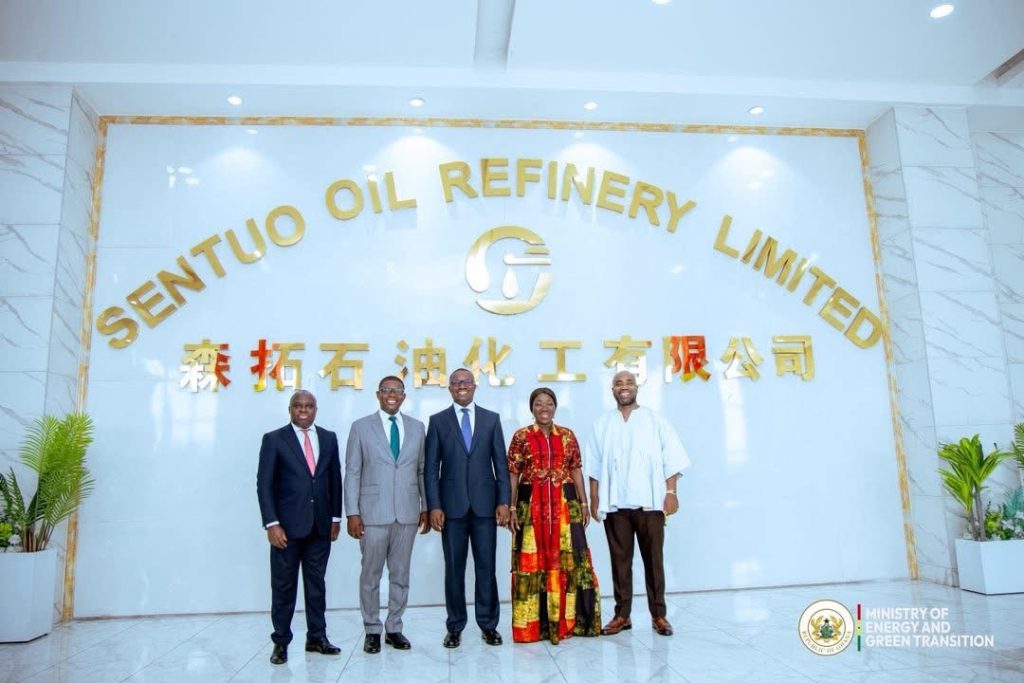
“Sentuo Refinery is indeed taking delivery of some one million barrels of crude from the Jubilee fields. Again, this is one of the best things the government could do considering the conflict that pertains in the Middle East,” Mr Amoah said.
He argued that with global shipping costs, insurance premiums and supply disruptions pushing up fuel prices, it makes economic sense for Ghana to process its crude oil domestically rather than exporting it for refining and subsequently importing finished products at a higher cost.
“At present, if you are paying so high for insurance premiums and other premiums to be able to land finished products and you have local refineries that could easily process your crude, then it is only reasonable and rational that you begin to look at giving them that crude so that you don’t take it to Europe for them to refine and go to buy back from Europe,” he explained.
According to him, local refining not only enhances fuel security but also ensures that a greater share of the petroleum value chain remains within the Ghanaian economy.
Mr Amoah further revealed that the Tema Oil Refinery is expected to receive a similar quantity of crude oil by the first week of July, creating a more predictable supply stream for domestic refineries.

“TOR had already gotten some cargo, if you recall, not long ago, and so it would be fair that Sentuo takes the first parcel. But what I am aware of is that TOR would also receive similar cargo by the first week of July, and that would mean that you would almost always have some of your liftings coming to the local refineries,” he stated.
He, however, called on government to broaden the initiative by extending support to smaller modular refineries, including Platon and Akwaaba, to ensure wider participation in the downstream petroleum sector.
“What we would want the government to consider is also to look at the smaller modular refineries like Platon and Akwaaba and also begin to look for ways to give them the same concessions so that they can process and even get the residual fuel oil that industries might need,” he added.
Mr Amoah expressed optimism that sustained crude allocations to local refineries could eventually translate into lower fuel prices for consumers by reducing exposure to costly shipping arrangements and elevated insurance charges currently affecting international fuel trade.
“If this is sustained, it has the tendency to gradually ease fuel prices because then again you could be cutting back on the expensive insurance premiums that pertain currently globally due to the closure of the Straits of Hormuz and the squeeze on global fuel supplies.

“I think that this is something that the Ministry of Energy has done very well. We only hope that it is sustained through the year because fuel prices have already become quite high for the Ghanaian pocket,” he remarked.
The decision to channel locally produced crude to domestic refineries is expected to become a central component of government’s broader energy transition and industrialisation agenda, with policymakers hopeful that increased local refining will strengthen energy security, create jobs, retain foreign exchange and reduce the country’s vulnerability to external supply shocks.