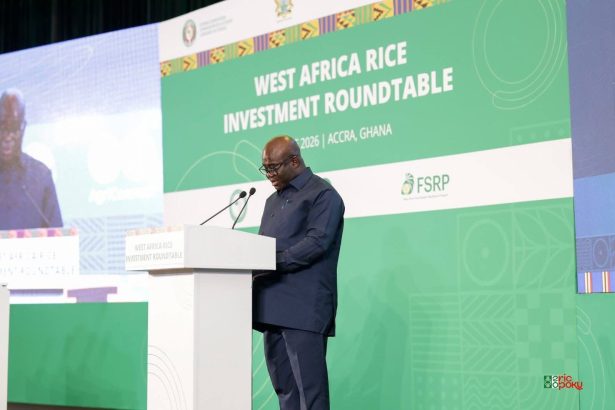
The Minister for Food and Agriculture, Eric Opoku, has announced plans to tie rice import permits to support for local rice production as part of efforts to reduce Ghana’s dependence on imported rice and boost domestic output.
The Minister made the announcement at the West Africa Rice Investment Roundtable 2026 held in Accra from 2-3 June, where governments, investors, development partners, financial institutions and agricultural stakeholders gathered to discuss strategies for achieving rice self-sufficiency across the region by 2035.
According to Mr Opoku, importers seeking permits to bring rice into Ghana will be required to demonstrate verifiable partnerships with local rice farmers and show evidence of procuring locally produced rice.
The policy, he said, is intended to channel investment into Ghana’s rice value chain while creating a sustainable market for domestic producers.
“We are not raising tariffs that punish consumers. We are not imposing bans that create shortages. We are redirecting the existing value in the rice trade towards building our own productive capacity,” the Minister stated.
More Read

He explained that the initiative forms part of broader government efforts to increase local rice production, strengthen food security and create employment opportunities within the agricultural sector.
Mr Opoku said the policy would help expand market access for Ghanaian rice farmers, attract private sector investment and reduce the country’s import bill.
The announcement comes amid renewed regional efforts to boost rice production under the ECOWAS Rice Agenda and the Regional Rice Roadmap (2025–2035), which seek to reduce West Africa’s reliance on imported rice.
The two-day roundtable focused on investment opportunities in irrigation, mechanisation, storage, processing, logistics and agricultural financing, with participants highlighting the need for stronger public-private partnerships across the rice value chain.
The Minister also announced plans to establish an inter-ministerial task force to combat rice smuggling through unauthorised border routes.
According to him, the illegal inflow of rice continues to undermine local producers and weakens efforts to develop a competitive domestic rice industry.
Mr Opoku said government remains committed to supporting policies that strengthen local production while ensuring consumers continue to have access to affordable food supplies.
The West Africa Rice Investment Roundtable is expected to play a key role in mobilising investment and partnerships aimed at transforming rice production and improving food security across the region.