
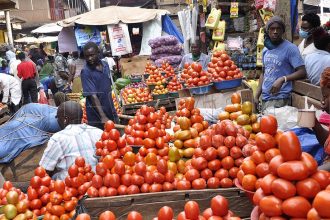
Ghana is on track to achieve large-scale domestic tomato production by the end of the year, aimed at reducing the country’s dependence on imports, particularly from Burkina Faso.
This assurance comes from Deputy Minister for Food and Agriculture, John Dumelo, in a press release issued on Tuesday, 17 February.
Mr Dumelo said Ghana’s overreliance on imported tomatoes is unsustainable, pointing to the country’s abundant fertile land and available human resources. He stressed that local production could comfortably meet national demand.
The Deputy Minister’s remarks follow a tragic terrorist attack in Burkina Faso, where seven tomato traders lost their lives and several others sustained injuries, highlighting the vulnerabilities of cross-border tomato trade.
According to Mr Dumelo, tomato production trials have already begun at several irrigation schemes, particularly in northern Ghana, yielding encouraging results.
More Read
“At some of the irrigation schemes, particularly in the north, we have begun trials in tomato production, and by the end of this year, we expect to be in full swing,” he said.
The Tono Irrigation Scheme, operating under the West Africa Food System Resilience Programme, currently hosts trials covering approximately 50 to 60 acres. Similar initiatives are ongoing at Akomadan, where multiple tomato varieties are being tested to determine their adaptability and yield potential.
“Some of the varieties are doing well; others are not. These trials are important so we can scale up what works best,” Mr Dumelo explained.
Mr Dumelo revealed that local tomato traders, many of whom traditionally source their supplies from Burkina Faso, have been briefed on the government’s interventions.
“Once these irrigation schemes come fully on stream, we expect tomato imports to reduce by at least half by the end of the year,” he added.
The Deputy Minister outlined that planting is scheduled to begin around May and June, with harvesting expected between August and September. Several irrigation schemes across the country are undergoing rehabilitation, renovation, or reconstruction to facilitate year-round tomato cultivation.
Government support also includes the distribution of solar-powered water pumps to farmers and the reassignment of pumps seized from illegal mining activities to farmers operating in non-galamsey riverbank areas.
“Once the interventions are fully implemented, we anticipate a robust tomato harvest, which will significantly reduce the need for cross-border trade and strengthen the country’s food security,” Mr Dumelo affirmed.