By Paul Mamattah
Drivers and commuters who ply the Bakoniaba-Wowosua stretch of the long-abandoned Sinohydro road project in the Sunyani East Municipality of the Bono Region have mounted renewed pressure on the government to urgently resume and complete the project, warning that continued neglect is endangering lives and undermining local economic activity.
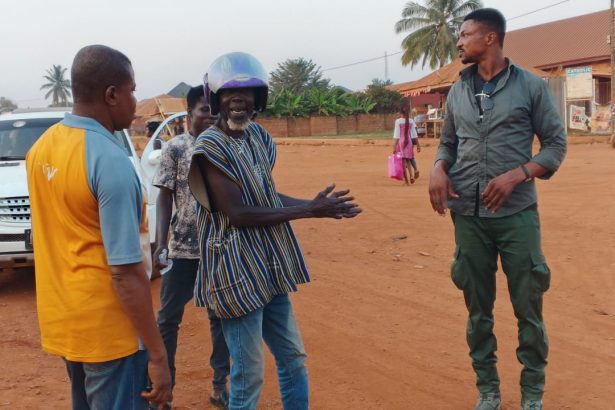
Speaking in an interview with the Herald Newspaper at Bakoniaba during a visit to assess conditions on the ground, residents and road users expressed deep frustration over what they described as years of official neglect.
They lamented the worsening state of the road, which is riddled with potholes and generates thick clouds of dust, leading to frequent motor and vehicular accidents as well as serious health concerns linked to prolonged inhalation of polluted air.
The situation, according to the commuters, has become a test case of the government’s commitment to infrastructure development and road safety, particularly in food-producing communities whose contributions to the national economy remain largely unreciprocated.
Residents, however, commended the interventionist leadership of the Nkorsohene (Development Chief) of the Nankwtewa Traditional Area, Mustapha Meshark, describing his actions as a stark contrast to what they see as state inaction.
In an interview with the Herald Newspaper, Mustapha Meshark stressed that the Bakoniaba-Sunyani Highway is a strategic corridor linking several farming communities that supply staple foods such as cassava, plantain, and maize to urban markets.
He noted that despite the road’s economic importance, its condition has deteriorated to a dangerous level.
“The stretch has become a death trap,” he said, revealing that he had personally witnessed two fatal accidents caused by potholes on the road.
He added that the situation has compelled community leaders and residents to take temporary measures in the absence of government intervention.
As a stopgap response, the Development Chief said he has been working with the Aboboya and Pragier (tricycle) Users Association of Bakoniaba and Wowosua to organise regular infilling of the worst portions of the road on a weekly or biweekly basis. He explained that he provided basic tools, including shovels, pickaxes, and wheelbarrows, to support the exercise, though the lack of water means the repairs are often washed away during rainfall.
Despite these setbacks, Mustapha Meshark maintained that the community would not relent.
“We will continue these efforts because they are saving lives,” he said, adding that the initiative would persist until the government provides a permanent solution.
He therefore called on the Ministry of Roads and Highways and the central government to treat the Bakoniaba-Sunyani Highway as a matter of national urgency. While acknowledging that President John Dramani Mahama had earlier visited the area to cut sod for the government’s “Big Push” infrastructure agenda, he insisted that the frequency of accidents on the stretch, almost every two weeks, sometimes resulting in deaths and amputations, demands immediate action.
The renewed agitation has also revived political debate around the stalled Sinohydro Master Project Agreement, under which several road projects, including the Bakoniaba-Wowosua stretch, were to be constructed in exchange for Ghana’s refined bauxite.
The US$1.5 billion barter deal, signed in 2018, has faced sustained criticism over delays, non-performance, and concerns about financial viability, with some projects remaining incomplete years after sod-cutting ceremonies.
Former President Nana Addo Dankwa Akufo-Addo inaugurated the Sinohydro Master Project in April 2019 with the sod-cutting for the Tamale Interchange, amid assurances that the agreement would address Ghana’s infrastructure deficit through the construction of roads, bridges, interchanges, hospitals, housing, railway lines, and rural electrification.
However, the slow pace of work and the stalling of several projects have kept the deal at the centre of political scrutiny, particularly as Ghana recently cancelled a separate bauxite agreement with Rocksure International, further intensifying calls for a review of resource-backed infrastructure arrangements.
For residents of Bakoniaba and Wowosua, the abandoned road has become a symbol of unfulfilled political promises.
They are now demanding decisive government action to complete the project and demonstrate that rural and peri-urban communities are not being sidelined in the country’s infrastructure priorities.