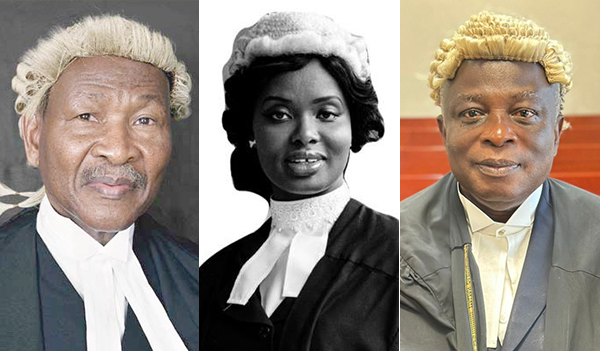
Peter Kweku Okudzeto has gone to the Court of Appeal, “dissatisfied” with a ruling by Justice Akosua Dansoa Asiama Christopher of an Accra High Court (Probate Division), which struck out Samuel Okudzeto, his daughter, Esine Okudzeto, and their law firm from a dispute concerning a will.
Peter and two others have accused Sam and the other respondents of forging documents and committing fraud to interfere with their mother’s estate. Sam’s stepmother previously owned the properties in question. The vast estates are located in prime areas across the country, especially in Accra, including the NCR Building on Kwame Nkrumah Avenue.
The ruling, delivered on 18 November 2025, is being challenged because the learned High Court judge erred in law and misdirected herself by proceeding on the erroneous legal premise that a contract for the provision of legal services to an estate cannot give rise to a cause of action in favour of beneficiaries against the estate’s legal counsel.
According to Peter, a half-brother of the 90-year-old Sam Okudzeto, the Court failed to recognize that the defendants, having been involved in the management of the estate’s affairs, owed fiduciary duties that extended to the ultimate beneficiaries, including the appellant.
He said the Court improperly confined his action to the narrow doctrine of contractual privity, thereby failing to recognize the true juridical foundation of the claim, which rests on the respondents’ alleged liability in law and equity for knowingly participating in breaches of trust or fiduciary duties owed to the estate.
More Read
He argued that the learned High Court judge committed a fundamental procedural error by summarily determining the issues against him and striking out Sam Okudzeto, his daughter and the law firm of Sam Okudzeto & Associates as respondents solely on the strength of conflicting affidavit evidence.
He said the Court acted in apparent contravention of established precedent, holding that allegations of fraud, which require a standard of proof higher than a mere balance of probabilities, cannot be summarily determined based on conflicting affidavit evidence alone.
Peter, who is also a lawyer, contended that the striking out of Sam and the other two respondents effectively deprived him of his fundamental right to cross-examine them on key facts concerning the alleged fraud, conflict of interest and unlawful enrichment.
He maintained that Justice Asiama Christopher erred in law by misapplying the test for necessary and proper parties under the Rules of Court, wrongly concluding that the 1st, 2nd and 3rd respondents were unnecessarily joined.
He said the ruling ignored the substantive claims for personal and corporate wrongful acts pleaded against the respondents, including the unlawful exercise of control and dominion over estate assets, which sought to establish direct and independent personal liability against them.
The Court, he said, failed to distinguish between the primary claim for the revocation of Letters of Administration and the cumulative, distinct claims based on the 1st, 2nd and 3rd respondents’ alleged unlawful dealings with estate property.
He argued that Justice Asiama Christopher committed a fundamental error, the consequence of which was to render the Court incapable of effectually and completely adjudicating upon and settling all questions involved in the matter.
“The striking out resulted in an incomplete and fragmented adjudication, as the Court is incapable of determining fundamental questions of fact and law concerning the alleged liability of the struck-out respondents,” he stated.
He added that the ruling stripped the Court of the power to enforce specific proprietary and prohibitory remedies, including injunctions, restitution and the recovery of documents sought against the 1st, 2nd and 3rd respondents, thereby rendering key reliefs unenforceable.
Peter is seeking an order setting aside the High Court’s ruling and reinstating Sam Okudzeto and the two other defendants/respondents as proper and necessary parties to the suit to respond to the substantive and personal claims pleaded against them.
Represented by Andreas Fiadorme of Kpatsa & Associates, he insists that Sam Okudzeto and the others cannot be excused from alleged forgery and fraud to interfere with the property while simultaneously being permitted to defend Eric Akwetey-Siaw Sappor and Charles Norble Doe Acolatse as lawyers.
He argued that the activities of the defendants constitute unlawful interference with the estate of Baby Angelina Mamle Siaw Sappore, and that extensive facts have been pleaded connecting the 1st, 2nd and 3rd respondents, in their personal capacities, directly to the alleged acts of fraud.
He is also seeking the suspension of proceedings pending the final determination of his interlocutory appeal against the ruling of Justice Asiama Christopher.
In the interest of justice, he is requesting the Court to declare that the purported will and last testament of the late Dr Daniel Narh Siaw are forgeries, and to issue a perpetual injunction restraining the 1st, 2nd and 3rd respondents from acting as legal representatives for the estate of Baby Angelina Mamle Siaw Sappore.
In his statement of claim, Peter averred fraud and particularised it against the 1st, 2nd and 3rd respondents, acting in concert with the 4th and 5th defendants, to defraud other lawful beneficiaries of the estate, making them necessary and relevant parties to the action.
He argued that, having connected Sam Okudzeto and the others directly to fraud, the proper legal course was for the trial court to determine the substantive allegations through a full trial, where credibility and proof could be adequately assessed.
He further contended that the trial court’s ruling constituted a significant legal and procedural error and satisfied the first element of exceptional circumstances. The trial judge, he said, erred by attempting to determine the truth of specific allegations of fraud solely based on plainly conflicting affidavit evidence, thereby improperly denying the need for a full trial.
According to him, his statement of claim states that the 1st, 2nd and 3rd respondents possess unique, historical and irreplaceable knowledge regarding the composition and value of the properties comprising the estate, as well as the management of the estate’s assets since 2009.
He warned that the integrity of the judicial process was profoundly imperilled by the institutional conflict of interest surrounding the 2nd respondent law firm, since the 1st respondent is both the founder and alter ego of the firm and the father of the 3rd respondent, who is an affirmed expectant beneficiary of the estate of Baby Angelina Mamle Siaw Sappore through Dr Daniel Narh Siaw.
To permit such key parties, he argued, who stand directly accused as co-conspirators and facilitators of the alleged fraud, to evade the jurisdiction of the Court at this stage would fundamentally undermine the search for judicial truth and allow the potential irreversible dissipation of estate assets.
He maintained that proceeding with the trial under such circumstances would lead to a miscarriage of justice, satisfying the second element of exceptional circumstances.
He warned that failure to stay proceedings would result in severe and irreversible consequences, including the loss of the right to cross-examine principal alleged perpetrators on material issues, thereby undermining the integrity of the trial and rendering the appeal nugatory.
He further argued that the continued operation of the impugned Letters of Administration creates an immediate risk of the estate being dissipated or unlawfully dealt with, irreversibly prejudicing lawful heirs and generating needless multiplicity of suits.
He stated that refusal to grant a stay would itself constitute a failure of judicial economy and severely prejudice his rights.
“Should the ruling of the trial judge be subsequently overturned by the Court of Appeal, the trial before this Court, having either been completed or reached an advanced stage, would be fundamentally vitiated. This procedural collapse would necessitate the compulsory re-joinder of the 1st, 2nd and 3rd respondents, inevitably leading to multiplicity of suits and a gross waste of judicial time and resources,” he said.
He added that granting a stay would preserve the integrity of the proceedings and allow the entire substantive dispute to be resolved in a single, comprehensive trial.
He concluded that the balance of convenience overwhelmingly favours granting the stay, as no hardship would be occasioned to the respondents by a short suspension compared to the risk of his claim being extinguished.
Given these exceptional circumstances, he insisted that a stay of proceedings is not merely a matter of convenience but an essential requirement for proper judicial case management, and that the Court has both concurrent and inherent jurisdiction to grant such relief.