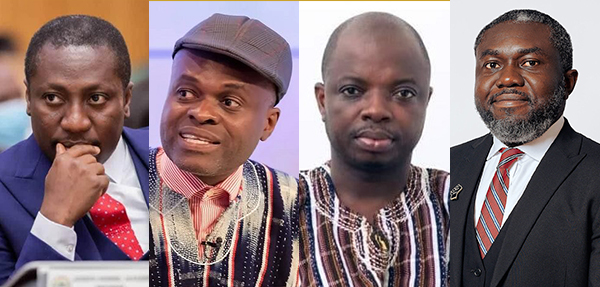
Several prominent legal figures, including Minority Leader, Alexander Afenyo-Markin, private legal practitioner Martin Kpebu, and civil rights activist Oliver Barker-Vormawor, have sharply criticised the decision to detain the New Patriotic Party’s (NPP) Bono Regional Chairman, Kwame Baffoe, alias “Abronye DC”.
Abronye was remanded by an Accra Circuit Court for a further week on Friday, 12 September 2025, to allow police to continue investigations into charges of publication of false news and offensive conduct conducive to the breach of the peace.
He is scheduled to reappear in court on Friday, 19 September.
The charges stem from allegations that Abronye, during a live television programme on 3 September, claimed that the ruling National Democratic Congress (NDC) held strategic meetings in Akwatia with the Inspector General of Police (IGP) in attendance.
He is also alleged to have described IGP Christian Tetteh Yohuno as the “most corrupt” police chief in the country’s history. Abronye has pleaded not guilty.
Moving a bail application, counsel for the accused, Minority Leader Afenyo-Markin, argued that his client was a public figure with deep social, political and economic ties in Ghana, who posed no risk of absconding. He therefore prayed the court for self-recognition bail.
The prosecution, however, opposed the application, citing “strong intelligence” and video evidence in their possession relating to national security. They argued that releasing Abronye could compromise investigations and urged the court to remand him for two weeks to enable a forensic review of the evidence.
Presiding Judge Samuel Bright Acquah rejected the bail application and remanded the accused, stressing that freedom of speech must be exercised responsibly.
“Freedom of speech goes with responsibility, and if the citizens do not set standards for themselves, the court will do that,” he ruled. “We should put in place policies to check the politics of insult.”
Addressing journalists after the proceedings, Afenyo-Markin questioned the rationale for holding Abronye in NIB custody rather than police cells.
“The police invited him on Monday, September 8. He went with his lawyers and submitted himself to interrogations. Within an hour, he was whisked into NIB custody,” he recounted.
He added, “Our checks at the NIB confirm they are not interrogating him and are not investigating him. They are only the recipient of the man, Abronye, at the request of the police. So the question is, why would the Ghana Police Service claim to be investigating a person and rather decide to send him to NIB cells? Is it to punish him?”
Private legal practitioner Martin Kpebu described the detention as disproportionate and urged NPP leadership to intervene directly with the IGP.
“This is a small offence that somebody in the position of a regional chairman is not likely to abscond. If senior NPP figures go to beg the IGP, this case can be withdrawn,” he said in a radio interview.
Civil rights activist Oliver Barker-Vormawor went further, accusing the IGP of misusing state resources to pursue a personal vendetta. He argued that if the police chief considered Abronye’s comments defamatory, he should pursue civil litigation rather than deploy criminal prosecution.
“Using the police to settle personal insults, and now creating ridiculous visual imagery as if he is some war criminal or Hannibal Lecter, is causing unnecessary attention and disaffection for the Government,” Barker-Vormawor wrote on social media.
The case has drawn senior NPP figures to the court in support of Abronye, including former National Chairman Freddie Blay, National Youth Organiser Henry Nana Boakye, and former Attorney-General Godfred Dame.
Observers say the matter highlights Ghana’s increasing tension between safeguarding free speech and limiting inflammatory rhetoric in a more polarised political climate.
Meanwhile, the Circuit Court Judge, Samuel Bright Acquah, has come under criticism for his choice of words while remanding Abronye DC into custody for one week.
In his ruling, Judge Acquah explained that while the charges were misdemeanours, the remarks attributed to Abronye had implications for national security and public order.
“It is always said that all persons are equal, but in practice, it is not so. Courtesy George Orwell in his book Animal Farm, one of the commandments is that all men are equal, but some are more equal than others. Translated into this case, all men are equal, but some are more equal than others,’ he noted.
Judge Acquah stressed that freedom of expression in Ghana must be exercised responsibly, cautioning that unchecked insults could “pollute society” and undermine national security.
The judge defended his ruling by pointing to consistency in past cases.
“One of the codes of ethics for judges is that their decisions should be consistent. I have a case before me, The Republic v. Raphael Okai Ankrah, who appeared on May 16, 2023.
He was an NDC sympathiser who openly insulted then-President Nana Addo Dankwa Akufo-Addo and was given a two-week remand.
“Just about two or three weeks ago, another matter before me, The Republic v. Emmanuel
“Just about two or three weeks ago, another matter came before me, The Republic v. Emmanuel Kwakye, a journalist from Wontumi TV, and he was also remanded for two weeks. So, under two different regimes, the court has been consistent, and the court does not see why it should deviate from that consistency,” Judge Acquah explained.
The judge added that while criticism of policies is acceptable, direct insults against individuals in authority are not. Citing Section 96(5)(a) and (c) of the Criminal and Other Offences (Procedure) Act, he said bail could be refused if there is a likelihood of the accused repeating the offence or failing to appear in court.
Judge Acquah ordered that Abronye be remanded into the custody of the National Intelligence Bureau (NIB).
The case will be recalled on September 19, 2025, when Abronye’s lawyers are expected to renew their bail application.