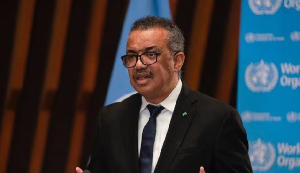
Africa is bleeding far more wealth than it receives in aid, the Director-General of the World Health Organisation (WHO), Dr Tedros Adhanom Ghebreyesus, has cautioned, describing the situation as a major barrier to the continent’s health and economic independence.
Speaking at the Africa Health Sovereignty Summit held in Accra, Dr Ghebreyesus drew attention to the stark financial paradox confronting the continent: while Africa received $74 billion in aid in 2023, it lost $90 billion to illicit financial flows and another $55 billion to corporate tax exemptions in the same year.
“We cannot ignore the broader economic context. In 2023, Africa received $74 billion in aid but lost $90 billion to illicit financial flows and $55 billion to corporate tax exemptions,” he told summit participants.
The WHO chief stressed that charity alone will not solve Africa’s systemic health challenges. Instead, he called for urgent financial reforms, including overhauls to tax systems, public resource management, and global financial rules that continue to disadvantage developing economies.
He noted that up to 17% of budgets in low- and middle-income countries go unspent due to weak financial systems, while debt servicing continues to strip national budgets of funds that could have gone into health, education, and infrastructure.
More Read
On the role of external funding, Dr Ghebreyesus said:
“Private and philanthropic capital are important, but they must complement, not replace, Africa’s public financing. What’s more important is how effectively the money is used.”
His comments reflect growing frustration among African leaders and health advocates over the outflow of capital from the continent, often through legal and illegal channels that deprive countries of the means to invest in their own development.
The WHO chief urged governments to rethink their dependency on aid and instead push for equitable trade and tax systems, alongside stronger domestic resource mobilisation. He added that health sovereignty must go hand-in-hand with financial sovereignty, if Africa is to truly take charge of its development agenda.
The Accra summit, which brought together heads of state, policymakers, development partners, and health experts, focused on reimagining Africa’s place in the global health architecture. A central theme throughout the event was the call for African countries to assert control over both health and economic decision-making.
Dr Ghebreyesus’ remarks have added momentum to what many now see as a continental push for reform of global financial and aid systems, to better reflect Africa’s needs, contributions, and aspirations in the 21st century.