The Minister for Lands and Natural Resources, Emmanuel Armah-Kofi Buah, has announced that miners will no longer be allowed to operate in any district without approval from a district-level committee, as government intensifies efforts to tighten oversight of mining activities and curb illegal mining.
He explained that the move is also intended to address situations where individuals or groups from other regions enter a district and claim ownership of land or present permits to undertake mining activities without proper local authorisation, a practice government says it is determined to eliminate through the establishment of District Mining Committees.
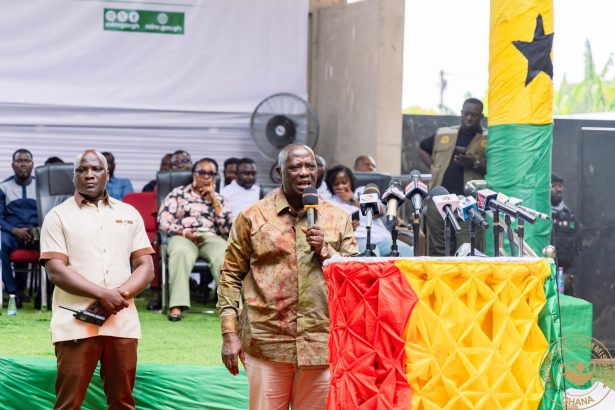
Speaking at the launch of the Responsible Cooperative Mining and Skills Development Programme (rCOMSDEP) in New Abirem in the Eastern Region on Monday, 8 June 2026, the minister said the new arrangement will ensure that local communities play a central role in decisions regarding mining operations within their jurisdictions.
According to him, prospective miners will be required to obtain a recommendation from a District Mining Committee before permits are issued by the Environmental Protection Agency (EPA) and the Minerals Commission.
Armah-Buah said the initiative forms part of government’s broader strategy to address illegal mining through regulation, community participation and economic empowerment.
He identified rCOMSDEP, the National Anti-Illegal Mining Operations Secretariat (NAIMOS), the Blue Water Guard Initiative, and District Mining Committees as key interventions being deployed to tackle illegal mining.
The minister also announced the rollout of a Cooperative Mining Scheme at Akyem Kotoku in the Eastern Region as part of efforts to formalise small-scale mining and promote responsible practices.
A key feature of the scheme is the introduction of the Gold Katcha machine, which will be deployed at Akyem Kotoku as the first beneficiary site. The equipment is designed to improve gold recovery rates—up to about 98 percent according to the minister—while reducing losses associated with traditional mining methods and minimising environmental impact.
He explained that Birim North has been designated as the first beneficiary district for the deployment of the Gold Katcha machine due to its significance as one of the country’s major mining areas.
The minister described rCOMSDEP as a practical alternative to illegal mining, noting that it will provide training, certification and modern equipment to help miners operate responsibly and profitably.
According to him, the introduction of modern equipment under the programme is expected to improve efficiency and reduce wastage in mining operations.
Armah-Buah further disclosed that President John Dramani Mahama has fully endorsed the initiative and supports increased Ghanaian participation in the mining sector.
He said government is encouraging Ghanaians interested in mining to take advantage of the programme, while introducing a medium-scale mining category for operators seeking to expand their activities.
The minister added that he has directed the Environmental Protection Agency (EPA) and the Minerals Commission to facilitate certification for individuals who have completed training under the programme.
The Eastern Regional Minister, Rita Akosua Adjei Awatey, commended the initiative, describing it as a major step towards reducing unemployment and formalising small-scale mining.
She assured participants that miners who complete training and obtain certification would be recognised as legitimate operators.
The National Coordinator of rCOMSDEP, Ama Mawusi Mawuenyefia, said some residents of Birim North had already undergone training, adding that participating communities would also benefit from a development fund financed through mining proceeds.
According to her, the fund will support community development projects and ensure that mining communities directly benefit from resources extracted from their lands.
The programme is expected to be rolled out nationwide as part of efforts to formalise the mining sector, improve environmental compliance and create sustainable livelihoods in mining communities.
The Paramount Chief of the Akyem Kotoku Traditional Area, Oseadeeyo Dr Frimpong Manso IV, welcomed the initiative, describing it as a timely intervention that could transform livelihoods and promote responsible mining practices.
He assured government of the full support of the Akyem Kotoku Traditional Council in the implementation of the programme and urged residents to comply with its regulations.