
…As NACOC tightens airport security, repairs scanners & acquires more sniffer dogs
A high-powered security delegation from Lebanon is expected in Ghana for further investigations into the seizure of 46.7 kilogrammes of cocaine at Beirut’s Rafic Hariri International Airport, following the arrest of a Syrian national who travelled from Accra with the illicit consignment.
The Herald has gathered that the visit forms part of ongoing joint investigations between Ghana’s Narcotics Control Commission (NACOC) and Lebanese security authorities to establish the full circumstances surrounding the shipment and identify individuals suspected of facilitating the movement of the drugs through Ghana’s main international airport.
The latest controversy follows the arrest of a Syrian national, identified only by his initials, B.H., at Beirut’s Rafic Hariri International Airport on Saturday, October 31, 2026.
The suspect reportedly arrived from Accra aboard Middle East Airlines flight MEA 576, carrying two suitcases containing 46.7 kilogrammes of cocaine.
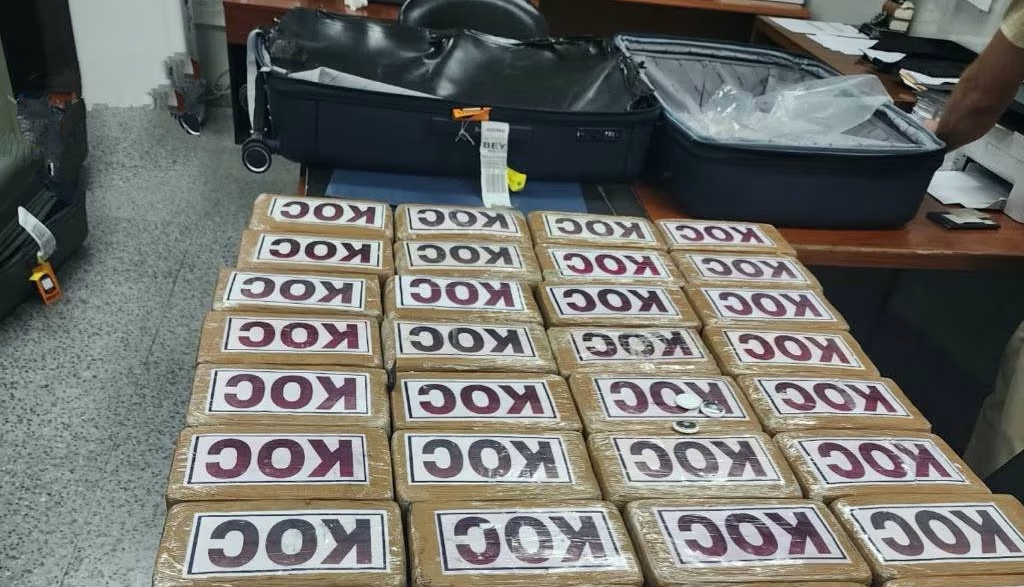
The impending visit comes amid growing public concerns over security lapses at the Kotoka International Airport (KIA), particularly how the substantial quantity of cocaine allegedly passed through security checks in Accra before being intercepted in Beirut.
Information available to The Herald suggests that Ghanaian security authorities are awaiting the outcome of the joint investigations before making comprehensive disclosures about the circumstances surrounding the operation.
Sources familiar with the matter indicated that the Lebanese delegation’s engagement with Ghanaian investigators would help establish the identities of persons connected to the shipment, the methods employed by the trafficking network and the possible involvement of local collaborators.
The investigations are also expected to examine allegations of bribery and possible security breaches at the airport, although sources have cautioned against prematurely attributing responsibility to NACOC.
According to the sources, several state security and regulatory agencies operate at the airport, making it inappropriate to single out NACOC without evidence establishing the involvement of its officers.
“The speculation about bribery must be treated carefully because NACOC is not the only security agency operating at the airport. We cannot conclude that NACOC officers were involved without establishing the facts,” a source familiar with the investigations told The Herald.
The source indicated that high-level national security consultations were also being pursued in connection with the incident, as authorities sought to strengthen coordination and determine the appropriate response.
The Herald has also learnt that Ghanaian officials are concerned about the impression created by the initial announcement from Lebanese authorities, which credited their Customs and General Security agencies with the seizure without acknowledging NACOC’s reported involvement in the operation.
NACOC has maintained that the arrest resulted from a coordinated controlled delivery operation involving Ghanaian and Lebanese authorities, intended to identify individuals operating within a wider international drug trafficking network.
A controlled delivery is an investigative technique in which law enforcement agencies permit a suspected illicit consignment to proceed under surveillance to identify the persons involved in its transportation, receipt and distribution.
Sources explained that although participating countries may agree on the operational arrangements, the authorities in the destination country retain control over their public communications.
Consequently, a foreign agency’s failure to acknowledge Ghana’s contribution does not necessarily mean Ghanaian authorities played no role in the operation.
The sources recalled a similar incident in 2020 when NACOC reportedly collaborated with security authorities in the United Kingdom on a controlled delivery operation intended to expose members of an international drug trafficking organization.
According to the account, NACOC had agreed with its British counterparts to allow the consignment to proceed under surveillance to facilitate the identification of individuals connected to the trafficking network.
However, UK Customs and Border Force officers subsequently intercepted the drugs, reportedly arguing that the quantity involved was too substantial to risk allowing it to enter circulation.
The British authorities allegedly announced the interception without acknowledging NACOC’s contribution to the intelligence and operational arrangements.
The sources argued that the Beirut incident should therefore not be interpreted solely on the basis of the Lebanese authorities’ initial public statement.
They maintained that the full extent of Ghana’s involvement would become clearer after the joint investigations concluded.
But in the meantime, The Herald has gathered that the government, working through the relevant security agencies, is taking steps to strengthen narcotics detection capabilities at the airport.
The measures include the procurement of additional sniffer dogs, the repair of defective scanning equipment, and the acquisition of more scanners to improve the screening of passengers, baggage, and cargo.
Sources disclosed that some scanners previously reported to have been tampered with have undergone repairs, while arrangements are being made to procure additional equipment to address existing security vulnerabilities.
The government is also seeking to expand the deployment of trained narcotics detection dogs to improve the identification of concealed drugs and other prohibited substances.
The renewed security measures follow concerns about the effectiveness of existing surveillance and screening arrangements, particularly in sensitive areas of the airport.
Information reaching The Herald suggests that attention is increasingly being directed towards activities around food vending operations and private jet terminal facilities, which have emerged as areas of concern in discussions about airport security.
Security officials are understood to be examining how access to these areas is regulated and whether existing arrangements provide sufficient safeguards against exploitation by criminal networks.
The sources, however, stressed that the ongoing security review should not be interpreted as evidence that individuals operating in those areas were involved in the Beirut shipment.
According to a statement issued by Lebanon’s General Directorate of Customs on Sunday, November 1, officers discovered 40 packages of cocaine concealed in the passenger’s luggage.
The drugs had reportedly been wrapped in sophisticated packaging and insulation materials designed to evade detection by airport scanning equipment.
Investigators also discovered electronic tracking devices concealed inside the packages, suggesting that those behind the shipment had taken additional measures to monitor the movement of the consignment.
Lebanese Customs described the seizure as the largest cocaine interception recorded at Beirut’s international airport.
Preliminary investigations indicated that the suspect had entered Lebanon through the Masnaa border crossing several weeks before travelling to Accra and subsequently returning with the drugs.
Investigators believe he had been recruited to transport the consignment to Lebanon for delivery to another individual at a designated location.
Lebanese authorities have consequently launched efforts to identify the intended recipient and other individuals connected to the suspected trafficking organization.
Lebanese Prime Minister Nawaf Salam has congratulated the country’s General Security and Customs authorities for the operation, describing it as an important achievement in the fight against international drug trafficking.
In a statement published on X through the Grand Serail, the Prime Minister pledged that Lebanon’s land, sea, and air borders would not be allowed to serve as routes for drug trafficking, money laundering, and other illegal activities.
He also promised stronger border controls, improved intelligence-sharing and closer cooperation among security agencies to dismantle organized criminal networks.
The Lebanese authorities’ announcement, however, did not mention Ghana’s reported participation in the operation, a development that has generated questions about the exact nature of the cooperation between the two countries.
NACOC’s position is that the operation was deliberately coordinated to facilitate the identification of individuals beyond the courier who physically transported the drugs.
The Beirut seizure has once again placed Ghana’s international airport and the country’s broader border security arrangements under scrutiny.
It comes barely months after the seizure of nearly four tonnes of cocaine at the Port of Dunkirk in France, with an estimated street value of €225 million.
That consignment, which was linked to a shipment originating from Ghana, triggered investigations involving Ghanaian security agencies and their European counterparts.
The Dunkirk case has also raised questions about the possible activities of international drug trafficking syndicates operating through Ghana’s ports and other entry and exit points.
The latest Beirut incident has intensified concerns about whether criminal organizations are exploiting weaknesses in cargo inspection, passenger screening and inter-agency coordination.
Security analysts have argued that the recurring interceptions of substantial quantities of cocaine linked to Ghana underscore the need for sustained investment in intelligence gathering, modern detection equipment and closer international law enforcement cooperation.
However, the circumstances surrounding the Beirut seizure also highlight the distinction between an uncontrolled security breach and a controlled delivery operation deliberately undertaken by law enforcement agencies.
If NACOC’s account is substantiated, the movement of the consignment from Accra to Beirut would form part of an intelligence-led investigation rather than necessarily representing a failure to detect the drugs.
Nevertheless, questions remain about the level of surveillance maintained over the shipment, the agencies involved in authorizing its movement, and the safeguards adopted to prevent the consignment from disappearing into criminal distribution channels.
For now, the expected arrival of the Lebanese security delegation is likely to be critical in establishing what happened, identifying possible Ghanaian accomplices, and determining whether any security personnel compromised the operation.
Until the joint investigations are completed, allegations of bribery, official complicity and security failures remain unproven.
The Herald understands that Ghanaian security authorities are keen to establish the full facts before drawing conclusions, as pressure mounts for greater accountability and tighter controls at the country’s international gateways.