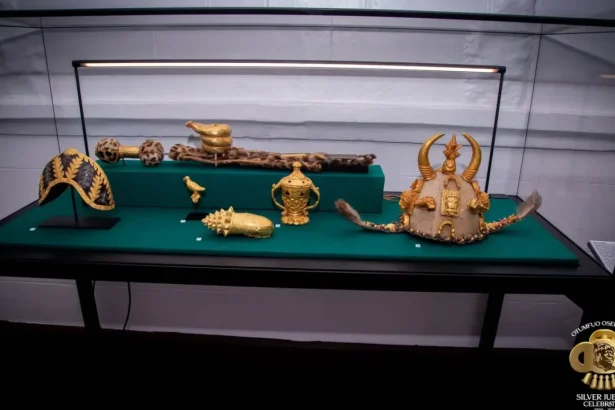
The British Museum has agreed to extend the loan of 15 pieces of Asante royal regalia to the Manhyia Palace Museum in Kumasi for another three years.
The extension will take effect when the current agreement expires in April 2027, allowing the historically significant artefacts to remain in Ghana under an arrangement that has brought them to the country for the first time in more than a century.
The renewal was announced following a visit to Kumasi by British Museum Director Nicholas Cullinan, who was invited by the Asantehene, Otumfuo Osei Tutu II.
The artefacts are on display at the Manhyia Palace Museum as part of its Homecoming exhibition, giving Ghanaians an opportunity to see some of the royal objects for the first time in about 150 years.
One of the items is a small gold ornament shaped like a lute-harp, known as sankuo.
The object was among gold artefacts presented to British diplomat Thomas Bowdich in 1817 during his visit to Kumasi to negotiate a trade treaty with the Asantehene, Osei Bonsu.
Bowdich said the objects were intended as gifts for the British Museum and represented the wealth and status of the Asante nation.
The collection also includes royal regalia associated with the Anglo-Asante conflicts of 1873–1874 and 1895–1896. Some of the objects were looted from the Asante royal palace in Kumasi and are linked to the reigns of Asantehene Kofi Karikari and Prempeh I.
The Victoria and Albert Museum in London, which has loaned 17 objects associated with the Asante royal court, is also expected to renew its agreement with the Manhyia Palace Museum under the institutions’ Renewable Cultural Partnership.
The Asantehene has highlighted the educational value of the arrangement, particularly its role in allowing Ghanaian children to experience the craftsmanship of the artefacts and learn about their history.
He also said the partnership would promote cultural understanding and create mutual benefits for the participating institutions.
Visitor numbers at the Manhyia Palace Museum have doubled over the past two years, while visits by schoolchildren have almost quadrupled, according to information accompanying the announcement.
Dr Cullinan said the partnership went beyond the exchange of artefacts, describing it as an opportunity to build relationships, share knowledge and create avenues for research and historical interpretation.
He expressed appreciation to the Asantehene and the Manhyia Palace Museum team for their continued cooperation.