The Herald ghanaThe Herald ghana
  • Home
  • General
  • Entertainment
  • Politics
  • Editorial
  • Business
  • Sports
  • Feature
  • Health
  • World
Reading: Farmer led tea seedlings production
Share
Aa
The Herald ghanaThe Herald ghana
Aa
  • Home
  • General
  • Entertainment
  • Politics
  • Editorial
  • Business
  • Sports
  • Feature
  • Health
  • World
Search
  • Home
  • General
  • Entertainment
  • Politics
  • Editorial
  • Business
  • Sports
  • Feature
  • Health
  • World
Follow US
  • Advertise
Copyright © 2022 The Herald Ghana. All Rights Reserved
Major 3World

Farmer led tea seedlings production

Published October 18, 2026 3 Min Read
Share
3 Min Read
SHARE

By Misozi Magaleta, Project Manager at Solidaridad (Southern Africa)

Smallholder tea farmers in Mulanje and Thyolo are transforming tea production in Malawi through farmer led seedling nurseries supported by the Solidaridad’s Pathways to Prosperity (P2P)  Tea Project, funded by the Dutch Ministry of Foreign Affairs.

 What started as a pilot initiative has now grown into a scalable solution that is helping farmers tackle one of the tea sector’s biggest challenges which is limited access to quality planting materials.

For years, many farmers depended on aging tea bushes that produced lower yields, were more vulnerable to pests and diseases, and struggled to cope with climate shocks such as prolonged dry spells and erratic rainfall.

 Accessing improved seedlings from institutions such as the Tea Research Foundation and private estates was often expensive and difficult because of long distances and limited supply.

More Read
Better grazing, more milk: Solidaridad helps Namwala farmers increase their dairy tanks 

Talensi MP rolls out GHC60,000 seed support, engages mining firms to boost dry season farming
Solidaridad, Kvuno, and Planboo partner to promote sustainable agriculture in Zambia through biochar technology
Solidaridad launches harmonized Cotton Extension Manual to transform farmer support in Zambia

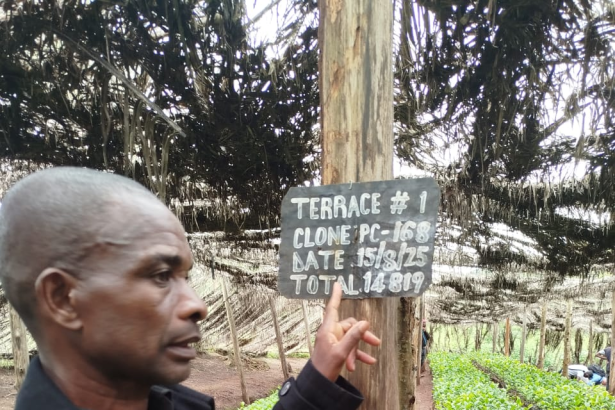
Through the P2P Tea Project, farmers have received practical training in clonal propagation, nursery management, soil and water management, pest and disease control, and the selection of climate resilient tea varieties. This support has enabled farmers to establish and manage their own nurseries while reducing dependence on external suppliers.

The results have been remarkable. During the 2025 to 2026 growing season, three farmer associations namely Chizunga, Thuchira, and Msuwazi collectively produced 200,280 seedlings. This is a major increase from the 80,000 seedlings raised during the 2024 to 2025 season, representing growth of more than 150 percent in just one year.

Approximately 2,000 farmers are expected to benefit from the increased availability of seedlings. Farmers are now able to fill gaps in their tea fields, replace old plants, and expand production areas at a lower cost and with better timing for planting seasons.

“As farmers we are proud that we can now produce our own seedlings even more than we managed in year one. This progress shows that with the right support and knowledge, we can take control of our tea farming future,” said Mr Muhilima, Chairperson of the National Smallholder Tea Growers Association.

Beyond increasing production, the initiative is creating wider social and economic impact. Individual farmers are independently establishing nurseries, creating additional income opportunities for youth and women while strengthening local farmer institutions. Farmer managed nurseries are also contributing to climate adaptation by promoting improved tea varieties that can withstand temperature fluctuations and irregular rainfall.

The initiative is proving that localized innovation and farmer ownership can strengthen resilience, improve livelihoods, and lay the foundation for a more sustainable and competitive tea sector in Malawi.


You Might Also Like

Better grazing, more milk: Solidaridad helps Namwala farmers increase their dairy tanks 

Talensi MP rolls out GHC60,000 seed support, engages mining firms to boost dry season farming

Solidaridad, Kvuno, and Planboo partner to promote sustainable agriculture in Zambia through biochar technology

Solidaridad launches harmonized Cotton Extension Manual to transform farmer support in Zambia

razak.bawa October 18, 2026
Share this Article
Facebook Twitter Whatsapp Whatsapp Copy Link
What do you think?
Love0
Sad0
Cry0
Happy0
Surprise0
Angry0
Wink0
Previous Article Africa’s population surge demands governance reforms – Lasi
Next Article SMAIR Foundation and Faithful Ajah building a legacy for Nigeria’s next-gen innovators

Stay Connected

Facebook Like
Twitter Follow
Instagram Follow
Youtube Subscribe
- Advertisement -
Ad imageAd image

Latest News

GAF spends GH¢113,800 on medical care for Baba Yara stampede victim
General Major 2 November 13, 2026
Aliko Dangote/CNG Truck/Bombardier Inc.
Dangote in talks to process 500,000 tonnes of cocoa in Ghana – Ato Forson
Business Major 3 November 13, 2026
GWL shuts down Owabi treatment plant after heavy rains
General Major 3 November 13, 2026
Mahama offers to mediate UTAG-GTEC dispute over university autonomy
General Major 4 November 13, 2026
CurrencyRate

You Might also Like

FeatureMajor 4

Better grazing, more milk: Solidaridad helps Namwala farmers increase their dairy tanks 

November 8, 2026
Talensi MP/Daniel Dung Mahama
GeneralMajor 3

Talensi MP rolls out GHC60,000 seed support, engages mining firms to boost dry season farming

October 17, 2025
GeneralMajor 3

Solidaridad, Kvuno, and Planboo partner to promote sustainable agriculture in Zambia through biochar technology

December 23, 2024
Major 3World

Solidaridad launches harmonized Cotton Extension Manual to transform farmer support in Zambia

December 5, 2024
Show More

Copyright © 2022-2025 The Herald Ghana. All Rights Reserved

Removed from reading list

Undo
Welcome Back!

Sign in to your account

Lost your password?