By Paul Mamattah
President John Dramani Mahama’s appointment of Dr. Joseph Kwaku Asamoah and Emelia Afi Agbenyo as Deputy Chairpersons of the Electoral Commission (EC) has reignited debate about political neutrality, institutional independence and public confidence in Ghana’s electoral process.
While the appointments bring professional experience to the Commission, Madam Agbenyo’s background as a former National Democratic Congress (NDC) manifesto spokesperson has raised concerns among opposition figures, particularly the New Patriotic Party (NPP). The NDC, however, maintains that her qualifications and integrity make her suitable for the position.
The controversy presents President Mahama’s appointees with a crucial challenge by demonstrating that their loyalty lies with Ghana’s Constitution and democratic institutions, rather than any political party.
Dr. Asamoah, a law lecturer and former EC Director of Finance, Director of the Training Centre and Head of Audit, brings considerable institutional experience to the Commission.
His involvement in the 2012 and 2016 general elections, district-level elections and the 2019 referendum on the creation of six new regions gives him practical knowledge of electoral administration.
His background in finance, auditing and training could help strengthen internal controls, improve staff capacity and promote accountability in the management of electoral resources.
Madam Agbenyo brings a different set of skills. A development professional, she previously served as Deputy Director-General of Operations at the Ghana TVET Service and as a Commissioner of the National Development Planning Commission.
Her experience in public policy, operational management, skills development and gender transformation could contribute to improved coordination, stakeholder engagement and more inclusive electoral planning.
Together, the two deputies offer complementary expertise that could strengthen the Commission’s administrative effectiveness.
However, their professional credentials must be matched by impartial conduct and transparent decision-making.
The appointment of the two deputies has been presented as an opportunity to strengthen confidence in the Commission. But neutrality cannot be achieved simply by appointing new officials. It must be demonstrated through decisions that are fair, consistent and free from partisan influence.
Madam Agbenyo’s former association with the NDC does not automatically mean she will act in the party’s interest. Equally, her qualifications alone cannot eliminate public concerns about perceived political influence.
Dr. Asamoah must also demonstrate that his institutional experience translates into independent leadership and accountability.
The real test is whether both officials can defend decisions based on the law, even when those decisions are unpopular with the government or the opposition.
Their appointments could help strengthen internal oversight, improve administrative procedures and encourage more transparent electoral management.
However, the goal should not be to balance one perceived partisan influence against another. It should be to ensure that no political party can improperly influence the Commission’s work.
The debate has revived memories of the opposition that greeted former President Akufo-Addo’s appointment of three EC members in March 2023, particularly Dr. Peter Appiahene and Hajia Salima Ahmed Tijani, whose reported links to the NPP attracted criticism and calls for their resignation.
The similarity between the two controversies has raised questions about political double standards. Parties that criticise appointments made by their opponents must be prepared to apply the same standards when they assume power.
The appropriate test should be whether appointees possess the necessary competence, satisfy applicable legal requirements and demonstrate independence in carrying out their responsibilities.
Public scrutiny is legitimate, especially when the credibility of elections is at stake. But concerns should be addressed through consistent standards and evidence rather than partisan accusations alone.
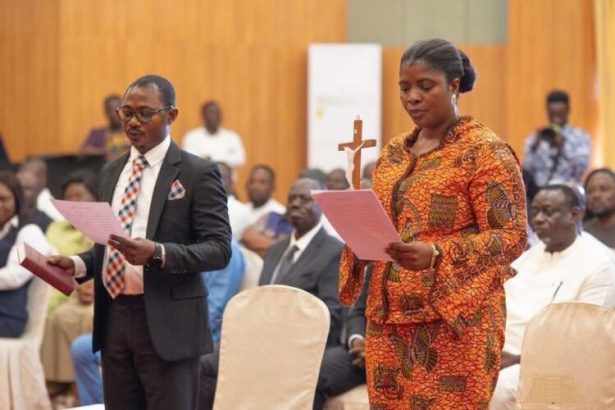
President Mahama, during the swearing-in ceremony, charged the two deputies to uphold integrity and impartiality and work with EC Chairperson Jean Mensa to ensure free, fair and transparent elections.
As Ghana approaches the 2028 general elections, the Commission must translate that commitment into practical reforms.
Priority areas include transparent management of the voter register, reliable results collation, effective staff training, accessible public communication and fair procedures for addressing electoral complaints.
The EC should also strengthen engagement with political parties, civil society organisations and election observers. Explaining decisions clearly and responding promptly to legitimate concerns can reduce suspicion and help prevent administrative problems from developing into wider disputes.
Dr. Asamoah’s experience in auditing and finance could support stronger internal controls, while Madam Agbenyo’s operational and development background could contribute to coordination and inclusive stakeholder engagement.
Nevertheless, electoral credibility is a collective responsibility involving the entire Commission, political parties, security agencies, the judiciary, the media and the electorate.
The appointments provide an opportunity for institutional renewal, but their success will depend on performance rather than promises.
Both deputies must show that their professional responsibilities take precedence over political associations.
The Commission, in turn, must operate through clear procedures, consistent standards, and transparent decisions that apply equally to every political party.
President Mahama also has a responsibility to respect the Commission’s independence and ensure that the institution can discharge its mandate without improper political interference.
Ultimately, the credibility of the appointments will be measured by whether Ghanaians have greater confidence in the electoral process when they go to the polls in 2028.
If Dr. Asamoah strengthens administrative accountability and Madam Agbenyo demonstrates impartiality beyond reasonable political suspicion, their combined expertise could help rebuild trust in the EC.
Ghana needs more than assurances of neutrality. It needs an Electoral Commission whose actions consistently demonstrate fairness, independence and integrity.
That is the real test of resetting the EC and the standard by which President Mahama’s two appointments must ultimately be judged.