Across Ghana’s landscapes, from forested headwaters to vital aquifers, environmental threats are accelerating. Climate change, pollution, and unsustainable land use are reshaping ecosystems and putting water resources at risk.
Yet beneath these challenges lies a scientific approach offering new hope: ISOTOPE SCIENCE. Isotope science, particularly stable isotope and tritium analysis, allows researchers to trace invisible processes that shape our environment.
From identifying pollution sources to calculating groundwater recharge, these tools are revolutionising how we manage and protect our natural resources.
What are Isotopes, and why do they matter?
Isotopes are naturally occurring variants of chemical elements. Isotopes of elements are like siblings of those elements. The isotope of an element has the same number of protons and electrons but a different number of neutrons than the primary form of the element.
This difference in neutrons doesn’t affect their chemical properties at all. Rather, this difference allows scientists to track and measure how the isotopes move through the environment. Environmental scientists and biologists measure ratios of stable isotopes of common elements and study these ratios of isotopes to measure biological samples and study how they cycle through the environment.
More Read
Knowledge from isotope science can help in understanding how nutrients move between ecosystems, interactions between microbes and environmental conditions, how plants allocate carbon to its roots and releases chemicals from its roots to the surrounding soil, carbon cycle, nitrogen cycle, etc.
Isotope science has applications in several scientific areas, such as public health, agriculture, environmental science, natural resources management, atmospheric and climate sciences, water resources management, etc. When used in water resources management, for example, it helps scientists to understand:
- The origin and flow of water through landscapes
- How and where groundwater is replenished
- Sources of pollution in rivers and aquifers
- Climatic trends that influence water availability
Capacity building in Isotope Science
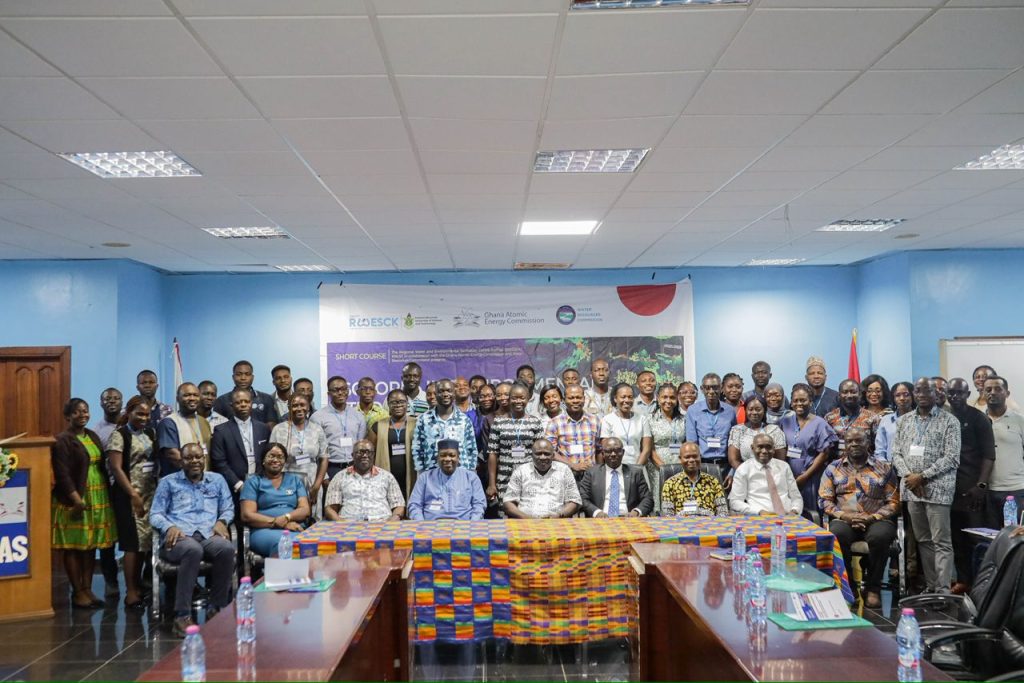
In recent training at the Ghana Atomic Energy Commission (GAEC), facilitated by the Regional Water and Environmental Sanitation Centre Kumasi of the Kwame Nkrumah University of Science and Technology (RWESCK–KNUST) and other partners, researchers gained firsthand experience using isotope science tools and techniques to reveal water’s hidden journeys.
Insights from hydrogen, oxygen, and carbon isotopes can shape real-world decisions affecting agriculture, sanitation, and climate resilience.
Relevance for Ghana’s water sector in the face of increasing pollution of waterbodies
One of the most urgent applications of isotope science in Ghana water sector is determining how our groundwater gets recharged. With many communities relying on wells and boreholes for farming, drinking, and development, it is important the groundwater sources, volumes available, safe yields, recharge capacities and water quality, among others, and also safeguard their future.
Using isotopes, water scientists can:
- distinguish whether recharge comes from rainfall, stream seepage, or deep ancient sources
- calculate groundwater “age” with tools like tritium and carbon-14, revealing whether aquifers are vulnerable or sustainable
- Identify zones at risk of over-extraction or contamination
Isotope science is critical at this time for Ghana. It is highly needed because of the growing threats of pollution of our water resources, especially from illegal mining happening in and around our waterbodies. Illegal mining (galamsey) and poorly regulated extractive practices are degrading water bodies at an alarming rate. Rivers are polluted, aquifers are compromised, and communities are left without safe water. By deploying isotope tracers, researchers can:
- pinpoint pollution sources in complex watersheds
- assess how contaminants travel through surface and groundwater systems
- monitor restoration efforts and hold polluters accountable
This is not abstract science; it’s essential for public health, food security, and long-term sustainability.
Call to action
To make progress, Ghana’s leaders must act decisively. Isotope research is underfunded and undervalued despite its immense potential. Here’s what must happen:
- Government ministries (Environment, Sanitation, Agriculture, Water Resources) should integrate isotope monitoring into their programs and invest in laboratory infrastructure
- Funding agencies should prioritize grants that use isotope techniques in climate-smart and water-related projects
- Universities and research institutes should expand interdisciplinary training to build national expertise
- International partners like the European Union can provide technical support and foster knowledge-sharing
Conclusion
To make the most we can get from isotope science, Ghana needs collaboration, sustained investment, and national policy recognition of isotope science as a cornerstone of Ghana’s environmental strategy. Science is not a luxury, it is our strongest ally in adapting to climate change and reversing environmental degradation. Isotope techniques make the invisible visible. They empower researchers, communities, and governments to protect what truly matters: clean water, resilient agriculture, and a sustainable future.
Let Ghana lead Africa in applying advanced science to local solutions. The time to invest, collaborate, and act is now.
Acknowledgement:
The short course forms part of capacity building initiatives under the ACEWATER III project being implemented by RWESCK-KNUST under the auspices of the AUDA-NEPAD African Network of Centres of Excellence in Water Sciences, with financial support from the European Commission. The ACEWATER project has a mission to develop the next-generation water and environment experts that will adequately respond to the water quality challenges in the sub-region, positively influencing the nexus between academia-industry-government for socioeconomic development of the African Continent.
About the author:
Juliet GYAMPOH is with the Office of Grants and Research of the Kwame Nkrumah University of Science and Technology (OGR-KNUST). She is a water scientist with an MSc in Water Resources Engineering and Management from the Regional Water and Environmental Sanitation Centre Kumasi of the Kwame Nkrumah University of Science and Technology (RWESCK–KNUST).