…As Wassa Fiase & Apinto Chiefs bare teeth
The future of Gold Fields Ghana Limited’s operations at the Tarkwa Gold Mine in the Western Region has come under intense scrutiny, as chiefs and queen mothers of the Wassa Fiase Traditional Area have called on President John Dramani Mahama to reject the renewal of the South African mining company’s leases when they expire in April 2027.
The traditional leaders want the government to take control of the lucrative gold mine and subsequently hand its operations to a competent indigenous Ghanaian investor, arguing that decades of gold extraction have failed to translate into meaningful development for the communities that bear the environmental and social consequences of mining.
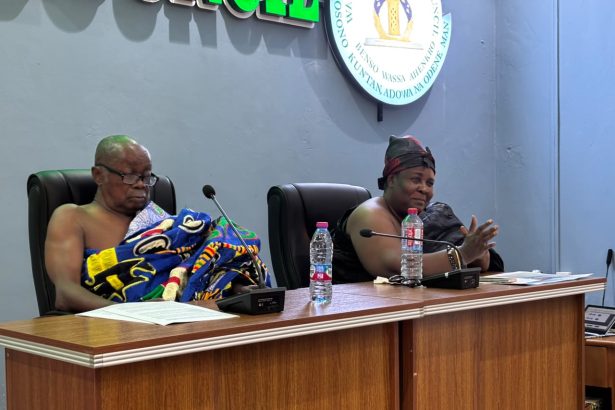
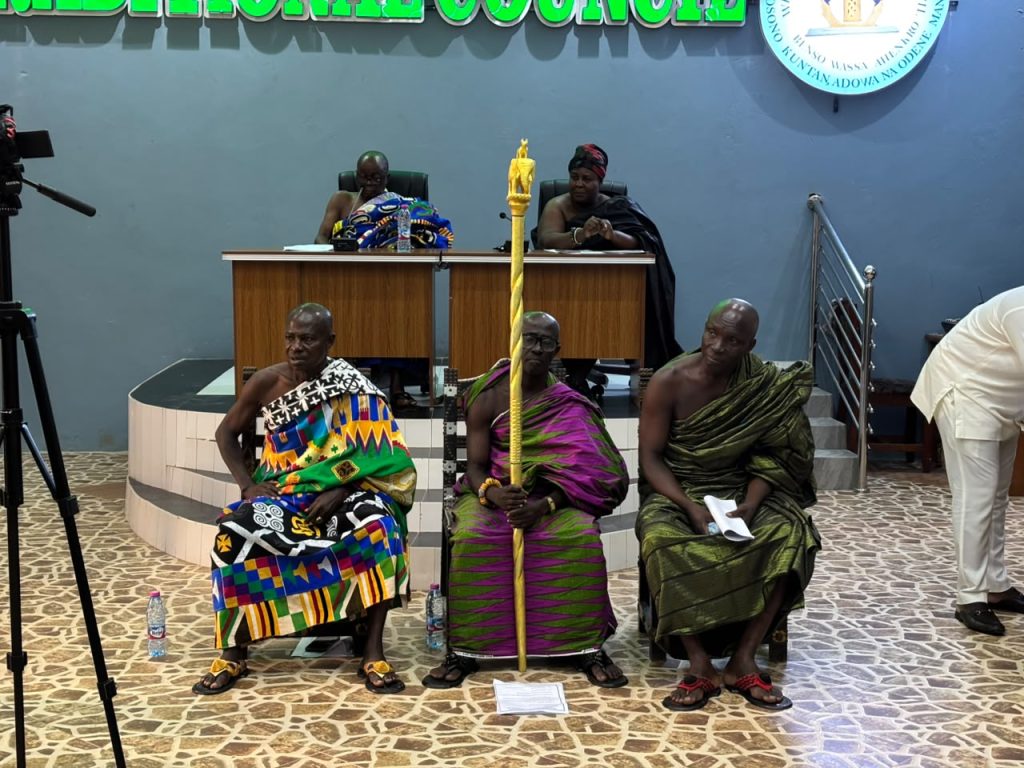
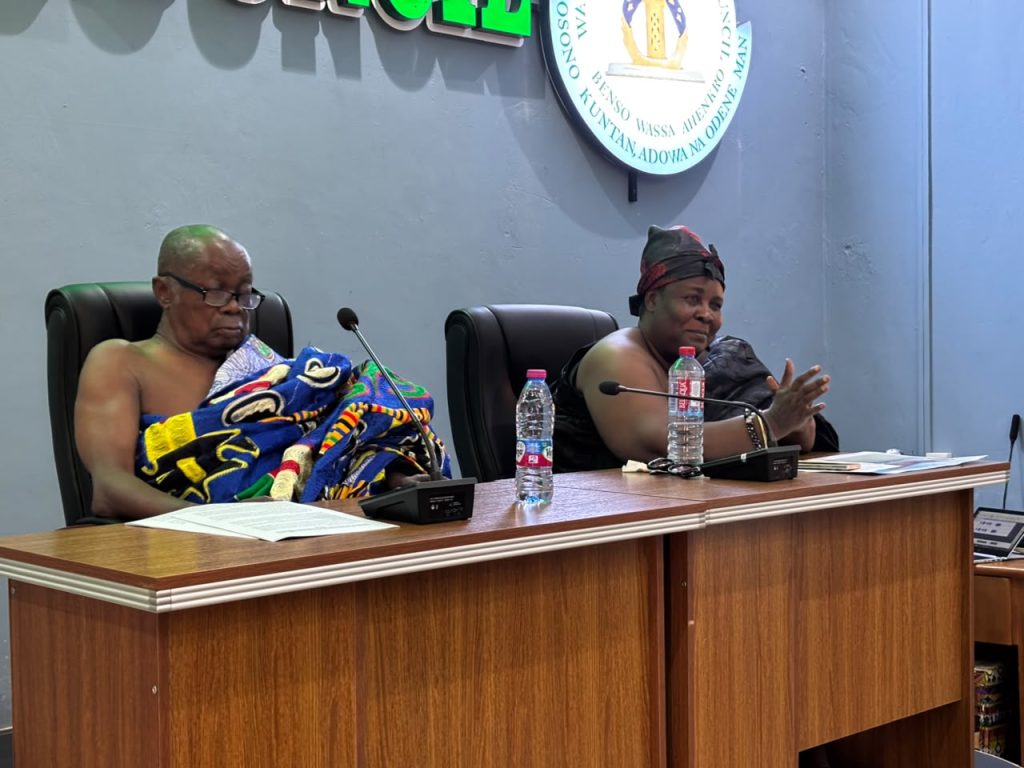
The demand was made at a general meeting of the Wassa Fiase Traditional Council on Wednesday, 4 November 2026, where divisional chiefs and queen mothers expressed frustration over what they described as the inadequate benefits accruing to their communities despite the enormous wealth generated from gold mining.
Their concerns centred on the poor state of roads, inadequate social infrastructure, insufficient corporate social responsibility (CSR) projects and delays in the payment of royalties due to the traditional authorities.
More Read

The meeting, which also discussed land-related matters and other developmental challenges confronting the traditional area, saw the chiefs rally behind calls for the indigenization of Gold Fields’ Tarkwa operations.
The Herald has gathered that the growing opposition to the company’s continued control of the mine is partly being driven by a new generation of highly educated and financially independent traditional rulers who are increasingly demanding transparency and accountability in the management of mineral resources within their jurisdictions.
Unlike in previous years, when some traditional authorities were perceived as being more interested in the immediate financial benefits associated with mining royalties, several of the current chiefs and queen mothers are professionals, including holders of doctoral degrees, who are capable of independently scrutinizing financial statements, mining agreements and corporate reports.
Sources familiar with developments within the traditional area told The Herald that the educational backgrounds and professional experience of these traditional leaders, some of whom are lecturers, have significantly changed the dynamics of their relationship with the mining company.
According to the sources, many of the chiefs are gainfully employed and are therefore less dependent on royalties for their personal upkeep, allowing them to focus more attention on the long-term development of their communities as well as their people.
This emerging leadership, the sources explained, is increasingly interested in examining the financial performance of mining companies, the revenues generated from mineral extraction and the proportion of those earnings invested in host communities.
The development is said to be presenting fresh challenges to Gold Fields, whose operations in the Tarkwa enclave have spanned more than three decades.
Leading the calls for a change in ownership was the Queen Mother of the Wassa Fiase Traditional Area, Nana Abena Konadwoa II, who expressed disappointment over what she considered the company’s inadequate contribution to the development of communities within its operational areas.
She questioned why communities that had hosted large-scale mining activities for decades continued to struggle with poor roads, inadequate healthcare facilities and other infrastructure deficits.
According to her, repeated appeals to the mining company for assistance in addressing some of these challenges had failed to produce the desired results.
The Queen Mother drew attention to Gold Fields’ financial performance in 2025 and the first half of 2026, questioning whether the company’s investments in community development and royalties reflected the scale of its mining activities.
Although she did not provide specific figures at the meeting, she maintained that the benefits received by the traditional area were insufficient when measured against the wealth extracted from its lands.
Nana Abena Konadwoa II argued that communities hosting major mining operations should not remain deprived of basic infrastructure while substantial revenues were being generated from the natural resources beneath their lands.
She consequently appealed to President Mahama to intervene and ensure that the expiry of the company’s mining leases provided an opportunity for a new ownership arrangement that would prioritize Ghanaian participation and local development.
The Queen Mother also cited developments within the Damang mining enclave following the transfer of the Damang Gold Mine to Ghanaian ownership.
She referred to road and hospital projects, an astroturf facility and an airport project associated with the Damang area as examples of the investments she believed could be pursued under indigenous ownership.
According to her, such initiatives demonstrated the potential for Ghanaian investors to combine commercial mining activities with meaningful investments in the communities where they operate.
She therefore urged the government to consider a similar arrangement for the Tarkwa mine when the existing leases expire.
The Queen Mother’s position received support from several divisional chiefs, who argued that the time had come for Ghana to exercise greater control over its mineral resources.
Among the traditional leaders who endorsed the proposal were Nana Kwabena Gyan II, Nana Sompreh, Divisional Chief of Bogoso, and Nana Nteboah Prah, Divisional Chief of Prestea-Heman.
Other traditional leaders, including Nana Kwandoh II and Nana Kwandoh Brempong II, were also identified among the chiefs associated with discussions on the future of mining operations in the traditional area.
The chiefs maintained that transferring the mine to a capable indigenous investor would provide an opportunity to establish a more beneficial relationship between mining operators and host communities.
They argued that Ghanaian ownership, backed by appropriate government supervision and clearly defined developmental obligations, could help ensure that a greater proportion of the wealth generated from the mine remained within the national economy.
The traditional authorities also stressed the need for any future operator to demonstrate financial capacity, technical expertise and a commitment to environmental protection and community development.
Their position reflects growing demands for greater Ghanaian participation in the ownership and management of the country’s mineral resources.
Meanwhile, the Apinto Divisional Council, within whose traditional jurisdiction the Tarkwa Gold Mine is located, has separately petitioned the government to reject the renewal of Gold Fields Ghana Limited’s mining leases.
The petition calls for the concession to be transferred to a capable Ghanaian investor who would operate the mine while making substantial investments in the surrounding communities.
The Council believes that the expiry of the leases presents an opportunity for the government to review the existing ownership structure and consider an arrangement that would deliver greater economic and developmental benefits to the country.
The Apinto Divisional Council’s position reinforces the broader demand by the Wassa Fiase Traditional Council for a fundamental change in the management of the mine.
During Wednesday’s meeting, Nana Adu Panyin of the Apinto Divisional Council also raised concerns about delays in the payment of royalties due to the traditional authorities.
Responding to the concerns, the Registrar of the Traditional Council explained that the royalty payments had been deposited into an account but could not be disbursed immediately because of an ongoing land dispute.
The Registrar indicated that the funds would be released once the dispute had been resolved. The explanation notwithstanding, the discussions highlighted growing concerns among traditional authorities over the administration and distribution of revenues associated with mining activities.
The Tarkwa Gold Mine is one of Ghana’s major gold-producing operations and remains an important asset in Gold Fields’ international mining portfolio. The mine operates under five mining leases dated 18 April 1997, covering approximately 20,825 hectares in the Western Region.
The leases are expected to expire in April 2027, placing the future of the operation at the centre of an emerging debate involving the government, traditional authorities, host communities and the mining company.
Gold Fields currently holds a 90 percent interest in the Tarkwa operation, while the Government of Ghana retains the remaining 10 percent. The company’s involvement in the mine dates back to 1993, when it entered into a management arrangement with the Rawlings government.
The first phase of the mine’s open-pit development was completed in 1998, followed by the closure of underground operations in 1999 as the company expanded its surface mining activities.
In 2011, Gold Fields increased its ownership interest to 90 per cent after acquiring IAMGold’s 18.9 per cent stake.
The mine currently operates four large open pits and has a processing plant with a capacity of approximately 13.5 million tonnes of ore annually.
Over the years, the operation has undergone several expansions and technological changes, including the introduction of carbon-in-leach processing facilities and a return to contractor mining in 2018.
Mining activities in the Tarkwa area date back to the 1930s, making the enclave one of Ghana’s longest-established gold-producing centres.
Despite this long history, the traditional authorities insist that the economic transformation of the surrounding communities has not matched the scale and value of the resources extracted.
The demands by the Wassa Fiase chiefs come against the backdrop of the government’s decision to transfer the Damang Gold Mine to Ghanaian ownership.
That development has intensified discussions about the possibility of increasing indigenous participation in the country’s large-scale mining industry.
Supporters of the proposed takeover of the Tarkwa mine believe that Ghanaian investors, given access to established mining assets and supported by appropriate regulatory arrangements, could retain more mining revenues within the domestic economy.
However, the chiefs’ proposal would require the government to consider the legal, financial and operational implications of any decision not to renew the existing leases.
The expiry of mining leases does not, by itself, necessarily transfer ownership of a company’s equipment, processing facilities and other assets to the state. Any proposed takeover would therefore have to comply with Ghana’s mining laws, applicable contractual obligations and the rights of the existing operator.
The traditional leaders nevertheless maintain that the approaching expiry provides the Mahama government with an opportunity to negotiate a new arrangement that places greater emphasis on Ghanaian ownership, employment, local procurement and infrastructure development.
For the chiefs and queen mothers, the issue goes beyond the identity of the company operating the mine.
They insist that the central question is whether the communities that have hosted mining activities for generations are receiving a fair share of the economic benefits.
With less than six months remaining before the stated expiry of the mining leases, attention is expected to turn to President Mahama and the Ministry of Lands and Natural Resources led by Armah Kofi Buah over the government’s position on the future of the Tarkwa operation.
The traditional authorities want the administration to resist any attempt to automatically renew the leases without addressing their longstanding concerns.
They are demanding a new approach that would place Ghanaian interests and the development of mining communities at the centre of decisions concerning the country’s mineral wealth.
For the Wassa Fiase chiefs, the question is no longer simply how much gold is extracted from their lands, but how much of the wealth generated is reflected in the living conditions of their people.
Their position also signals a shift in traditional leadership, with educated and professionally accomplished chiefs increasingly seeking a stronger voice in decisions involving natural resources, corporate accountability and community development.
As the April 2027 deadline approaches, the government faces a potentially significant decision over the future of one of Ghana’s most important gold mines.
Whether President Mahama will support the chiefs’ demand for state ownership and indigenous operation or allow Gold Fields to continue under a renewed lease arrangement remains to be seen.
For now, the message from the Wassa Fiase Traditional Council is clear: after decades of gold extraction, the chiefs want a new arrangement that ensures the wealth beneath their lands delivers greater and more visible benefits to the people living above it.