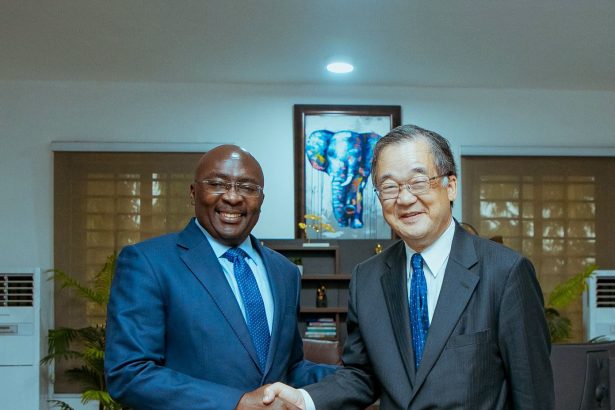
Former Vice-President and New Patriotic Party (NPP) 2028 flagbearer, Dr Mahamudu Bawumia, has turned his attention to Japan’s advanced environmental technologies, exploring innovative solutions that could help Ghana tackle illegal mining, popularly known as galamsey, and restore the country’s polluted rivers and degraded lands.
Dr Bawumia, who is currently on a study tour of Japan in the company of the NPP National Chairman, John Boadu, and others, has been visiting leading Japanese technology companies, research laboratories, and institutions to examine how scientific innovations can address some of Ghana’s most pressing developmental challenges.
On the trip with Dr. Bawumia are Ambassador Emmanuel Enos, Dr. Augustine Blay, Dr. Kwasi Nyame Baafi and Dr. Ekua Amoakoh.
In a Facebook post yesterday, Tuesday, 3 November 2026, the former Vice-President disclosed that he had visited 3R, a Japanese environmental technology company specializing in sustainable innovations, including the treatment of contaminated water and soil.
According to him, the company has developed advanced technology capable of recycling water and removing harmful heavy metals, including mercury, from contaminated soil.
The technology could be particularly relevant to Ghana, where years of illegal mining have resulted in the destruction of farmlands, forest reserves and water bodies, with mercury and other hazardous substances posing serious environmental and public health concerns.
Dr Bawumia described the technology as a potentially important intervention in Ghana’s efforts to rehabilitate areas devastated by illegal mining.
“As part of our study tour of Japan, I had the incredible opportunity to visit 3R, a cutting-edge environmental technology company leading the way in sustainable innovation,” he wrote.
“3R has developed advanced, game-changing technology capable of recycling water and cleaning contaminated soil by completely removing harmful heavy metals, including mercury.”
The former Vice-President said witnessing the technology firsthand had strengthened his conviction that scientific innovation could play a critical role in addressing Ghana’s environmental challenges.
“Seeing this innovation firsthand was truly inspiring, especially as we look for sustainable, long-term solutions to restore our lands and water bodies impacted by Galamsey,” he stated.
He expressed optimism that Ghana could overcome some of the environmental damage associated with illegal mining through the appropriate deployment of modern technology, backed by determination and long-term planning.
“Innovation like this proves that with the right technology, determination, and foresight, we can heal our environment, protect our natural resources, and secure a safer, cleaner future for generations to come,” Dr Bawumia added.
He thanked the management and technical team of 3R for granting him and his delegation access to the company’s facilities and sharing their expertise.
The visit comes against the backdrop of persistent concerns about the destruction of Ghana’s water bodies and forest reserves through illegal mining activities.
Although successive governments have introduced various interventions to combat galamsey, the restoration of already contaminated rivers and degraded lands remains a major challenge.
The use of mercury in gold extraction, particularly within parts of the small-scale mining sector, has raised concerns about the long-term implications for human health, agriculture, aquatic life and the availability of safe drinking water.
Dr Bawumia’s interest in the Japanese technology suggests that environmental restoration could feature prominently in his policy discussions as he prepares for the 2028 general election.
However, he did not indicate whether any formal agreement had been reached with 3R or whether there were immediate plans to introduce the technology into Ghana.
Beyond environmental restoration, the former Vice-President has also been exploring Japan’s achievements in artificial intelligence (AI), satellite technology and scientific research.
In an earlier Facebook post on Monday, 2 November 2026, Dr Bawumia disclosed that he had visited the internationally recognized Matsuo-Iwasawa Laboratory at the University of Tokyo.
The laboratory specializes in deep learning and generative artificial intelligence, with applications in healthcare, education, manufacturing, agriculture, and other sectors.
According to him, the visit formed part of efforts to understand how Japan translates advanced scientific research into practical solutions to everyday problems.
“On Monday, November 2, 2026, as part of our study tour of Japan to learn about their application of cutting-edge research to solving practical problems, I visited the world-famous Matsuo-Iwasawa Laboratory at the University of Tokyo,” he wrote.
He explained that the laboratory’s research focuses on deep learning and generative AI, particularly their application to critical sectors of the economy.
The visit reflects Dr Bawumia’s longstanding interest in digitalization and the application of emerging technologies to public administration, economic development and service delivery.
During his tenure as Vice-President, he championed several digitalization initiatives, including the Ghana Card, digital addressing systems and electronic platforms designed to improve access to public services.
His latest engagements in Japan appear to build on that interest, with greater attention being given to how advanced technologies can address challenges in agriculture, environmental management and disaster prevention.
Dr Bawumia further disclosed that his delegation had held discussions with leading Japanese space technology institutions and companies on the use of satellite data to address developmental challenges.
Among the institutions and firms involved in the engagements were Axelspace, Hanibashi and Cross U.
The discussions centred on the application of satellite technology to flood monitoring, deforestation, drought assessment, crop monitoring and other environmental and agricultural challenges.
These technologies could have significant implications for Ghana, where flooding, forest degradation and unpredictable rainfall patterns continue to threaten livelihoods, infrastructure and agricultural productivity.
Satellite imagery and related data analysis can support the monitoring of changes in forest cover, identify environmental degradation and provide information for agricultural planning and disaster risk management.
For Ghana, such capabilities could also complement efforts to monitor illegal mining activities, particularly in forest reserves and areas surrounding major water bodies.
Dr Bawumia said he was particularly impressed by the relationship between Japanese universities, private companies and government institutions in developing and deploying technology.
“I was particularly impressed by how closely universities, industry and government work together,” he stated.
The former Vice-President’s observations highlight the importance of collaboration between research institutions, industry and policymakers in transforming scientific discoveries into practical solutions.
His engagements in Japan also come as Ghana continues to debate how technological innovation can be harnessed to address longstanding economic, environmental and governance challenges.
While the immediate outcome of the study tour remains unclear, the visits have exposed the NPP’s 2028 presidential candidate to technologies with potential applications in environmental restoration, agricultural productivity, disaster management and public service delivery.
The tour also provides an opportunity for Dr Bawumia to broaden his technology-driven policy agenda beyond digital public services to include environmental protection, artificial intelligence and satellite-based solutions.
Whether the Japanese innovations eventually find practical application in Ghana will depend on their technical suitability, cost, institutional partnerships and the willingness of policymakers to invest in their deployment.