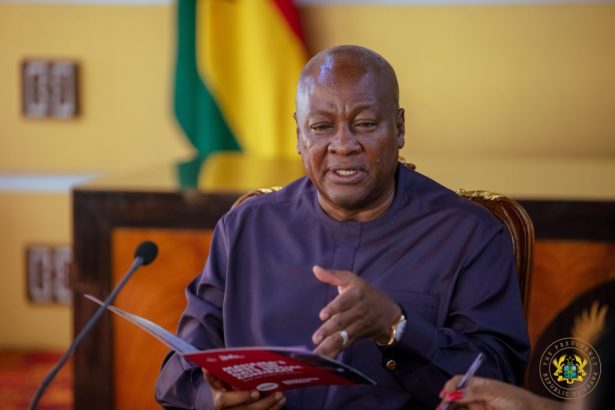
President John Dramani Mahama has announced plans to invest US$10 billion over five years in nine key sectors of the economy under a proposed New Economy Policy aimed at accelerating job creation, expanding local manufacturing and reducing Ghana’s dependence on imports.
The initiative, which will involve an annual investment of US$2 billion, is expected to target productive sectors, including textiles and garments, agriculture and agribusiness, pharmaceuticals, and tourism.
President Mahama said the programme would be financed from domestic resources rather than borrowing, as the government seeks to consolidate economic recovery and create sustainable employment opportunities.
“When the Minister presents the 2027 Budget, he is going to announce what we call the New Economy Policy. The policy has selected nine areas, or nine pillars, in which the government is going to invest about US$2 billion every year for five years. That is a total of US$10 billion,” he said.
“As I have said, this is our own money. We are not going to borrow money for the New Economy Policy.”
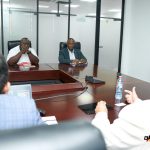
The President made the announcement during a courtesy call by chiefs from the Western North Region, where he outlined the government’s economic recovery measures, industrialization plans and interventions to address illegal mining.
He said the economy had begun recovering from the debt default and economic crisis that confronted the government when it assumed office on January 7, 2025.
According to him, the International Monetary Fund (IMF) had projected Ghana’s economic growth at 5.7 percent, above the average forecast of about four percent for sub-Saharan Africa.
“Just yesterday [Friday], the IMF predicted that we would grow at 5.7 percent,” he said, adding that Ghana continued to record strong economic growth despite external pressures, including rising petroleum prices linked to tensions between Iran and Israel.
President Mahama attributed the improving economic conditions to the government’s fiscal measures, which he said had helped stabilize the macroeconomy, reduce interest rates and create conditions for businesses to access credit.
He explained that the government’s reduced reliance on domestic borrowing had eased pressure on the banking sector, enabling financial institutions to redirect funds towards private businesses.
“Today, the government is living within its means, and everything we are financing is being financed from our taxes and what the government brings into the Exchequer,” he said.
He added that the government was no longer borrowing from domestic banks or international credit markets, allowing businesses to compete more effectively for available credit.
The President said Treasury bill rates had fallen from about 29 percent to approximately seven percent, making lending to private companies more attractive to banks.
“It is better for them to lend at about 13 percent to a private company. That is going to enable private companies to invest, expand their businesses, and employ more people,” he said.
He said the government would continue creating an enabling environment for private-sector growth while directing public investment towards sectors with the potential to generate large numbers of jobs.
The President said the construction industry was already generating substantial employment through the government’s Big Push infrastructure programme.
He cited the growing demand for skilled workers, including excavator operators, civil engineers, masons, and steel benders, as evidence of the employment opportunities emerging from ongoing road and building projects.
“The construction industry alone has created hundreds of thousands of jobs because of the Big Push and the money the government is putting into infrastructure,” he said.
Beyond construction, he pointed to investments in manufacturing as another avenue for expanding employment.
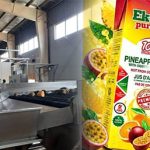
He cited a textile manufacturing factory in northern Ghana, established with support from the Ghana Export-Import Bank, which produces garments for export to the United States and European markets.
According to him, the facility employs 2,300 people, about 80 percent of whom are women, and operates under the 24-hour economy model.
He said the factory was providing employment for young women who might otherwise have migrated to major cities to engage in head porterage, popularly known as kayayei.
President Mahama also cited production-line expansions by companies such as Nestlé and Kasapreko as examples of businesses increasing their operations and creating more jobs.
Under the New Economy Policy, the government will also invest in pharmaceutical manufacturing, aiming to position Ghana as a production hub serving West Africa and the wider African market.
The President disclosed that foreign pharmaceutical companies had expressed interest in establishing facilities at a pharmaceutical hub for which the government had acquired land and provided essential infrastructure, including roads, electricity and water.
He said the initiative would strengthen local manufacturing capacity, reduce dependence on imported medicines, and create employment for young people.
President Mahama also announced plans to establish a vaccine production hub in Ghana, citing the difficulties African countries faced in accessing vaccines during the COVID-19 pandemic.
“We have learnt a lesson, and we want to produce our own vaccines and medicines,” he said.
He said the pandemic had exposed the risks associated with depending heavily on other countries for essential medical supplies, with African countries receiving vaccines later than many other parts of the world.
“We learnt a lesson from COVID-19. When vaccines became available, Africa was placed at the end of the queue. Everybody received vaccines before us,” he said.
The President said the government was championing initiatives under the broader Accra Reset agenda to achieve health sovereignty, strengthen local pharmaceutical production and reduce external dependence.
“There are other issues we are working on, including the Accra Reset, which is aimed at achieving health sovereignty, investing in the health of our people and breaking the cycle of dependency,” he said.
He added that strengthening domestic production would improve Ghana’s capacity to respond to future public health emergencies.
President Mahama also announced plans to construct airstrips in regions without airports to improve emergency air transport and facilitate medical evacuations.
Western North, which currently has no operational commercial airport, is expected to benefit from the initiative.
He explained that regions without existing airports would receive airstrips measuring approximately two kilometers in length, alongside small control offices to facilitate aircraft landings during emergencies.
“We are going to provide an airstrip in every region that does not already have an airport. Sometimes there are emergencies, and sometimes medical evacuations are necessary. At the moment, some regions do not have landing sites for aircraft,” he said.
He added: “Regions that already have airports are covered, but those without airports will receive landing strips. They will be about two kilometres long and will have a small control office so that aircraft can land in the region in an emergency. Western North will be one of the beneficiaries.”
The proposed infrastructure is intended to improve access to emergency air transport, particularly in areas where the absence of suitable landing facilities could delay the evacuation of critically ill patients.
On illegal mining, President Mahama said soldiers would remain stationed in forest reserves cleared of illegal mining activities to prevent operators from returning.
He said all nine forest reserves previously classified as red zones because of extensive destruction and the presence of heavily armed illegal miners had been cleared, with troops deployed to protect the areas.
“We have now cleared all nine of those red zones. There are no galamsey operators in those forest reserves, and we have stationed soldiers there to ensure that the illegal miners do not return. The soldiers will remain in those areas,” he said.
The President explained that previous attempts to clear some reserves had failed because illegal miners returned shortly after military personnel withdrew and forest guards resumed responsibility for protecting the areas.
“Whenever forest guards went there, they were fired upon, and some lost their lives,” he said.
He urged traditional authorities in the Western North Region to collaborate with the government in sustaining the fight against illegal mining, particularly in communities where some residents and traditional leaders had resisted operations by the National Inter-Ministerial Coordinating Committee on Illegal Mining (NAIMOS).
He said chiefs were strategically positioned to help address the local factors sustaining illegal mining because they lived among the people and understood the circumstances driving the activities.
The President also expressed concern about incidents in which soldiers had discharged firearms during enforcement operations, resulting in deaths.
He said stronger community engagement and cooperation with traditional leaders were necessary to prevent further casualties while protecting forest reserves and water bodies.
On the restoration of degraded lands, President Mahama said the Ghana Gold Board (GoldBod) had begun engaging the military in a programme to reclaim destroyed forest areas and replant them with economic trees.
Under the programme, bulldozers would be used to level degraded land, while the Forestry Commission would work with the military on reclamation and reforestation.
He also announced that the finance minister had provided GH¢400 million in the 2027 Budget to recruit additional Blue Water Guards to patrol water bodies and intensify efforts to eliminate illegal mining.
The guards had been instructed to destroy changfang machines used for illegal mining whenever they encountered them, he said.
According to the President, several machines had already been destroyed, contributing to the clearance of major river channels.
However, he noted that illegal mining in tributaries continued to contribute mud and silt to rivers, undermining efforts to restore water bodies.
He said the government’s response must go beyond enforcement to address the economic circumstances pushing young people into illegal mining.
President Mahama expressed optimism that the combined impact of infrastructure spending, industrial expansion, pharmaceutical manufacturing and targeted investments under the New Economy Policy would accelerate job creation, strengthen the productive economy and improve livelihoods.
The details of the nine investment pillars and their respective allocations are expected to be announced when the Finance Minister presents the 2027 Budget.