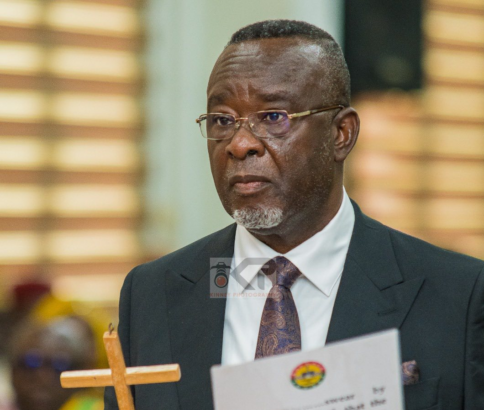
The Ghana Catholic Bishops’ Conference has dismissed calls for the resignation of Chief Justice Paul Baffoe-Bonnie over comments he made during separate visits to the Social Security and National Insurance Trust (SSNIT) and the Minerals Income Investment Fund (MIIF).
The Bishops described the demands for his removal as disproportionate, while acknowledging that aspects of the Chief Justice’s comments could raise questions about the perception of judicial neutrality.
In a statement issued on Sunday, September 6, the Conference said there was no impropriety in the Chief Justice visiting public institutions, reviewing their operations or recognising improvements in their performance.
It, however, took issue with the political interpretation that could be attached to some of his remarks, particularly his reference to the “past eight years”.
The Conference said the phrase, within Ghana’s political context, could easily be interpreted as a comparison between the performance of the current administration and that of the previous government.
More Read

“In our national context, such a phrase is readily heard as a comparison between the present administration and its predecessor,” the Conference said.
According to the Bishops, the comments therefore moved beyond an assessment of institutional performance and, at least in perception, could be viewed as a political judgment.
The Conference noted that similar concerns had been raised by the Ghana Centre for Democratic Development (CDD-Ghana), which warned that the remarks could give the impression of political endorsement and affect public confidence in the Judiciary’s impartiality.
However, the Bishops said they had taken into account the explanation provided by the Judicial Service that the Chief Justice’s comments were made in good faith and were not intended to undermine judicial independence.
The Judicial Service, it added, had also reaffirmed the Chief Justice’s commitment to judicial integrity and the principle of equality before the law.
“We receive that clarification in good faith,” the Bishops said.
Despite rejecting calls for the Chief Justice’s resignation, the Conference said the controversy should prompt a broader discussion about the ethical responsibilities of judicial office holders and the importance of maintaining public confidence in the Judiciary.
It stressed that the Chief Justice occupies a position unlike that of an ordinary public commentator because the courts may be required to adjudicate disputes involving the government, political parties and public institutions.
“Judicial independence is not only a matter of actual impartiality; it also depends on the visible, unmistakable appearance of impartiality,” the statement said.
The Bishops, however, cautioned against interpreting the incident as proof that the Chief Justice is politically partisan or that the Judiciary has lost its independence.
“Such conclusions would go well beyond the evidence available to us, and calls for his resignation on this basis alone strike us as disproportionate to the offence,” they said.
The Conference maintained that the Chief Justice, like every citizen, was entitled to hold personal political or other convictions, but said his public conduct must be measured against the expectations attached to his office.
It suggested that the achievements of SSNIT and MIIF could have been acknowledged without drawing comparisons between the records of successive governments.
The Bishops also called on both the governing party and the opposition to avoid politicising the controversy.
“The governing party ought not to treat criticism of the Chief Justice as an attack on its own record, nor should the opposition treat his remarks as proof that the courts have been captured,” the statement said.
The Conference further urged public officials, irrespective of political affiliation, to exercise restraint and conduct themselves in ways that preserve confidence in Ghana’s democratic institutions.