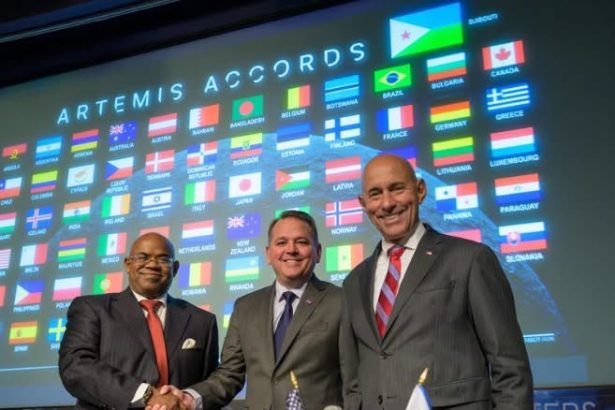
Djibouti has become the 72nd country and eighth African nation to sign the Artemis Accords, formally joining an international framework focused on peaceful, safe and transparent exploration of space.
The agreement was signed on Monday, September 14, 2026, at NASA Headquarters in Washington, D.C., by Djibouti’s Ambassador to the United States, Mohamed Siad Douale.
The signing was witnessed by NASA Deputy Administrator Matt Anderson and U.S. Assistant Secretary of State for African Affairs Frank Garcia.
The United States welcomed Djibouti’s decision, describing the signature as a commitment to the peaceful exploration of space and highlighting the country’s growing participation in space-related activities.
“Djibouti joins this coalition of like-minded nations at an important time,” NASA Deputy Administrator Matt Anderson said at the ceremony.
The Artemis Accords were established in 2020 by the United States, NASA and seven other founding countries to create practical principles for civil space exploration, particularly as nations and private companies expand activities around the Moon and beyond.
The framework promotes peaceful and transparent exploration, the sharing of scientific data, assistance to astronauts in distress, coordination between space missions and the protection of historically significant sites and artefacts.
For Djibouti, the signing builds on its emerging space programme. The country launched its first satellite, Djibouti-1A, in 2023 aboard a SpaceX Falcon 9 from Vandenberg Space Force Base in California. A second satellite, Djibouti-1B, followed in 2024 from the same launch facility.
The country has also participated in U.S.-Africa space cooperation, including the Department of State’s U.S.-Africa Technical and Regulatory Space Training Meeting in April 2026.
Ambassador Douale said the agreement would provide opportunities for deeper cooperation between Djibouti, the United States and other countries involved in peaceful space exploration.
“By joining the Artemis Accords, Djibouti seeks to deepen its partnership with the United States and with the growing community of nations committed to peaceful space cooperation,” he said.
“We look forward to building partnerships in scientific research, satellite applications, education, and technical training, while creating new opportunities for Djibouti students, researchers, engineers, and entrepreneurs.”
Djibouti’s accession also expands Africa’s presence in the Artemis framework. Nigeria and Rwanda were the first African countries to sign in 2022, followed by Angola, Senegal, Morocco, Botswana and Mauritius.
With Djibouti’s addition, eight African countries are now part of the 72-member framework, with four African states joining during 2026 alone.
The Artemis Accords are not a space treaty but a set of principles intended to guide responsible civil space activities and reinforce existing international obligations, including those under the 1967 Outer Space Treaty.
The latest signing comes as the United States seeks broader international participation in its Artemis programme, which aims to return humans to the Moon and use lunar exploration as a foundation for future missions to Mars.