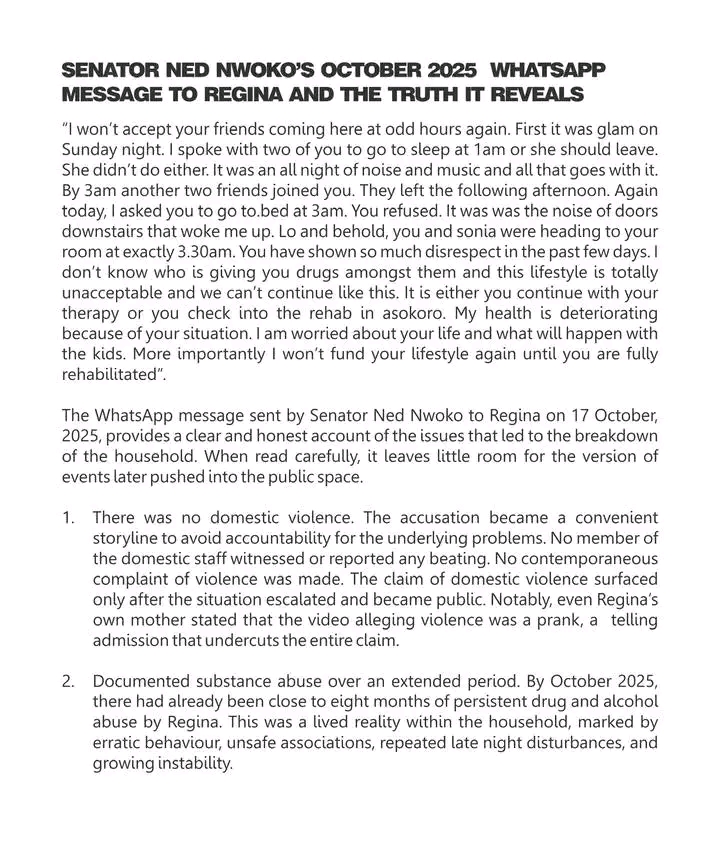
A private WhatsApp message from Senator Ned Nwoko to his wife, actress Regina Daniels, has been released by his communication team, revealing allegations of drug abuse and late-night disturbances as the catalyst for their domestic rift.
The message, dated 17 October 2025, directly challenges Regina Daniels’s public accusations of domestic violence, framing the conflict as an intervention into a destructive lifestyle rather than an act of spousal abuse.
The message, sent months before the dispute became public, shows Senator Nwoko expressing acute frustration. “I won’t accept your friends coming here at odd hours again,” he wrote, referencing a specific incident where noise and music continued until 3:30 AM.
He explicitly linked the behaviour to substance use, stating, “I don’t know who is giving you drugs amongst them and this lifestyle is totally unacceptable.”
The senator concluded with an ultimatum, insisting Regina choose between therapy or a rehabilitation centre and warning, “I won’t fund your lifestyle again until you are fully rehabilitated.”
More Read
The release of this correspondence forms the cornerstone of Senator Nwoko’s rebuttal to his wife’s allegations.
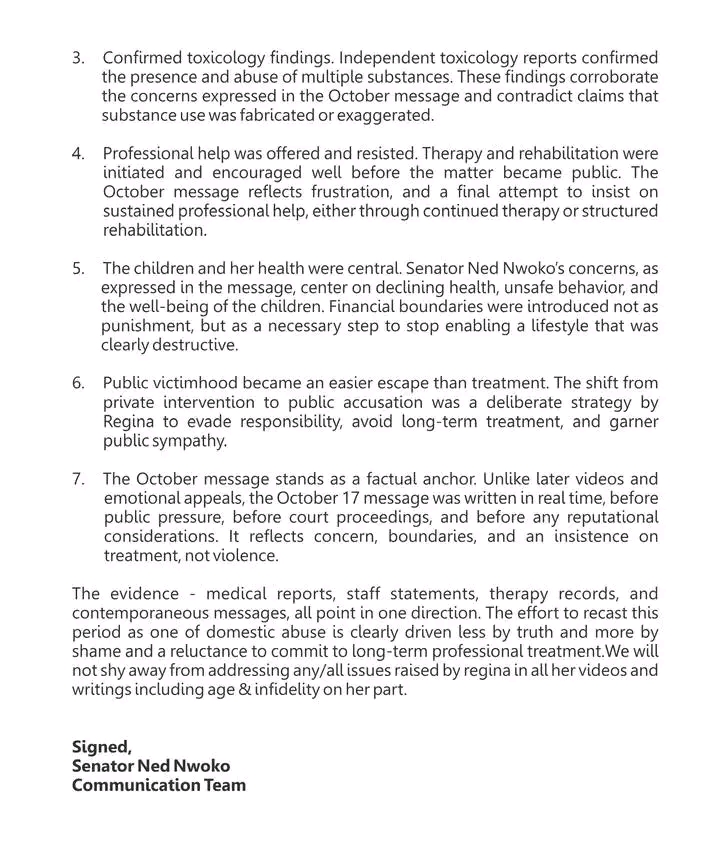
In an accompanying statement, his communication team asserted the message provides a “factual anchor” written before any public or legal pressure. They categorically denied any violence occurred, citing statements from domestic staff and noting that Regina Daniels’s own mother reportedly called a related video evidence “a prank.”
Instead, they pointed to “documented substance abuse over an extended period” and “confirmed toxicology findings” as the core issue, alleging professional help was repeatedly offered and resisted.
This private appeal stands in stark contrast to the very public accusations made by Regina Daniels in recent months. While she has admitted to past drug use, she has levelled serious counter-allegations against the senator, including domestic violence, sexual assault, and confinement.
She has argued the focus on substance abuse is a deliberate distraction from these claims.
The dispute has escalated rapidly since late 2025, involving social media campaigns, the arrest of Mrs. Daniels’s brother, and a bitter war of words that has captivated the Nigerian public.
The conflicting narratives present two irreconcilable versions of the marriage’s breakdown: one of a husband attempting to stage a desperate intervention for a spouse struggling with addiction, and another of a wife suffering abuse and control. With both parties entrenched in their positions and legal dimensions emerging, the saga continues to unfold in the court of public opinion.