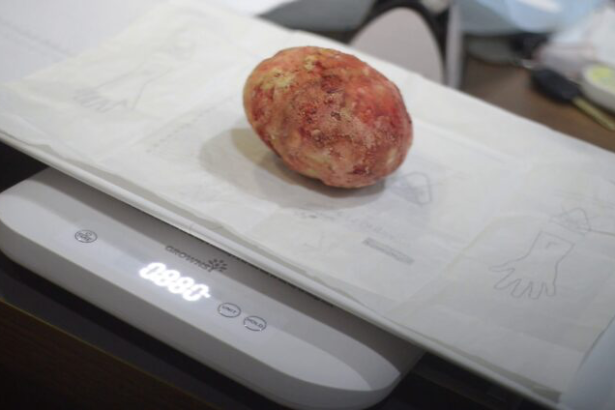
Doctors at Kumasi Hospital, a private health facility in the Ashanti Region, have removed an 880-gramme bladder stone from a 49-year-old man who endured pain and urinary difficulties for nearly three decades.
The oval-shaped stone measures 11.8 centimetres long, 9.5 centimetres wide and nearly eight centimetres across, with the surgical team suggesting it could be among the largest bladder stones ever removed in Africa.
The patient, identified as Akoto, not his real name, said the condition severely affected his quality of life, particularly his ability to urinate.
“It was really painful. Not being able to urinate is something I wouldn’t wish for anyone,” he said.
The hospital’s Chief Executive Officer, Dr Samuel Koranteng Asante, said the team had searched medical literature on the continent but could not find a documented case of a bladder stone of comparable size that had been surgically removed.
He told Luv FM’s Emmanuel Bright Quaicoe that the stone initially weighed 980 grammes before losing weight through drying, with its mass still measuring 880 grammes after more than a day of desiccation.
However, the claim that it could be Africa’s largest requires independent verification against documented medical cases.
According to Guinness World Records, the largest bladder stone on record was removed in Brazil in 2003. It weighed 1.9 kilogrammes and measured 17.9 centimetres in length.
Another case was reported in Sri Lanka in August 2026, when doctors removed a 3.1-kilogramme bladder stone from a 55-year-old man.
Bladder stones develop when minerals in urine crystallise and harden, often because urine remains in the bladder for extended periods. Conditions that prevent the bladder from emptying properly can increase the risk of their formation.
Dr Asante said the team identified a ureteric stricture in Akoto, a narrowing of the tube that carries urine from the kidney to the bladder, as part of the underlying urinary tract problem.
He explained that urinary tract conditions, including untreated infections in some cases, can contribute to complications that encourage stone formation.
While small bladder stones may pass naturally, larger ones can obstruct urine flow and require medical treatment. Stones exceeding four centimetres are generally described as giant bladder stones.
For Akoto, the condition affected more than his physical health. The prolonged suffering disrupted his social life and sexual intimacy, further diminishing his quality of life.
The case highlights the potential consequences of prolonged urinary problems and the importance of seeking medical attention when symptoms persist.
Dr Asante advised people to drink adequate amounts of water, explaining that dilution of urine can reduce the concentration of minerals that contribute to stone formation.
For Akoto, the surgery brings relief after years of suffering, while his experience underscores the need for timely medical assessment of persistent abdominal pain, difficulty urinating and other changes in urinary habits.