Ghana’s plastic waste, discarded textiles and agricultural by-products could become sources of industrial raw materials and new business opportunities, but gaps in financing, technology and market access remain barriers to commercial expansion.
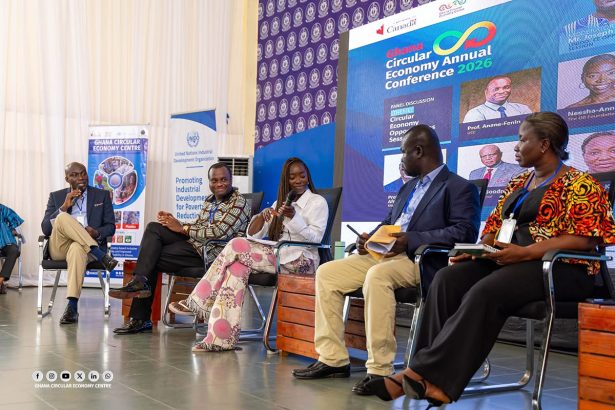
The opportunities were examined at the Ghana Circular Economy Annual Conference 2026 (GCEAC2026), held at Ho Technical University, where industry players, researchers, government representatives and other stakeholders explored how waste recovery could translate into commercially viable enterprises.
The panel session, dubbed Circular Economy Opportunities: From Circular Economy Opportunities to Commercial Scale, drew on opportunity mapping undertaken by the Ghana Circular Economy Centre to identify areas where businesses could recover resources, develop new products and strengthen domestic industries.
In the plastics sector, discussions focused on expanding recycling activities and developing markets for recycled materials, while the textile industry was identified as having opportunities beyond the reuse of discarded clothing.
These include upcycling, fibre recovery and remanufacturing, which could enable businesses to extract greater value from textile waste and create new products.
Agriculture and agro-processing also featured prominently, with cassava, mango, fish and other processing by-products identified as potential inputs for new products and commercial ventures.
However, panellists highlighted challenges that could prevent these opportunities from reaching commercial scale, including the quality and availability of raw materials, access to appropriate technology and financing, compliance with standards and limited market access.
The discussions also emphasised the need to connect circular economy practices with industrialisation by improving cleaner production and resource efficiency across local industries.
Moderated by Joseph Yeboah, Strategic Partnerships and Engagements Lead at the United Nations Industrial Development Organization (UNIDO), the session explored how cooperation among industry, research institutions, government and investors could help address these barriers and develop viable markets for locally produced circular solutions.
The conference was organised by the Ghana Circular Economy Centre and Ho Technical University, with UNIDO, in partnership with the Ministry of Environment, Science, Technology and Innovation. It was funded by Global Affairs Canada.
The discussions underscored the commercial potential of turning waste into productive resources, while highlighting the need for investment, suitable technology and reliable markets to move circular economy initiatives beyond identified opportunities into sustainable businesses.