The Mo Ibrahim Foundation released today the 2026 Ibrahim Index of African Governance (IIAG), the most comprehensive assessment of public governance performance and trends across all 54 African countries. Overall Governance combines scores across four main dimensions (Security & Rule of Law; Participation, Rights & Inclusion; Foundations for Economic Opportunity; and Human Development), covering 16 sub-categories, drawing on 96 indicators built from data produced by 51 sources.
Covering the decade 2016–2025, the Index shows that Overall Governance in Africa has improved despite cumulative global shocks, even if these gains remain uneven and fragile.
Progress at the continental level is driven by improvements in the economic and human development dimensions (Foundations for Economic Opportunity and Human Development), with notable improvements in Infrastructure, Health and Education. Foundations for Economic Opportunity progress is particularly notable, having improved over 2016-2025 in 44 countries, hosting 68% of the continent’s population, demonstrating the continent’s resilience in the face of multiple challenges over the decade, such as the COVID pandemic, the impact of the Ukraine/Russia war on access to energy and food security and historical decreases in development aid.
The largest progress is achieved in Infrastructure, the most improved of the Index’s 16 sub-categories, with gains that are both widespread (52 countries – all bar Nigeria and Gambia – covering 84% of the continent’s population), and accelerating over the decade. This is led by significant improvement in mobile connectivity, as well as in access to energy and internet. Following closely, both Education (in 34 countries hosting 75% of the continent’s population), and Health (in 40 countries, covering 87% of the continent’s population) also improve.
However, stronger and further progress remains impeded by continued deterioration in security, rule of law and participation. Both Security & Rule of Law and Participation, Rights & Inclusion register declines over the decade in 34 and 31 countries, hosting 78% and 60% of Africa’s population respectively. Positively though, the deterioration of security slows down from 2022, with progress beginning to appear in 27 countries.

The 2026 IIAG also shows that 25 countries, (home to almost 47% of the continent’s population) have managed to increase economic progress despite the deterioration of security over the decade. However, progress in Foundations for Economic Opportunity is stronger on average where Security & Rule of Law also improved, as shown for 20 countries, home to 22% of the continent’s population.
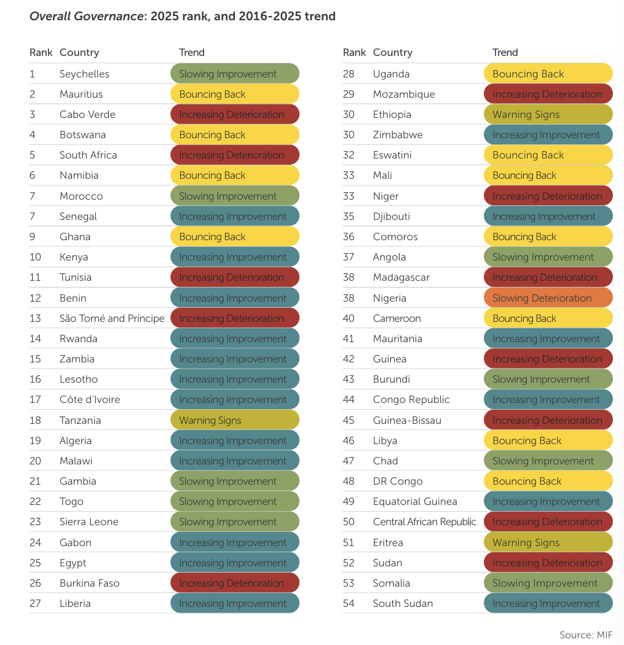
At the end of the decade under review (2025), Seychelles ranks first, and Morocco replaces Tunisia in the top ten. Though still in the top ten (5th), South Africa follows a concerning trend of increasing deterioration.
Concerningly, in four of the continent’s most populous countries – Nigeria, DR Congo, South Africa and Sudan – Overall Governance has deteriorated over the decade. At the other end of the governance ladder, Angola and Congo Republic leave the bottom ten, replaced by Libya and Guinea-Bissau. Meanwhile, over the decade, Sudan, the Central African Republic and Guinea-Bissau follow a trend of worsening deterioration (full list below).
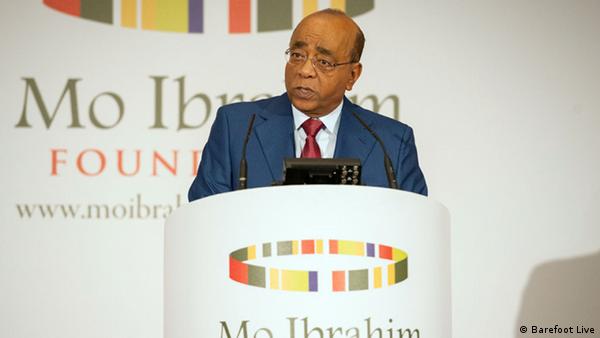
Commenting on the findings, Mo Ibrahim, Chair and Founder, Mo Ibrahim Foundation, said: “The 2026 IIAG results highlight Africa’s resilience in a challenging global environment. They also show that many countries manage to achieve economic and human development despite deterioration in security and rule of law. But this is not a sustainable trade-off. Economic and social gains will not last, and will always be weaker, without progress in security, rule of law and participation”.