



Source: GNA
Bilateral trade between Ghana and China reached a record $14.1 billion in 2025, representing a 19.3% increase over the previous year, according to Chinese Ambassador to Ghana Cong Song.
Speaking at his first official press briefing in Accra on Monday, May 11, 2026, Mr Cong said the growth underscored deepening economic relations between the two countries and reinforced China’s position as Ghana’s largest trading partner and a major source of foreign investment.
He described Ghana-China relations as broad, dynamic, and strategically aligned, particularly as both countries pursued ambitious economic transformation programmes.
“China and Ghana share highly compatible development philosophies, and the prospects for cooperation in various fields are broad,” he said.
More Read
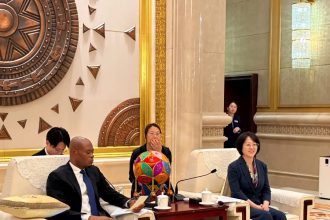
Mr Cong noted that while China was implementing its 15th Five-Year Plan focused on high-quality development, technological advancement and industrial modernisation, Ghana was pursuing economic recovery and industrial growth under the Government’s “24-Hour Economy” and “Resetting Ghana” agenda.
The Ambassador said Ghana’s economy had shown strong signs of recovery, recording six per cent Gross Domestic Product growth in 2025, while inflation reportedly declined to 3.4 per cent by April 2026.
He attributed the rise in bilateral trade partly to increasing Chinese investments in mining, energy, manufacturing, aviation and construction.
According to him, Chinese-invested mining firms, power plants, oil refineries, airlines, steel factories, ceramic companies and cement manufacturers had established strong operations in Ghana, creating thousands of jobs and contributing to industrialisation.
“The China-invested mining companies, power plants, oil refineries, airlines, steel companies, ceramic companies and cement factories have deeply rooted themselves in Ghana, creating thousands of jobs and significantly improving the lives of local residents,” he said.
Mr Cong said China was prepared to deepen cooperation with Ghana through increased investment, technology transfer and industrial collaboration to support the country’s industrial transformation agenda.
He said this included support for the proposed Volta Economic Corridor project, which was expected to create opportunities in manufacturing, logistics and trade.
The Ambassador said China’s strengths in capital, technology and industrial development aligned with Ghana’s development priorities and resource potential.
He added that both countries were seeking to strengthen industrial value chains through the deep processing of agricultural products and the promotion of local manufacturing.
Mr Cong also highlighted China’s zero-tariff policy for all products from 53 African countries with diplomatic ties to China, including Ghana, describing it as a major boost to Africa-China trade relations.
The policy, which took effect on May 1, 2026, removes import duties on Ghanaian exports to China, including cocoa products, cashew, shea butter, textiles, and handicrafts.
“For example, Ghanaian cocoa previously had tariffs ranging from eight to 22%, but after the implementation of the zero-tariff treatment, cocoa and other products can now enter China duty-free,” he said.
He noted that the initiative would reduce export costs for Ghanaian businesses, improve competitiveness in the Chinese market and attract additional investment into local processing industries.
Mr Cong said the policy would also help Ghana diversify exports, create jobs and expand opportunities for small and medium-scale enterprises.
On cultural and educational cooperation, the Ambassador disclosed that more than 10,000 Ghanaian students were studying Chinese language and culture, while several exchange programmes had been planned under the 2026 China-Africa Year of People-to-People Exchanges initiative.
He said nearly 600 exchange activities involving youth, media, tourism, arts, and governance would be organised across Africa this year to deepen cultural understanding and cooperation.
Touching on illegal mining, popularly known as galamsey, Mr Cong reiterated China’s support for Ghana’s efforts to combat the menace and protect the environment.
He stressed that the Chinese Government opposed the involvement of Chinese nationals in illegal mining and had consistently directed its citizens abroad to obey the laws of host countries.
The Ambassador called on the Ghanaian media to continue reporting fairly and comprehensively on Ghana-China cooperation and the contributions of Chinese businesses and communities operating in the country.
He expressed optimism about bilateral relations, saying the growing economic partnership between Ghana and China would continue to create opportunities for trade, investment, industrialisation and sustainable development.